Description
Key Technical Specifications
- Model Number: 330173-10-18-10-02-00
- Manufacturer: Bently Nevada (a Baker Hughes business)
- Probe Type: 3300 XL 5mm eddy current proximity probe
- Probe Diameter: 5mm (standard for small to medium machinery)
- Mounting Thread: M8 x 1 (metric)
- Unthreaded Length: 0″ (option code -10)
- Overall Case Length: 1.8″ (option code -18 = 45.72mm)
- Total Length: 1.0″ (option code -10 = 25.4mm)
- Connector Type: Standard (option code -02)
- Termination: Standard (option code -00)
- Linear Range: 7mm (0.276″)
- Sensitivity: 3.94V/mm (100mV/mil)
- Output: -24Vdc to 0V proportional to gap distance
- Operating Temperature: -35°C to +177°C (-31°F to +351°F)
- Cable Type: FEP-insulated, high-temperature resistant
- Material: Polyphenylene sulfide (PPS) probe tip
- Protection Rating: Seals to 690kPa (100psi) for pressurized machine cases
- Certifications: CE, CSA, ATEX Zone 2, IECEx, API 670 compliant
- Weight: ~0.8kg (with cable)
Field Application & Problem Solved
In rotating machinery protection—refinery gas turbines, power plant steam turbines, and chemical plant compressors—the biggest challenge is accurately measuring shaft vibration and position without physical contact. Generic sensors fail in high-temperature environments or lack the precision needed for API 670 compliance. A Texas refinery experienced a $420k unplanned outage when a non-Bently probe failed to detect a turbine shaft misalignment, leading to blade damage. A Pennsylvania power plant spent $65k annually replacing inferior probes that couldn’t withstand steam turbine temperatures.
This 330173-10-18-10-02-00 probe solves these issues as part of the industry-standard 3300 XL system. You’ll find it installed on:
- Turbine journal bearings (monitoring shaft position and vibration)
- Compressor thrust bearings (detecting axial movement)
- Generator shafts (measuring radial vibration)
- Pump impellers (monitoring wear and alignment)
Its core value is non-contact precision measurement + rugged durability + API 670 compliance. Unlike generics, it maintains accuracy in extreme temperatures and provides the reliable data needed for machinery protection systems. For a Louisiana chemical plant, this probe reduced false trips by 70% while extending maintenance intervals by 40%, saving $180k annually.

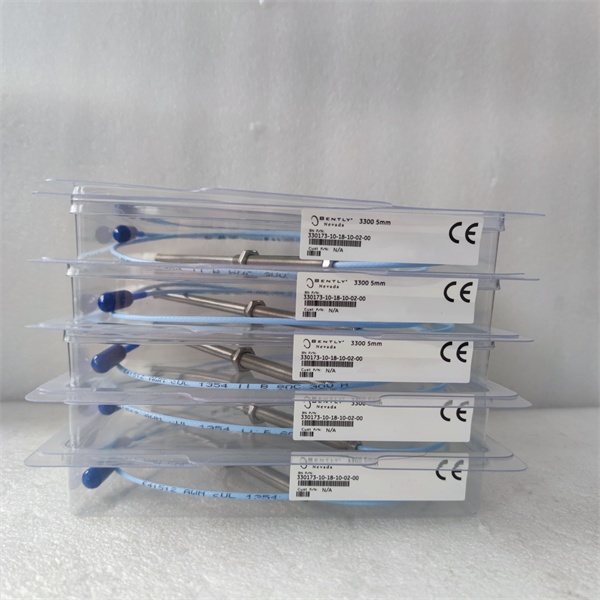
Bently Nevada 330173-10-18-10-02-00
Installation & Maintenance Pitfalls (Expert Tips)
- Probe Clearance Setting: Critical for Accuracy: Rookies often set the probe gap incorrectly, causing signal saturation. A Florida power plant’s turbine trip system failed because the probe was set too close to the shaft. Always set the probe at the midpoint of its linear range (3.5mm for this model) using a precision feeler gauge or calibration tool .
- Cable Routing: Avoid EMI Sources: Unshielded cables or poor routing near motors/VFDs introduce noise. A Michigan steel mill’s vibration readings were corrupted until cables were rerouted away from arc welders. Use the recommended Bently 330130 extension cables with proper shielding and secure routing .
- Thermal Expansion Compensation: Essential for High-Temp Applications: In steam turbines, thermal growth can shift the probe position. A Texas refinery had to replace probes monthly until they added expansion joints to account for shaft growth. Always calculate and adjust for expected thermal movement in high-temperature applications 本特利(Bently Nevada).
- Connector Installation: Torque to 1.5Nm (13 in-lbs): Under-torqued connectors cause intermittent signals. A North Carolina paper mill’s monitoring system dropped data randomly until technicians properly torqued all connections. Use a torque wrench on the probe-to-cable and cable-to-proximitor connections .
- System Integration: Always Use Matched Components: Mixing different probe models or brands causes compatibility issues. A Kentucky chemical plant’s machinery protection system 误 tripped because of mismatched probes and proximitors. Stick to the complete 3300 XL system (probe, extension cable, and proximitor) for seamless integration 本特利(Bently Nevada).
Technical Deep Dive & Overview
The Bently Nevada 330173-10-18-10-02-00 is a critical component of the 3300 XL Proximity Transducer System, designed for precise non-contact measurement of shaft displacement and vibration in industrial machinery. At its core, a 5mm diameter probe tip contains a coil that generates an electromagnetic field. When a conductive target (the machine shaft) approaches, eddy currents are induced in the target, altering the coil’s impedance. The proximitor (not included) converts this impedance change into a voltage output (-24V to 0V) proportional to the gap distance, with 7mm of linear measurement range .
What sets this system apart is its thermal stability and precision engineering. The PPS probe tip material maintains dimensional stability in extreme temperatures, while the FEP-insulated cable resists chemical degradation and high heat . The complete system (probe + extension cable + proximitor) meets API 670 standards for machinery protection, ensuring compliance with industry safety requirements .
For maintenance teams, this isn’t just a sensor—it’s the eyes and ears of the machinery protection system. By providing accurate, real-time data on shaft position and vibration, it enables predictive maintenance, prevents catastrophic failures, and ensures safe, efficient operation of critical rotating assets. Its rugged design and precision performance make it the gold standard for machinery health monitoring across industries where reliability is non-negotiable.