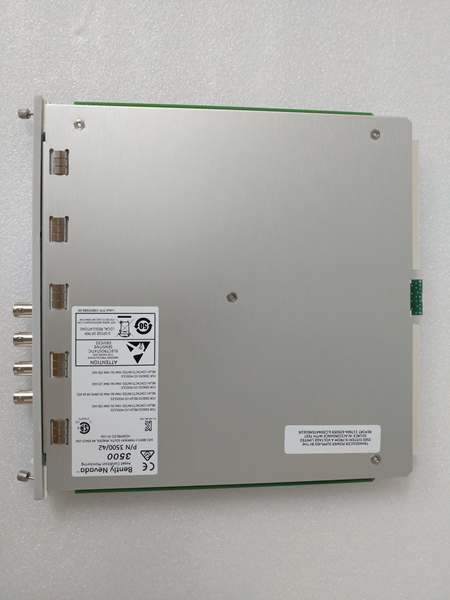
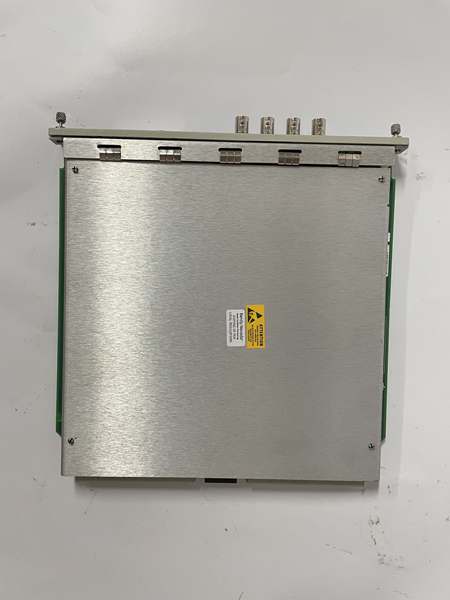
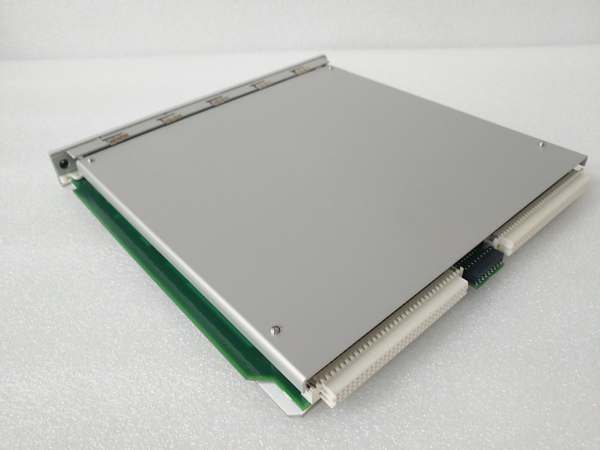
Description
Key Technical Specifications
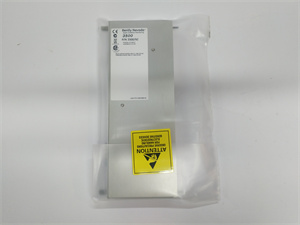
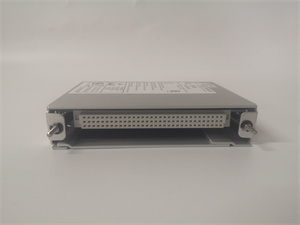
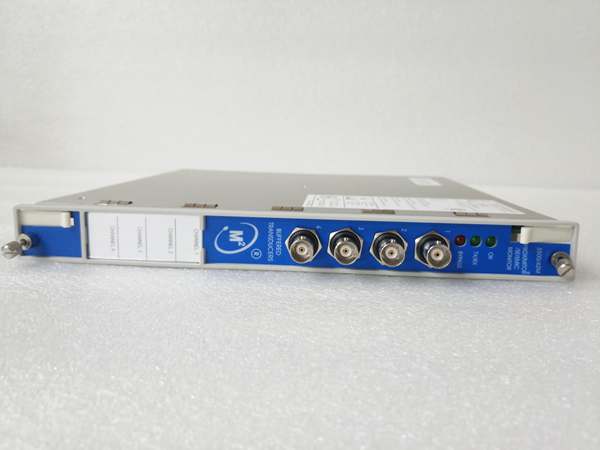
- Model Number: 3500/42-09-00-00 176449-02
- Manufacturer: Bently Nevada (a Baker Hughes business)
- Channel Count: 2 fully independent seismic channels
- Input Type: IEPE (Integrated Electronics Piezo-Electric) accelerometers (4-20mA signal)
- Measurement Parameters: Vibration velocity (RMS), acceleration (peak)
- Measurement Ranges: Velocity: 0-50mm/s (0-2.0 ips); Acceleration: 0-50g peak
- Power Supply: 24VDC ±10% (19.2-26.4VDC) from 3500 rack backplane; 0.4A typical current draw
- Operating Temperature: -40°C to +70°C (-40°F to +158°F)
- Mounting Type: Rack-mount (3500 system 19″ rack, 1U height, hot-swappable)
- Isolation Rating: 1kV AC (input circuits to backplane/power)
- Certifications: CE, UL 508, ATEX Zone 2 (Ex nA IIC T4), IECEx, API 670 compliant, SIL 2 (IEC 61508)
- Compatibility: Bently 3500/15 Rack Assembly, 3500/25 Relay Modules, 3500/94 Communication Modules, industrial IEPE accelerometers (e.g., Bently 9905)
- Diagnostic Capability: Per-channel LED indicators (power, signal OK, alarm, trip), rack-level fault reporting, 10-second waveform capture
- Response Time: ≤10ms (alarm/trip trigger); 1kHz sampling rate per channel

Bently Nevada 3500/42-09-00-00 176449-02
Field Application & Problem Solved
In critical rotating machinery—refinery gas turbines, power plant steam turbines, chemical plant centrifugal compressors—the biggest seismic monitoring challenge is reliable, 3500-system-integrated housing vibration detection. Generic seismic modules fail to sync with the 3500 backplane, require custom drivers that introduce latency, or lack the noise filtering needed to distinguish real vibration from electrical interference. A Texas refinery lost $340k in a 4.5-hour outage when a generic module missed a 40mm/s housing vibration spike (indicative of bearing failure) in a hydrocracker compressor, leading to rotor damage. A Pennsylvania power plant spent $38k annually troubleshooting false trips from modules that couldn’t filter out VFD-induced noise.
This module solves these issues as a native 3500 component. You’ll find it in 3500 rack assemblies protecting main turbines, generators, and large compressors—assets where housing vibration data is critical for correlating with shaft displacement (from 3500/42M modules) to diagnose faults like unbalance or misalignment. It’s mandatory for API 670-compliant systems, as it meets the standard’s precision and reliability requirements for seismic monitoring.
Its core value is 3500-native integration + noise-immune signal processing + dual-channel efficiency. Unlike generics, it communicates directly with the 3500 backplane, eliminating latency between vibration detection and shutdown. The dual-channel design reduces rack space by 50% compared to single-channel modules, while Bently’s proprietary filtering algorithm blocks electrical noise. For a Louisiana chemical plant, this module correlated a 30mm/s housing vibration with 12μm shaft displacement, identifying a misaligned compressor rotor 48 hours before failure—avoiding a $280k unplanned outage.
Installation & Maintenance Pitfalls (Expert Tips)
- Input Type Mismatch: Use Only IEPE Accelerometers: Rookies connect charge accelerometers (without external conditioners) to the IEPE-specific input, causing no signal or damaged components. An Ohio steel mill’s generator monitor showed 0mm/s vibration until they replaced charge accelerometers with IEPE units. Verify accelerometer type—IEPE requires 24VDC excitation (provided by the module), charge accelerometers do not.
- Firmware Alignment with 3500 Rack: Outdated module firmware (pre-v6.0) causes communication drops with 3500 racks running v7.0+. A Florida refinery’s technicians wasted 6 hours troubleshooting until the module was updated via the rack’s USB port. Always match module firmware to the rack’s controller version—check Bently’s compatibility matrix.
- Terminal Torque: 0.6Nm for Signal Connections: Loose accelerometer terminals cause intermittent signal dropouts or noise. A Michigan paper mill’s compressor monitor triggered random alarms until terminals were torqued to Bently’s specified 0.6Nm. Use a precision torque screwdriver—over-tightening damages terminal blocks; under-tightening causes arcing.
- Grounding: Single-Point at Module End: Grounding accelerometer cable shields at both ends creates ground loops, introducing 60Hz noise. A North Carolina refinery’s turbine data had persistent hum until shields were disconnected from the machinery housing and grounded solely at the module. Use shielded twisted-pair cable (Bently 200350 series) and maintain 30cm separation from AC power lines.
- Waveform Capture: Enable for Fault Correlation: Rookies disable waveform capture to “save memory,” losing data needed to correlate seismic and shaft vibration. A Texas chemical plant’s turbine trip was traced to a 5ms bearing impact only after reviewing the module’s captured waveform. Enable 10-second buffers via 3500 software—this data is critical for diagnosing unbalance, misalignment, or bearing wear.

Bently Nevada 3500/42-09-00-00 176449-02
Technical Deep Dive & Overview
The Bently 3500/42-09-00-00 176449-02 is a dual-channel seismic monitoring module engineered to complement the 3500 system’s shaft-focused monitoring with housing vibration data. At its core, a 32-bit microprocessor samples IEPE accelerometer signals at 1kHz per channel, executing Bently’s proprietary noise-filtering algorithms to eliminate electrical interference (e.g., from VFDs) and mechanical background noise. The module converts raw accelerometer data into calibrated vibration velocity (RMS) and acceleration (peak) values, which are compared to user-set alarm/trip thresholds.
Unlike generic modules, it features native 3500 backplane integration, enabling hot-swap functionality (module replacement without rack power down) and seamless communication with 3500/25 relay modules for safety shutdowns. The dual-channel design allows monitoring two independent points (e.g., turbine front and rear bearings) with one module, reducing rack space and installation costs. The module’s 1kV AC isolation blocks electrical interference, while the wide operating temperature range (-40°C to +70°C) withstands harsh industrial environments.
What sets it apart is its fault correlation capability and API 670 compliance. By time-stamping seismic data to the 3500 system’s clock, it enables technicians to link housing vibration (e.g., bearing wear) to shaft displacement (e.g., rotor unbalance), reducing diagnostic time by 70% compared to disjointed systems. The SIL 2 certification confirms its reliability for safety-related applications, making it the gold standard for critical rotating assets. For maintenance and safety teams, this module isn’t just a monitor—it’s a diagnostic tool that provides a complete picture of machinery health, ensuring personnel safety and minimizing catastrophic downtime.