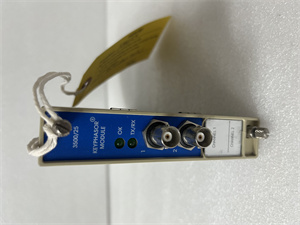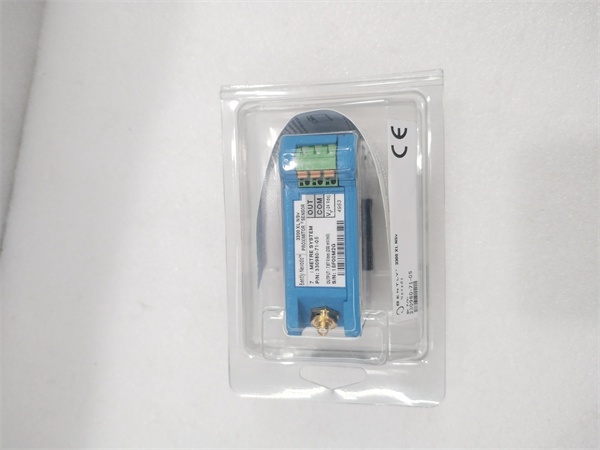
Description
Hard-Numbers: Technical Specifications
- System Length: 5.0 meters (16.4 feet) system length (Option 71 = 5.0m + Panel Mount; Option 70 = 5.0m Panel Mount no hardware; Option 72 = 5.0m DIN Mount)
- Mounting: Panel mount (Option 71 = 5.0m + Panel Mount; Option 70 = 5.0m Panel Mount no hardware)
- Agency Approval: Option 05 (Multi Approvals – CSA, IECEx, ATEX) as specified in Approvals Quick Reference Guide 108M1756. This certification covers:
- CSA (Class I, Division 2, Groups A, B, C, D, T4 @ -40°C to +70°C)
- IECEx (Ex nA IIC T4 Gc Class I, Zone 2)
- ATEX (II 3 G Ex nA IIC T4 Gc Class I, Zone 2)
- Power Supply:
- Without barriers: -17.5 Vdc to -26 Vdc at 12 mA maximum consumption
- With barriers: -23 Vdc to -26 Vdc
- Note: Operation at more positive voltage than -23.5 Vdc can reduce linear range
- Supply Sensitivity: Less than 2 mV change in output voltage per volt change in input voltage
- Output Resistance: 50 Ω
- Probe DC Resistance (by probe length) :
- 0.5 m probe: 4.0 ± 0.5 Ω
- 1.0 m probe: 4.2 ± 0.5 Ω
- 5.0 m probe: 5.3 ± 0.7 Ω
- 7.0 m probe: 5.9 ± 0.9 Ω
- Extension Cable DC Resistance: Center conductor 0.220 Ω/m, shield 0.066 Ω/m
- Extension Cable Capacitance: 69.9 pF/m (21.3 pF/ft) typical
- Field Wiring Maximum Length: 305 meters (1,000 feet) between Proximitor and monitor
- Linear Range (with NSv probe) : 1.5 mm (60 mils), from 0.25 mm to 1.75 mm gap (approximately -1 to -13 VDC)
- Recommended Gap Setting: 1.0 mm (40 mils)
- Average Scale Factor (ASF) : 7.87 V/mm (200 mV/mil)
- Incremental Scale Factor (ISF) : ±12.5%/-20% including interchangeability error over linear range (0°C to 45°C ambient)
- Deviation from Best Fit Straight Line (DSL) : Less than ±0.06 mm (±2.3 mils)
- Frequency Response: DC to 10 kHz (+0, -3 dB typical) with up to 305 meters field wiring
- Target Size (Flat Target) : Minimum 8.9 mm (0.35 in), recommended 13 mm (0.5 in)
- Shaft Diameter: Minimum 30 mm (1.2 in) for standard X-Y probe configuration
- Counterbore Minimum: 9.5 mm (0.375 in), recommended 13 mm (0.5 in)
- Input Compatibility: 3300 RAM or 3300 NSv proximity probe and extension cable
- Operating Temperature: -40°C to +70°C (-40°F to +158°F)
- Storage Temperature: -51°C to +105°C (-60°F to +221°F)
- Relative Humidity: 100% condensing, non-submersible when connectors are protected (IEC 68-2-3 damp heat tested)
- Dimensions (L×W×H) : 13.0 cm × 1.9 cm × 19.1 cm (approx.)
- Weight: 255 g (9 oz) typical
- Environmental Rating: Improved RFI/EMI immunity, meets European CE mark approvals without special mounting considerations
Bently Nevada 330980-71-05
The Real-World Problem It Solves
Centrifugal air compressors, refrigeration compressors, and process gas compressors often have tight installation restrictions that prevent use of standard 3300 XL 8mm proximity transducer systems. Counterbore limitations, sideview constraints, and small target areas (shafts under 51mm or flat targets under 15mm) make conventional probes impossible to install. The 330980-71-05 NSv Proximitor is specifically designed for these space-constrained applications, providing signal conditioning for NSv probes with a slim panel-mount or DIN-mount form factor. Its enhanced RFI/EMI immunity allows installation in fiberglass housings or near radio equipment without signal degradation, while SpringLoc terminals enable fast, reliable field wiring without special tools.
Where you’ll typically find it:
- Centrifugal air compressors with tight clearance around bearing housings
- Refrigeration compressors with restricted counterbore access
- Process gas compressors on small shafts (under 51mm diameter)
- Axial position measurements on flat thrust collars smaller than 15mm
- Tachometer and Keyphasor installations where space is at a premium
Bottom line: This is the NSv Proximitor for space-constrained NSv transducer systems, delivering 200 mV/mil sensitivity in a slim package with panel/DIN mounting options and multi-approvals (ATEX/IECEx/CSA) for hazardous area installations.
Hardware Architecture & Under-the-Hood Logic
The 330980-71-05 is a signal conditioning module that works with 3300 NSv proximity probes and extension cables to form a complete transducer system. It accepts the analog gap voltage signal from the probe (representing the distance between probe tip and conductive target), applies linearization and temperature compensation algorithms, converts the measurement to engineering units, and outputs a DC voltage proportional to position superimposed with AC vibration signal. The module features a slim design suitable for panel mounting (Option 71) with SpringLoc terminal strips for tool-free field wiring connections. Enhanced RFI/EMI immunity prevents nearby high-frequency radio signals from affecting the transducer system.
-
Probe Signal Reception: The Proximitor receives a gap voltage signal from the 3300 NSv probe via the extension cable. This signal represents the impedance change in the probe coil caused by eddy currents induced in the target surface.
-
High-Frequency Excitation: The Proximitor generates a high-frequency RF oscillator signal (typically 500 kHz to 1 MHz) to drive the probe coil. The frequency is optimized for NSv probe characteristics.
-
Demodulation and Linearization: The incoming gap voltage is demodulated to extract the DC position component and AC vibration component. The module applies linearization algorithms to correct for the non-linear relationship between gap voltage and physical distance (NSv linear range is 1.5 mm/60 mils from 0.25 to 1.75 mm).
-
Temperature Compensation: The Proximitor compensates for temperature-induced drift in the probe and extension cable circuitry. The NSv system maintains specified accuracy from 0°C to +45°C ambient.
-
Signal Amplification: The conditioned signal is amplified to the standard output scale factor of 7.87 V/mm (200 mV/mil), which is the most common output for eddy current transducers.
-
Output Stage: The final output is a composite signal containing:
- DC Offset (Gap Voltage) : Proportional to average gap distance (e.g., -9 VDC at 1.0 mm gap)
- AC Component: Superimposed vibration signal representing dynamic shaft motion
-
Output Circuit: The module provides a 50Ω output impedance, designed to drive monitor inputs through field wiring up to 305 meters without significant signal degradation.
-
SpringLoc Terminal Connections: The Proximitor features patented SpringLoc terminal strips that require no special installation tools. These terminals provide strong, vibration-resistant connections by eliminating screw-type clamping mechanisms that can loosen over time.
-
RFI/EMI Immunity: Enhanced shielding and filtering prevent nearby high-frequency radio signals (RFI) and electromagnetic interference (EMI) from affecting the transducer system. This immunity allows installation in fiberglass housings or near radio equipment without special shielded conduit.
-
Panel Mounting: The slim design allows mounting on panel mount (Option 71) or traditional panel mount (Option 70). A 4-hole mounting pattern matches previous Proximitor designs for retrofit compatibility.
-
Target Material Compensation: The Proximitor is calibrated at the factory for AISI 4140 steel targets. For non-ferrous materials (aluminum, brass, stainless steel), a material correction factor must be applied in the monitor configuration to compensate for different eddy current response.
-
System Electrical Length Matching: The Proximitor is calibrated for a specific total system electrical length (probe + extension cable). For 330980-71-05 (Option 71), the rated system length is 5.0 meters. The probe cable length plus extension cable length must equal this value for optimal performance.
-
Self-Diagnostics: The module continuously monitors its own health and the integrity of connected probes. Faults detected include:
- Probe open circuit
- Probe short circuit
- Out-of-range gap voltage
- Internal hardware faults
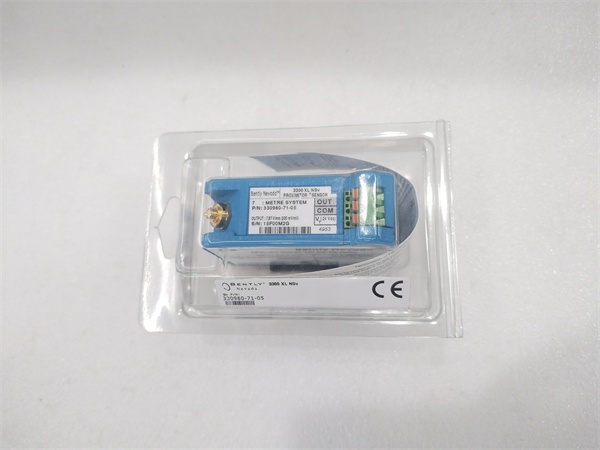
Bently Nevada 330980-71-05
Field Service Pitfalls: What Rookies Get Wrong
Mismatching System Electrical Length with 5.0m ProximitorTechs replace a failed 330980-71-05 Proximitor but keep the existing 4.5-meter extension cable from the old system. The new Proximitor is rated for 5.0 meters system length, but the actual installation is 4.5 meters. The mismatch causes sensitivity errors of 10-15% and incorrect vibration/position readings.
- Field Rule: Always verify the Proximitor’s rated system length (marked on label as “5.0m System” for 330980-71-05) and ensure the probe cable length plus extension cable length equals this value. For a 5.0m Proximitor using a 0.5m probe, the extension cable must be 4.5 meters. If upgrading from a 4.5m system to a 5.0m Proximitor, replace both the Proximitor and the extension cable to maintain matched electrical length.
Over-Tightening SpringLoc TerminalsNovices treat SpringLoc terminals like screw terminals and crank down hard with pliers. The spring mechanism gets damaged, losing its tension and grip strength. During machine vibration, the field wire works loose, causing intermittent signal loss and false alarms.
- Quick Fix: SpringLoc terminals require only finger pressure. Insert the stripped wire (0.2 to 1.5 mm², 16-24 AWG) into the terminal slot—no tools needed. The internal spring clamp secures the wire. If a wire must be removed, use a small screwdriver to press the release tab while pulling the wire out. Never use pliers or excessive force.
Ignoring Barrier Voltage Drop with Multi-ApprovalsTechs install 330980-71-05 with safety barriers (intrinsic safety) for hazardous area applications but fail to account for voltage drop across the barrier. The barrier drops 0.5V, so the Proximitor receives only -23.0V instead of the required -23.5V minimum. The linear range shrinks by 15%, and the probe may saturate during normal shaft movement.
- Field Rule: When using barriers, ensure the power supply voltage compensates for the barrier voltage drop. For a -24V system requiring -23.5V to -26V at the Proximitor, set the power supply to -25.5V or -26V to account for the 0.5V barrier drop. Measure the actual voltage at the Proximitor terminals during commissioning—must be -23V to -26V for full linear range.
Mixing NSv and Standard XL Probes with 330980Young engineers replace a failed NSv probe with a standard 3300 XL 8mm probe because it’s in stock. The NSv Proximitor is calibrated for NSv probes (1.5 mm linear range, different side-view characteristics). A standard 8mm probe has 2.0 mm linear range and different coil geometry, causing scale factor errors of 20-30% and linear range mismatch.
- Field Rule: Never mix NSv and standard XL transducer components. The 330980-71-05 is specifically calibrated for 3300 NSv probes and extension cables. If replacing a probe in an NSv system, use only NSv probe variants (330903, 330904, 330905, 330910 series or their extension cables). Mixing components limits system performance to the non-NSv specifications and defeats the purpose of the NSv design.
Improper Shield Grounding Causing RFI SusceptibilityRookies connect the shield of field wiring to ground at both the Proximitor end and the monitor end. This creates a ground loop that defeats the Proximitor’s enhanced RFI immunity. Nearby VFDs or radio transmitters induce noise on the signal, causing erratic vibration readings of 2-3 mils at 60 Hz line frequency.
- Field Rule: Ground the shield at the Proximitor end only (SpringLoc terminal has a dedicated shield terminal). Leave the shield floating at the monitor end to maintain single-point grounding. The enhanced RFI/EMI immunity only works correctly with proper grounding. Verify signal quality with an oscilloscope during commissioning—look for 60 Hz or RF noise riding on the vibration signal.
Failing to Use Connector Protectors in Wet EnvironmentsTechs connect the extension cable to the Proximitor without installing a connector protector in oil-lubricated compressors. Oil migrates into the ClickLoc connector over time, causing corrosion and intermittent connections. The monitor shows erratic readings that correlate with oil temperature changes.
- Field Rule: Always install connector protectors on both the probe-to-extension cable connection and the extension cable-to-Proximitor connection in environments where oil, moisture, or contaminants are present. The protectors seal the ClickLoc connectors, preventing liquid ingress. Use the silicone tape provided with extension cables only if connector protectors are unavailable—never rely on tape alone for oil environments.
Mounting Proximitor in High EMI Areas Without Metal EnclosureInstallers mount the 330980-71-05 in a fiberglass cabinet next to a large VFD without considering EMI. The Proximitor’s RFI immunity handles radio interference, but the intense magnetic fields from the VFD (20-60 kHz carrier frequency) induce noise in the field wiring. Vibration readings show 1-2 mils of noise at the VFD switching frequency.
- Quick Fix: Route Proximitor field wiring in grounded metal conduit, separated from VFD output cables by at least 12 inches (30 cm). If the Proximitor must be mounted in a high-EMI area, install it in a grounded metal enclosure to shield it from magnetic fields. The enhanced RFI/EMI immunity helps, but it’s not a substitute for proper installation practices in extreme EMI environments.
Commercial Availability & Pricing Note
Please note: The listed price is for reference only and is not binding. Final pricing and terms are subject to negotiation based on current market conditions and availability.