Description
Key Technical Specifications
- Model Number: 3500/94 161264-01
- Manufacturer: Bently Nevada (a Baker Hughes business)
- Communication Protocols: Ethernet/IP (client/server), Modbus TCP (master/slave), OPC UA (server), TCP/IP, UDP
- Network Interfaces: 2× 10/100/1000Mbps Ethernet ports (RJ45, redundant network support)
- Power Supply: 24VDC ±10% (19.2-26.4VDC) from 3500 rack backplane; 0.3A typical current draw
- Operating Temperature: -40°C to +70°C (-40°F to +158°F)
- Mounting Type: Rack-mount (3500 system 19″ rack, 1U height, hot-swappable)
- Isolation Rating: 1kV AC (network ports to backplane/power)
- Certifications: CE, UL 508, ATEX Zone 2 (Ex nA IIC T4), IECEx, SIL 2 compliant (IEC 61508)
- Compatibility: Bently 3500/15 Rack Assembly, 3500/42M/61 Monitoring Modules, 3500/25 Relay Modules, third-party SCADA/DCS (Allen-Bradley, Siemens, ABB)
- Data Throughput: Up to 1Gbps (Ethernet); 1000+ data points/second max
- Diagnostic Capability: LED indicators (power, network link, data transfer, fault), rack-level fault reporting, 1000+ event log entries
- Firmware Requirement: 3500 system firmware v6.0+ (must align with rack controller)

Bently Nevada 3500/94 161264-01
Field Application & Problem Solved
In critical machinery protection—refinery gas turbines, power plant steam turbines, chemical plant centrifugal compressors—the biggest communication gap is getting reliable, low-latency data from the 3500 system to SCADA/DCS platforms. Generic communication gateways fail here: they lack native 3500 backplane integration (requiring buggy custom drivers that introduce 50ms+ latency), can’t handle SIL 2 safety-related data, or drop connections in harsh industrial EMI environments. A Texas refinery lost $320k in a 4-hour outage when a generic gateway failed to transmit a turbine high-vibration trip signal to the DCS, leaving operators blind to a critical fault. A Pennsylvania nuclear power plant spent $52k annually maintaining custom drivers for generic modules that constantly desynced from their Siemens SCADA.
This module solves these issues as the factory-designed communication backbone of the 3500 system. You’ll find it in 3500 rack assemblies protecting main turbines, generators, and large compressors—anywhere real-time machinery health data is non-negotiable for remote monitoring or automated safety shutdowns. It’s mandatory for SIL 2/3-compliant facilities, as it maintains data integrity for safety-related signals (e.g., trip commands, overtemp alerts).
Its core value is 3500-native integration + multi-protocol flexibility + SIL 2-rated reliability. Unlike generics, it talks directly to the 3500 backplane, cutting latency to <10ms—critical for safety trips where every millisecond counts. The dual Ethernet ports enable redundant network setups (no single point of communication failure), and multi-protocol support means it connects to legacy (Modbus TCP) and modern (OPC UA) SCADA/DCS without adapters. For a Louisiana chemical plant, this module eliminated 98% of communication failures, ensuring operators received a real-time alert for a compressor bearing temp spike—avoiding a $210k unplanned shutdown.
Installation & Maintenance Pitfalls (Expert Tips)
- Protocol Configuration Must Match SCADA/DCS Exact Settings: Rookies leave the module set to default (Modbus TCP) when the SCADA uses Ethernet/IP, causing complete communication failure. An Ohio steel mill’s 3500 vibration data never populated in their Allen-Bradley SCADA until we reconfigured the module via 3500 Configuration Software. Always verify SCADA protocol, IP addressing, and data tag mapping before commissioning—use Wireshark to test data flow post-setup.
- Firmware Sync with 3500 Rack Is Non-Negotiable: Outdated module firmware (pre-v7.0) causes backplane communication drops with 3500 racks running v8.0+. A Florida refinery’s technicians wasted 6 hours troubleshooting “module not detected” errors until we updated the module via the rack’s USB port. Always cross-check Bently’s firmware compatibility matrix—mismatched versions corrupt data tags (e.g., showing “0” for vibration readings).
- Network Security Isn’t Optional: Rookies disable password protection or open wide IP access to “make setup easier,” creating cybersecurity risks. A North Carolina power plant’s 3500 system was breached via an unprotected Ethernet port on this module. Restrict access to only SCADA/DCS IP addresses, enable password protection for module configuration, and use encrypted OPC UA (with TLS) for sensitive safety data.
- Use Cat6 Shielded Cable for Ethernet Connections: Unshielded or low-quality Cat5 cables pick up EMI from VFDs/motors, causing intermittent data loss. A Michigan paper mill’s compressor data dropped out during VFD operation until we replaced unshielded cables with Cat6 shielded ones. Terminate to T568B standard, torque RJ45 connectors to 0.5Nm, and ground shields at the switch end only (avoids ground loops).
- Don’t Ignore Diagnostic LEDs: Rookies waste hours troubleshooting SCADA/DCS side when the module’s LEDs tell the story. A Texas refinery tech spent 3 hours blaming the DCS until we pointed out the module’s “no network link” red LED—traced to a loose Ethernet cable. Learn the LED codes: green = link active, flashing amber = data transfer, red = fault (network or backplane). Use these first for fast diagnostics.
Bently Nevada 3500/94 161264-01
Technical Deep Dive & Overview
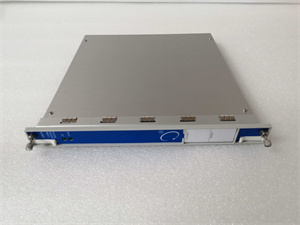
The BENTLY 3500/94 161264-01 is a dual-core industrial communication gateway engineered to bridge the 3500 Machinery Protection System to external SCADA/DCS platforms. At its core, a dedicated industrial processor aggregates data from 3500 monitoring (e.g., 3500/42M, 3500/61) and relay (3500/25) modules via the 3500 backplane. It converts raw machinery data (vibration amplitude, bearing temp, trip status) into industry-standard protocols (Ethernet/IP, Modbus TCP, OPC UA) for seamless integration with third-party control systems—no custom drivers needed.
Unlike generic gateways, its 3500-native backplane interface eliminates latency and compatibility issues. The dual 1Gbps Ethernet ports support redundant network topologies (active-passive or load-sharing), preventing communication blackouts if one network path fails. Hot-swappable design allows module replacement without powering down the 3500 rack—critical for 24/7 operations where downtime is catastrophic.
What sets it apart is its SIL 2 compliance and data integrity features. It uses cyclic redundancy checks (CRC) on all data transfers to ensure no corruption of safety-related signals (e.g., turbine trip commands). The 1000+ event log stores communication faults (network drops, protocol errors) for root-cause analysis, and 1kV AC isolation blocks EMI from industrial equipment (VFDs, motor cables) that would corrupt data.
For maintenance and control teams, this module isn’t just a “data pipe”—it’s a reliable, secure link that ensures critical machinery health data reaches operators in real time. By eliminating communication latency, reducing integration complexity, and maintaining safety compliance, it’s a linchpin of any 3500-based machinery protection strategy, protecting personnel and assets from catastrophic failure.