Description
Hard-Numbers: Technical Specifications
- Probe Size: 5mm tip diameter
- Linear Range: 0.25 to 1.5 mm gap (10 to 60 mils)
- Sensitivity: 200 mV/mil (7.87 V/mm) typical at mid-gap (35 mils or 0.89 mm)
- Excitation Voltage: -24V DC ±1V
- Excitation Current: 3 to 12 mA (4 to 8 mA typical)
- Frequency Response: DC to 10 kHz (±3 dB)
- Operating Temperature: -30°C to +177°C (-22°F to +350°F) (standard probe)
- Cable Length: Standard 3-meter cable (custom lengths available)
- Connector: Miniature coaxial (MS-style) or screw-lock (depending on variant)
- Housing Material: 316 stainless steel probe body
- Environmental Protection: IP67-rated probe tip (when properly sealed)
- Weight: 0.15 lbs (0.07 kg) including cable
- Thread Size: 1/4-28 UNF or M6x1 (variant dependent)
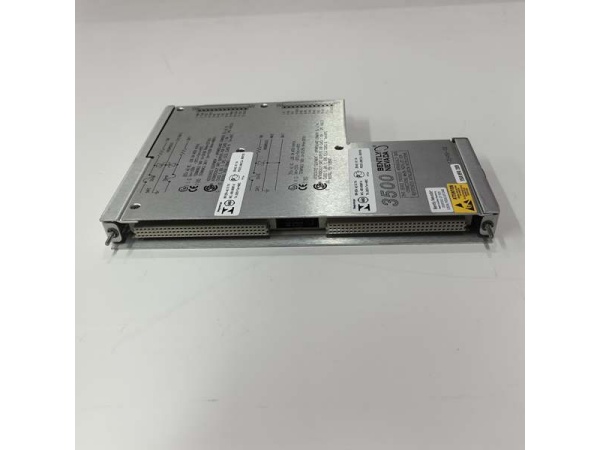
Bently 135489-02
The Real-World Problem It Solves
You need to monitor shaft vibration on small diameter shafts or tight-clearance machinery where 8mm probes physically won’t fit or have insufficient working range. The 135489-02 provides a compact 5mm eddy current probe with a shorter linear range, enabling installation in confined spaces while maintaining precision measurement.
Where you’ll typically find it:
- Small gearboxes and high-speed integrally geared compressors
- Pump and motor shafts with limited probe access or small bearing clearances
- Auxiliary turbines and small steam/gas turbine bearing monitoring
Bottom line: This is the 5mm version of the 3300 XL proximity probe, designed for tight spaces and smaller shafts where the 8mm probe won’t work.
Hardware Architecture & Under-the-Hood Logic
The 135489-02 operates on the same eddy current principle as the 8mm probe but with a smaller coil and reduced linear range. The probe contains a coil that generates a high-frequency magnetic field, inducing eddy currents in the conductive target surface. Changes in gap distance alter the coil impedance, which is converted to DC gap voltage by an external Proximitor. The smaller tip size reduces the magnetic field strength and linear range but enables installation in tighter clearances.
-
Eddy Current Generation: The probe coil generates an alternating magnetic field at the 5mm tip. When the shaft surface enters this field, eddy currents are induced in the conductive shaft material.
-
Impedance Change: The induced eddy currents create an opposing magnetic field that changes coil impedance. Closer gap = stronger eddy currents = higher impedance change. The 5mm coil has lower field strength than an 8mm coil, resulting in reduced linear range.
-
Gap Voltage Conversion: The Proximitor measures coil impedance and converts it to DC gap voltage. This gap voltage is linear across the probe’s linear range (0.25 to 1.5 mm). Typical output: -18V at 0.25 mm gap, -2V at 1.5 mm gap.
-
Signal Conditioning: The Proximitor amplifies and conditions the gap voltage signal, filtering noise and providing outputs for vibration (AC component) and position (DC component). Vibration is extracted using a high-pass filter (typically 10 Hz cutoff), while position is the DC gap voltage level.
-
Temperature Compensation: The probe’s calibration is temperature-dependent. The 135489-02 includes temperature compensation in the Proximitor to minimize drift across the operating temperature range (-30°C to +177°C).
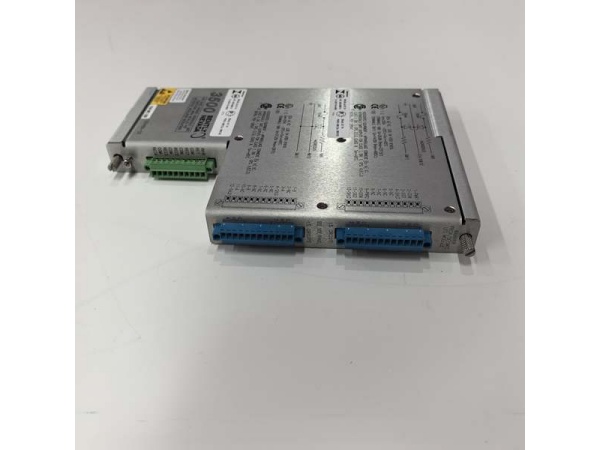
Bently 135489-02
Field Service Pitfalls: What Rookies Get Wrong
Confusing 5mm and 8mm Probe Linear RangesI’ve seen techs install a 135489-02 5mm probe thinking it has the same 0.5-2.5 mm range as the 8mm probe. They set mechanical gap at 1.27 mm (50 mils), which is outside the 5mm probe’s linear range (0.25-1.5 mm). The signal saturates, and vibration reading is pegged at maximum.
- Field Rule: Memorize the 5mm probe’s shorter linear range: 0.25 to 1.5 mm (10-60 mils). Always set mechanical gap at mid-range (typically 0.89 mm or 35 mils for 5mm probes). Verify the resulting gap voltage is around -10V DC at mid-gap.
Using 5mm Probes on Large Diameter ShaftsRookie engineers specify 5mm probes for a 300mm diameter turbine journal bearing because they’re “more compact.” But the 5mm coil field strength can’t penetrate large mass targets effectively, resulting in reduced signal strength and linearity errors up to 15%.
- Quick Fix: Use 8mm probes for shaft diameters larger than 150mm. The 8mm coil provides stronger field strength and better measurement on large mass targets. Reserve 5mm probes for shaft diameters under 100mm or where physical clearance prohibits 8mm installation.
Not Accounting for Shorter Cable Length Limits3300 XL 5mm probes have more stringent cable length limits than 8mm probes due to higher capacitance sensitivity. Techs run 8-meter cables thinking it’s the same as 8mm probes, causing signal attenuation and measurement errors.
- Field Rule: Follow 5mm probe cable length guidelines: max 3 meters with standard Proximitor, max 5 meters with extended-range Proximitor. If longer runs are required, use a signal repeater or move the Proximitor closer to the probe. Test signal quality at Proximitor terminals after wiring.
Forgetting to Downscale Alarm SetpointsTechs replace an 8mm probe with a 5mm probe during maintenance but forget to downscale the alarm setpoints in the monitor. The 8mm probe had Danger set at 20 mils (0.5 mm), but the 5mm probe’s full scale is 60 mils (1.5 mm). Now the setpoint is 33% of full scale instead of 25%, causing nuisance alarms.
- Field Rule: When changing probe type (8mm to 5mm or vice versa), always adjust alarm setpoints to match the new probe’s linear range. Convert setpoints using the probe’s sensitivity or recalibrate the channel with the new probe installed. Document setpoint changes in the maintenance log.
Installing in High-Vibration Areas Without Locking CompoundThe 5mm probe’s smaller thread size (1/4-28 UNF or M6x1) is more susceptible to loosening under vibration than 8mm probes. Techs don’t apply thread-locking compound, and the probe gradually drifts out of its linear range during operation.
- Quick Fix: Always apply thread-locking compound (e.g., Loctite 242) on 5mm probe threads during installation. Torque the lock nut to manufacturer specification (typically 3–5 Nm). Verify lock nut torque during PMs, especially in high-vibration machinery like gearboxes.
Mixing 5mm and 8mm Proximitor FamiliesI’ve seen techs use a 135489-02 5mm probe with an 8mm Proximitor (3300 XL 8mm version). The sensitivity curves don’t match, leading to measurement errors up to 30%. Gap voltage shows -12V when actual gap is 0.89 mm.
- Field Rule: Always use matching probe and Proximitor families. 5mm 3300 XL probes must be used with 5mm 3300 XL Proximitors. Verify the Proximitor part number matches the probe diameter before energizing. The Proximitor will have a suffix or label indicating the probe size it’s designed for.
Commercial Availability & Pricing Note
Please note: The listed price is for reference only and is not binding. Final pricing and terms are subject to negotiation based on current market conditions and availability.