
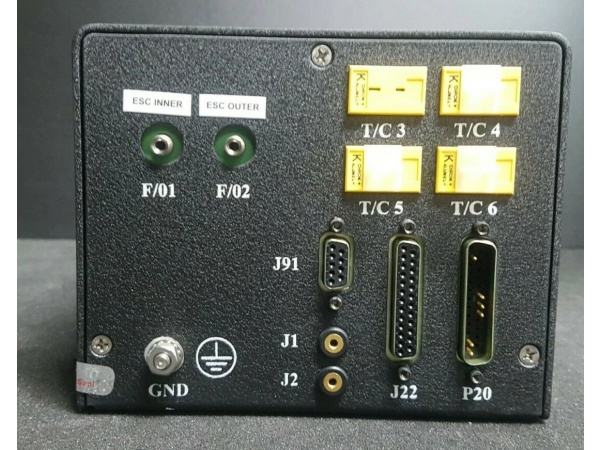
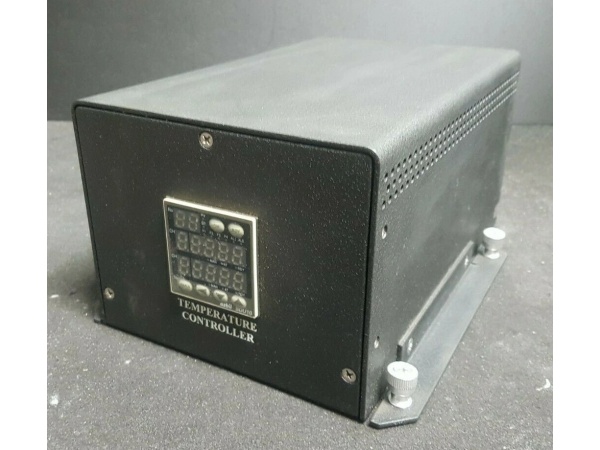
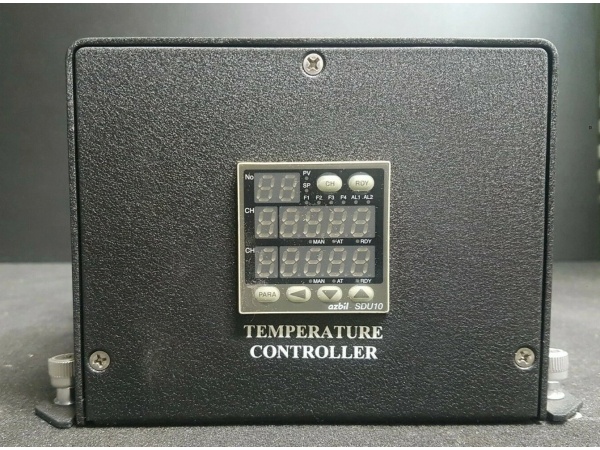
Description
Hard-Numbers: Technical Specifications
- AMAT Part Number: 0190-26463
- Yamatake Model: LOG-1215 FTC-DIN / CMC10 series
- Input Types: Thermocouple (J, E, T, R, S, B, N, WRe5-26), RTD (Pt100, JPt100), DC Voltage (0–1V, 1–5V, 0–5V, 0–10V), DC Current (0–20mA, 4–20mA)
- Temperature Ranges: -200°C to +2300°C (depending on input type)
- Control Accuracy:
- Thermocouple: ±1% FS or ±1 digit (whichever is larger)
- RTD / Analog: ±0.3% FS or ±1 digit
- Control Modes:
- On/Off
- Time Proportional
- PID (Proportional-Integral-Derivative)
- Current Proportional
- Sampling Cycle: 50ms, 100ms, 300ms, or 500ms (configurable)
- Control Output Options:
- Relay Output: SPDT, 250V AC / 30V DC, 3A
- Voltage Pulse Output: 19V DC ±15%, internal resistance 18Ω, max 24mA
- Current Output: 4–20mA DC, max load 600Ω
- Power Supply: 100–240V AC, 50/60Hz, 8VA max.
- Communication: RS-485 (Modbus compliant or proprietary PLC link), max 38,400 bps
- Display: 4-digit LED or LCD (depending on variant)
- Operating Temperature: -10°C to +55°C (or +45°C for tight mounting)
- Storage Temperature: -40°C to +70°C
- Humidity: 30–90% RH (non-condensing)
- Front Panel Rating: IP66 (NEMA 4/4X) – dust-tight and water-resistant
- Dimensions: 48mm (H) × 48mm (W) × ~74mm (D)
- Weight: ~130g (controller only), ~1.35kg (shipping weight per listing)
- Compliance: RoHS compliant, EN 61010-1, EN 61326-1 (industrial locations)

The Real-World Problem It SolvesIn semiconductor manufacturing and industrial process control, precise temperature regulation is critical for process consistency and product quality. The AMAT 0190-26463 Yamatake temperature controller provides accurate, reliable PID-based temperature control for heaters, chillers, and thermal processes in AMAT equipment. Its compact DIN form factor allows integration into tight panel spaces, while multi-range input flexibility supports various sensor types. RS-485 communication enables remote monitoring and setpoint changes via PLC or SCADA systems, crucial for automated production environments.
Where you’ll typically find it:
- Applied Materials semiconductor equipment (CVD, PVD, etch, RTP systems)
- Industrial process control panels (chemical processing, food & beverage, HVAC)
- Heat treatment ovens and furnaces
- Plastic injection molding machines
- Packaging machinery with temperature-controlled zones
Bottom-line: It’s a versatile, high-precision single-loop temperature controller designed for harsh industrial environments, offering multi-sensor compatibility, robust PID control, and communication capability for integration into automated control systems.
Hardware Architecture & Under-the-Hood LogicThe Yamatake LOG-1215 / CMC10 series controller is a compact digital PID controller designed for panel-mount applications.
-
Input Stage:
- Multi-range input selector supports thermocouples (types J, E, T, R, S, B, N, WRe5-26), RTDs (Pt100, JPt100), DC voltage (0–1V, 1–5V, 0–5V, 0–10V), and DC current (0–20mA, 4–20mA)
- Input sampling cycle is configurable (50ms to 500ms) for balancing response speed and noise immunity
-
Control Algorithm:
- PID control with auto-tuning capability (self-tuning or Just-FITTER algorithm on newer variants)
- Supports On/Off, time-proportional, PID, and current-proportional control modes
- “RationalLOOP PID” algorithm (derivative-forward PID) improves response characteristics
-
Output Stage:
- Relay output: SPDT contact, rated for 250V AC / 30V DC at 3A
- Voltage pulse output: 19V DC pulse train for driving solid-state relays (SSRs)
- Current output: 4–20mA analog output for controlling variable-frequency drives, valve positioners, or power controllers
-
Communication Interface:
- RS-485 serial port for Modbus RTU or proprietary PLC-link communication
- Enables remote setpoint changes, PV monitoring, and parameter adjustment
- Maximum baud rate: 38,400 bps
-
Display & Interface:
- 4-digit LED or LCD display showing Process Value (PV) and Setpoint (SV)
- Front-panel keys for parameter adjustment (MODE, SET, AUTO/MANUAL, etc.)
- Status indicators for RUN, ALARM, and communication
-
Power Management:
- Universal AC power supply (100–240V AC, 50/60Hz)
- Low power consumption: 8VA max.
- Internal isolation between input/output circuits and power supply
-
Environmental Protection:
- IP66-rated front panel protects against dust ingress and water jets
- Operating temperature range: -10°C to +55°C
- Designed for harsh industrial environments
 Field Service Pitfalls: What Rookies Get Wrong
-
Incorrect Input Type Configuration: Selecting the wrong sensor type (e.g., thermocouple type J instead of type K) causes massive temperature reading errors. Always verify sensor type and wire polarity before configuration.
-
Output Type Mismatch: Configuring a current output but connecting a relay load (or vice versa) results in non-functional control. Match output type to your final control element (SSR vs. electromechanical relay vs. analog driver).
-
PID Tuning Issues: Default PID parameters may cause overshoot, hunting, or slow response. Rookies often skip auto-tuning or manual PID adjustment. Use the controller’s auto-tune function or start with conservative P, I, and D values.
-
Wiring Errors: Reversing thermocouple leads produces incorrect readings offset by a fixed error. Always follow color coding (yellow=+, red=-) and verify polarity at both sensor and controller ends.
-
Ignoring Cold Junction Compensation: For thermocouples, cold junction compensation errors occur if the controller’s terminal temperature differs significantly from ambient. Ensure proper mounting and avoid heat sources near the controller.
-
RS-485 Termination: Failing to terminate the RS-485 bus (120Ω termination at each end) causes communication failures or intermittent errors. Follow proper RS-485 wiring guidelines.
-
Ground Loops: Connecting sensor shields to multiple ground points introduces noise. Use single-point grounding and shielded cables for analog inputs.
-
Alarm Configuration Not Set: Rookies often overlook alarm setup (high/low limits, deviation alarms). Properly configure alarms to protect equipment from over-temperature conditions.
-
Relay Contact Ratings: Exceeding relay contact ratings (250V AC / 30V DC, 3A) causes contact welding or premature failure. Check load requirements and consider adding an external SSR for high-current/heater applications.
-
Mounting in High-Temperature Areas: Mounting the controller near high-heat sources affects internal electronics and display readability. Ensure ambient temperature stays within -10°C to +55°C.
-
Firmware/Parameter Backup: After configuration, rookies often fail to save parameters via communication or front-panel backup. If power is lost, all settings return to defaults. Always document or save configuration.
-
Mixing Sensor Types on Same Controller: The controller is single-input; attempting to mix sensor types (e.g., thermocouple + RTD) requires an external selector or input module. Clarify sensor type before installation.
Commercial Availability & Pricing Note
-
Market Status: Available as used/refurbished stock from multiple AMAT spare parts suppliers. New stock may be limited; Yamatake (now Azbil) offers current-generation replacements.
-
Pricing Range:
- Used/Refurbished: ~$6,384 – $14,755 USD (varies by condition and supplier)
- New equivalent (current Azbil models): ~$1,200 – $2,800 USD
-
Warranty: 90-day warranty typical for used/refurbished units; new units may carry 1-year manufacturer warranty
-
Lead Time: Used/refurbished units often ship within days; new units may have 1–2 week lead time
-
Sourcing Channels:
- J316 Gallery (USA)
- KOEED (Global shipping)
- Santa Clara Systems (USA)
- SPW Industrial (USA)
- Semiconductor Spares Store (USA)
-
Replacement/Upgrade Path: For new deployments, consider current Azbil (Yamatake) models such as:
- C1M series (1/16 DIN, modern LCD display, enhanced PID)
- C15 series (1/8 DIN, compact, high-accuracy)
- DMC10 series (multi-channel modular controllers)
-
Documentation: Original Yamatake manuals may be available through Azbil or archived sources. For AMAT-specific integration, refer to equipment manuals for controller addressing and communication protocol details.


