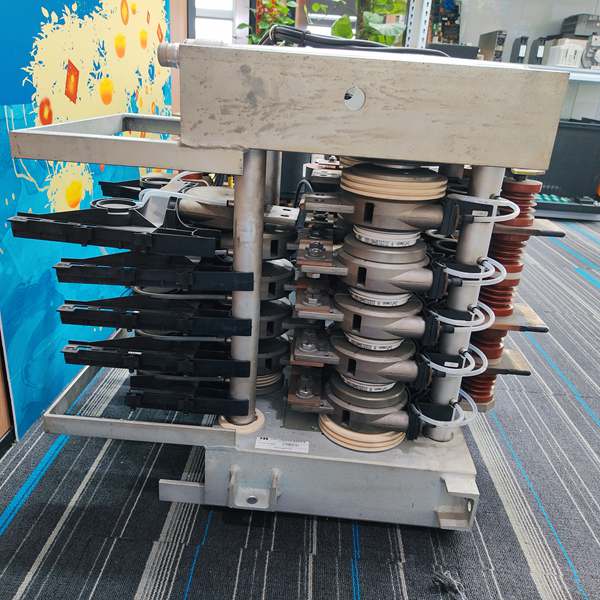
Description
Key Technical Specifications
- Model Number: ABB S-093H
- Manufacturer: ABB
- Pole Configuration: 3-pole (main contacts) + 1 auxiliary NO (normally open) contact
- Rated Current (AC-3): 93A @ 400V AC; 110A @ 230V AC
- Rated Voltage: Up to 690V AC (main contacts)
- Duty Cycle: AC-3 (motor starting/operation), AC-1 (resistive loads)
- Coil Voltage Options: 24V DC, 110V AC, 230V AC, 400V AC (factory-selectable)
- Coil Power Consumption: 12VA (pull-in), 3VA (hold) for AC coils; 10W (pull-in), 2W (hold) for DC coils
- Operating Temperature: -25°C to 60°C (-13°F to 140°F)
- Storage Temperature: -40°C to 85°C (-40°F to 185°F)
- Short-Circuit Withstand Current: 10kA @ 400V AC (1 second)
- Mechanical Life: 10 million operations
- Electrical Life (AC-3): 1 million operations @ rated load
- Mounting: DIN rail (35mm, EN 50022) or panel mounting
- Protection Features: Arc suppression, coil surge protection (DC coils)

ABB S-093H
Field Application & Problem Solved
In industrial motor control—pumps, fans, compressors, and conveyor systems—switching high-current AC loads requires contactors that balance durability, current capacity, and arc suppression. The challenge? Low-cost contactors fail prematurely under AC-3 duty cycles (motor starting), where inrush currents are 6-10x rated current. Many contactors lack sufficient short-circuit withstand, leading to catastrophic failure during faults. Others have poor arc suppression, causing contact pitting and shortened life. Mismatched coil voltages or inadequate mounting lead to intermittent operation. The ABB S-093H solves these pain points with AC-3 optimization, high current capacity, robust arc suppression, and flexible coil options.
You’ll typically find this contactor in applications like controlling 55kW (75HP) motors in water treatment pumps, switching heating elements in industrial ovens, or acting as the main contactor in conveyor motor starters. It’s a staple in motor control centers (MCCs) and panel builds, where its 93A rating handles medium-to-large motors. In manufacturing plants, it’s used to start/stop production line motors, relying on its 10kA short-circuit withstand to survive fault conditions. It also excels in retrofits of older systems, replacing worn contactors with a drop-in OEM solution that matches existing mounting and wiring.
Its core value is reliability and durability in heavy-duty load switching. AC-3 duty cycle optimization ensures it survives motor inrush currents, while arc suppression reduces contact wear. High short-circuit withstand prevents catastrophic failure during faults. For plant operators, this means reduced downtime, fewer replacement cycles, and safe load control—critical in 24/7 industrial environments where contactor failure halts entire processes.
Installation & Maintenance Pitfalls (Expert Tips)
- Coil Voltage Mismatch (Wrong Voltage = Coil Burnout): Rookies often install a 230V AC coil contactor on a 110V AC control circuit (or vice versa), burning out the coil within minutes. Always verify the control circuit voltage before ordering. Check the contactor’s nameplate for coil voltage, and use a multimeter to confirm the control signal matches. For DC coils, ensure the circuit has no reverse polarity—DC coils are polarity-sensitive and will not operate if wired backwards.
- Inadequate Mounting (Loose Fixing = Vibration Damage): The contactor relies on secure mounting to dissipate heat and resist vibration, but rookies often use undersized screws or leave mounts loose. Vibration causes contact bounce, leading to arcing and premature wear. Use M4 or M5 screws (per ABB specs) to mount to DIN rail or panel. Tighten to 1.5Nm torque, and add anti-vibration washers in high-vibration environments (e.g., near motors).
- Ignoring Arc Suppression (No Snubber = Contact Pitting): For inductive loads (motors, solenoids), voltage spikes during contact opening cause severe arcing, pitting contacts and shortening life. Rookies often omit arc suppression devices. Install an RC snubber (for AC loads) or freewheeling diode (for DC coils) across the contactor’s main terminals. For 3-phase motors, use a surge suppressor rated for the motor’s voltage and current.
- Overloading Beyond AC-3 Rating (Resistive vs. Inductive Loads): The 93A rating applies to AC-3 (inductive motor loads), but rookies often use it for AC-1 (resistive) loads exceeding 110A. Overloading causes excessive heat, melting contacts and tripping breakers. Calculate load current and match to the duty cycle: AC-3 for motors, AC-1 for heaters. Never exceed the nameplate’s rated current for the application’s voltage (e.g., 93A @ 400V AC-3).
ABB S-093H
Technical Deep Dive & Overview
The ABB S-093H is a 3-pole industrial power contactor designed for switching high-current AC loads, with a focus on motor control (AC-3 duty cycle). Its core design centers on silver-nickel alloy main contacts, chosen for their high conductivity, wear resistance, and arc-suppression properties. The contacts are arranged in a series-parallel configuration to distribute current evenly, reducing hotspots and extending life.
When energized, the coil creates an electromagnetic field that pulls the contactor’s armature, closing the main contacts and completing the load circuit. For AC coils, a shading ring on the armature eliminates humming and ensures smooth operation. DC coils include built-in surge protection to prevent voltage spikes from damaging the coil windings.
Arc suppression is critical for contact life—each main contact is paired with a magnetic arc chute that redirects and cools arcs during opening. This reduces contact pitting and extends electrical life to 1 million AC-3 operations. The contactor’s housing is made of flame-retardant polyamide, providing insulation and protection against dust and debris.
The auxiliary NO contact allows for interlocking or status feedback (e.g., signaling to a PLC that the contactor is closed). The contactor supports both DIN rail and panel mounting, with a compact footprint that maximizes space in control panels. Its mechanical design minimizes contact bounce, ensuring reliable switching even in high-vibration environments.
Compliance with IEC 60947-4-1 and UL 60947 standards ensures global compatibility and safety. The contactor’s robust construction—including high short-circuit withstand (10kA @ 400V AC)—makes it suitable for harsh industrial environments, from manufacturing plants to power generation facilities. It operates seamlessly with ABB’s line of overload relays and circuit breakers, forming a complete motor protection system.