Description
Key Technical Specifications
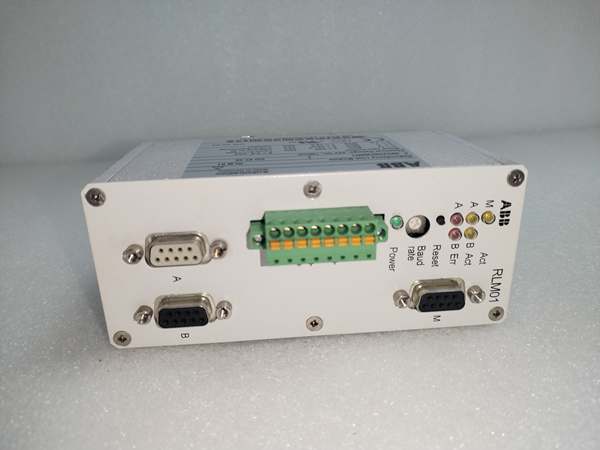
- Model Number: RLM01 3BDZ00398R1IMG
- Manufacturer: ABB
- Compatible Systems: ABB AC 800M DCS, Compact Control Builder (CCB), third-party PLCs
- Communication Protocol: ABB Remote I/O Link, Ethernet/IP (secondary), Modbus TCP (optional)
- Data Transfer Rate: Up to 100 Mbps (Ethernet), 10 Mbps (Remote I/O Link)
- Operating Temperature: -25°C to +70°C (-13°F to +158°F)
- Storage Temperature: -40°C to +85°C (-40°F to +185°F)
- Isolation: 2kV AC (network ports to power, I/O link to backplane)
- Power Supply: 24V DC (200mA typical), 18–30V DC operating range
- Dimensions (W x H x D): 100mm x 150mm x 70mm
- Weight: Approx. 420g
- Mounting: DIN rail (35mm) or panel-mount (compatible with standard I/O racks)
- Protection Features: ESD protection (±15kV), surge protection (4kV), short-circuit tolerance
- Compliance: IEC 61158 (fieldbus standards), IEC 61000-4 (EMC), UL 508
- Status Indicators: Power (PWR), Link Activity, I/O Communication, Fault (RED)
- Remote I/O Capacity: Supports up to 32 remote I/O modules per link
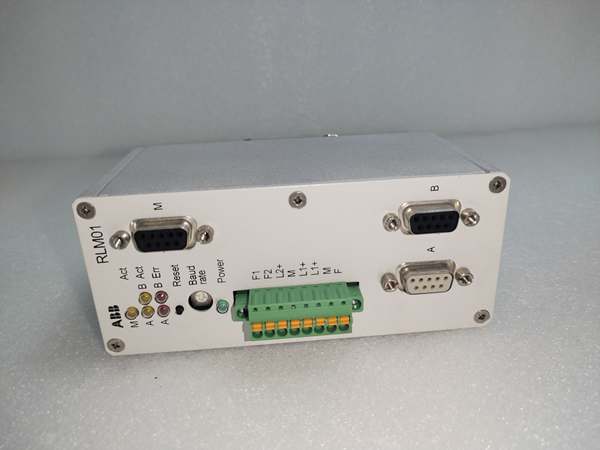
ABB RLM01 3BDZ00398R1IMG
Field Application & Problem Solved
In large-scale industrial facilities—refineries, power plants, and chemical plants—the biggest challenge is reliable connectivity between central DCS/PLC systems and remote I/O racks (located hundreds of meters away). Legacy remote I/O link modules suffer from slow data transfer, poor noise immunity, or limited capacity, leading to delayed I/O updates, data corruption, and unplanned downtime. This module solves that by combining high-speed communication with ruggedized design and large I/O capacity, eliminating the “distance barrier” of traditional link modules.
You’ll typically find this module connecting remote I/O racks to central AC 800M DCS systems: think refinery tank farm level sensors linked to the main control room, power plant boiler auxiliary I/O (valves, pumps) connected to the central PLC, or chemical plant reactor peripheral I/O synced with the DCS. It’s also used in pulp mills (digester section remote I/O) and water treatment plants (distributed pump station I/O), where remote equipment is spread across large sites. For retrofits, it replaces outdated serial-based remote I/O links, upgrading to high-speed Ethernet while maintaining compatibility with existing I/O modules—saving installation time and cost.
Its core value is speed and scalability. The 100 Mbps Ethernet transfer rate ensures real-time I/O updates (critical for fast process loops), while the ability to support 32 remote modules per link reduces the number of required link modules. The rugged design withstands EMI from large motors and transformers, while the wide operating temperature range handles extreme conditions in outdoor or unconditioned areas. For plant operators, this translates to centralized control over distributed equipment, faster fault detection, and reduced wiring costs—critical in facilities where running long cable runs is impractical or expensive.
Installation & Maintenance Pitfalls (Expert Tips)
Link Configuration: Match Master/Slave Settings
Rookies often misconfigure the module as a “master” when it should be a “slave” (or vice versa), breaking communication with the central DCS. The module acts as a slave to the DCS master—never reverse this. Use ABB’s Control Builder software to set the correct role, and verify the link address matches the DCS configuration. A mismatched master/slave setting is the #1 cause of remote I/O communication failures, and it’s often overlooked during troubleshooting.
Cable Length & Type: Don’t Exceed Limits
The Remote I/O Link has a maximum cable length (100m for twisted-pair, 2km for fiber), but technicians frequently use undersized cable or exceed length limits. This causes signal attenuation and data loss. Use shielded twisted-pair cable (Cat5e or higher) for runs up to 100m, and fiber optic cable for distances beyond. For twisted-pair runs, keep total length below 100m—adding a repeater if needed. Using unshielded cable in high-EMI areas will degrade signal integrity by 50% or more.
Power Supply Redundancy: Don’t Skip It
Remote I/O link modules are critical for distributed equipment, but rookies often use a single power supply. A power failure takes down the entire remote I/O link, halting communication with critical equipment. Use a redundant 24V DC power supply (1+1 configuration) for the module. Wire the power inputs to separate supply rails, and install a surge protector on each input—this ensures continuous operation if one supply fails.
Firmware Compatibility: Match DCS Version
Mismatched firmware between the module and central DCS causes intermittent communication glitches (e.g., dropped I/O updates) or complete link failure. Before installation, check the DCS firmware version and download the matching module firmware from ABB’s portal. Use Control Builder to flash the firmware—never use outdated firmware, as it may lack critical bug fixes for protocol compatibility. Verify firmware version post-installation via the module’s status interface.
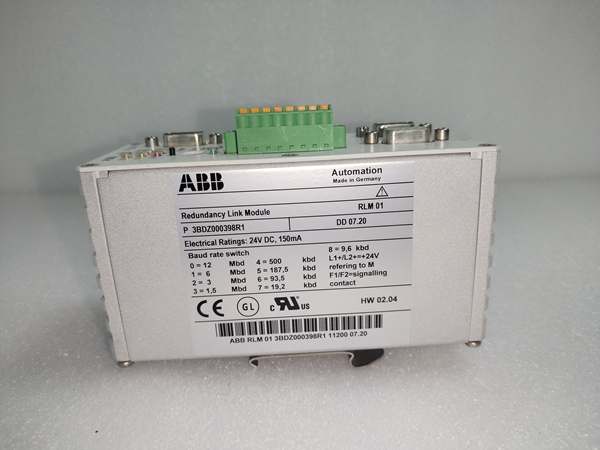
ABB RLM01 3BDZ00398R1IMG
Technical Deep Dive & Overview
The ABB RLM01 3BDZ00398R1IMG is a high-performance remote I/O link module designed to facilitate fast, reliable communication between central control systems and distributed I/O racks. At its core, it acts as a bridge: translating DCS/PLC commands into signals for remote I/O modules, while transmitting I/O data back to the central system via high-speed Ethernet or ABB’s proprietary Remote I/O Link.
The module’s dual-protocol support (Remote I/O Link + Ethernet/IP) provides flexibility: the proprietary link ensures low-latency communication with ABB I/O modules, while Ethernet/IP enables integration with third-party PLCs. The 100 Mbps Ethernet port supports full-duplex communication, ensuring simultaneous data transmission and reception without bottlenecks. Internally, a dedicated processor handles protocol processing, offloading the central DCS and ensuring consistent performance even with maximum I/O load.
Powered by a 24V DC supply (with wide voltage tolerance), the module draws minimal current, making it suitable for remote locations with limited power. The 2kV isolation between ports and power supply prevents ground loops, a common issue in distributed systems with multiple grounded devices. The rugged housing and shielded ports protect against EMI, while the ESD and surge protection guard against electrical hazards in industrial environments.
Integration with ABB DCS systems is seamless via Control Builder software, which allows configuration of link addresses, master/slave roles, and I/O mapping. The status LEDs provide at-a-glance visibility into link activity and faults, while diagnostic data (e.g., link error rate, power supply status) is transmitted to the DCS for remote monitoring. The compact DIN rail design fits into standard I/O racks, simplifying installation in space-constrained areas.
Overall, this module is a workhorse for distributed industrial control: it delivers high-speed, reliable connectivity between central systems and remote I/O, with the ruggedness and scalability needed for large-scale facilities. Its compatibility with ABB and third-party systems makes it a versatile choice for both new installations and retrofits.