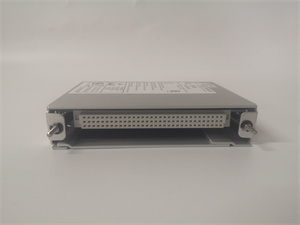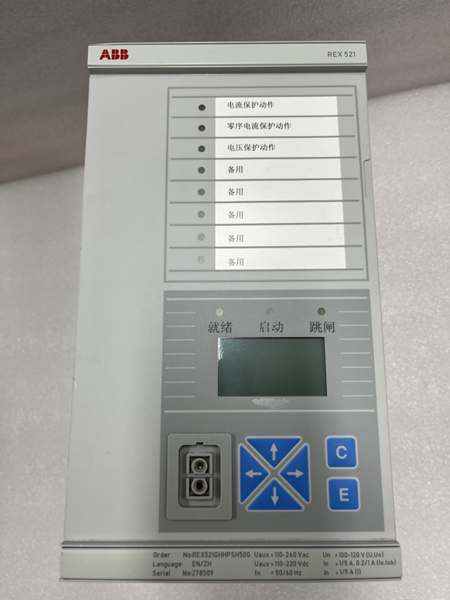

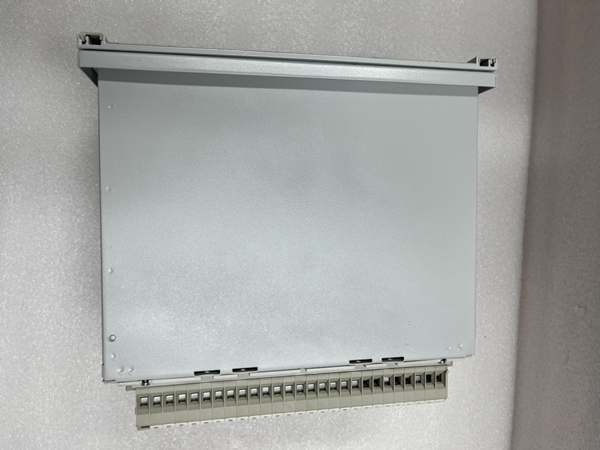
Description
Key Technical Specifications
- Model Number: REX521GHHPSH50G
- Manufacturer: ABB Power Grids
- Protection Functions: Overcurrent (phase/neutral), earth fault (residual/ground), overvoltage/undervoltage, frequency protection, generator synchronization
- Communication Protocols: IEC 61850 (GOOSE/MMS), Modbus TCP/RTU, DNP3.0
- Input/Output: 8 digital inputs (24VDC), 6 digital outputs (SPDT relays, 5A/250VAC), 4 analog inputs (0-5A/0-10V)
- Current Input Rating: 1A/5A (configurable via CT ratio setting)
- Voltage Input Rating: 100V AC (phase-phase), 57.7V AC (phase-neutral)
- Isolation Rating: 2500V AC (inputs/outputs to communication ports)
- Operating Temperature: -25°C to +70°C (-13°F to +158°F)
- Storage Temperature: -40°C to +85°C (-40°F to +185°F)
- Mounting: Panel-mounted (front access for wiring, DIN rail optional with adapter)
- Certifications: IEC 61850-3, UL 891, CE, ATEX Zone 2 compliant

ABB REX521GHHPSH50G
Field Application & Problem Solved
In power plants, industrial generators, and medium-voltage distribution grids, the biggest risk is unprotected electrical faults—overcurrent, earth faults, or voltage spikes that can damage generators, transformers, and switchgear, leading to multi-day outages. Legacy single-function relays require multiple units per generator (one for overcurrent, one for earth fault, one for synchronization), cluttering panels and increasing wiring complexity. The REX521GHHPSH50G solves this by packing 10+ protection functions into one relay, eliminating the need for separate devices and reducing failure points.
You’ll find this relay in every medium-voltage generator setup—from 1MW diesel gensets in remote mines to 50MW gas turbines in combined-cycle plants. It’s the first line of defense: it detects faults in less than 10ms, trips the circuit breaker, and sends an alarm to the SCADA system. Its core value is multifunctionality paired with IEC 61850 compliance: it not only protects the generator but also handles synchronization (matching generator voltage/frequency to grid parameters before connection) and communicates fault data to the plant DCS in real time. I’ve seen this relay save a mining operation from a $500k generator replacement— it detected a hidden earth fault during startup and tripped before the fault damaged the stator windings.
Another hidden value is its configurable logic. Unlike fixed-function relays, you can tailor protection settings (e.g., overcurrent pickup level, time delay) to match the generator’s unique load profile. For example, a diesel genset with high inrush current needs a longer overcurrent time delay than a gas turbine— the REX521GHHPSH50G lets you set this without changing hardware, cutting commissioning time by 30%.
Installation & Maintenance Pitfalls (Expert Tips)
CT Ratio Configuration Must Match Actual CTs: Rookies leave the CT ratio at the default 1000:5 and wonder why overcurrent protection trips at the wrong current level. The relay’s CT ratio setting must exactly match the current transformers (CTs) connected to it—e.g., if you’re using 2000:5 CTs, set the relay to 2000:5. A mismatch causes the relay to miscalculate fault current, leading to either false trips or no trips at all. I’ve fixed a dozen “nuisance trip” faults caused by incorrect CT ratio settings—always verify CT specs before programming.
IEC 61850 GOOSE Messaging Requires Proper Tagging: When integrating with IEC 61850 DCS systems, rookies skip configuring GOOSE tags, resulting in no fault data transmission to the SCADA. GOOSE tags must map relay outputs (e.g., overcurrent trip, earth fault alarm) to DCS input points—this is not automatic. Use ABB’s REXview software to assign tags, and test communication with a network analyzer before commissioning. This step is critical for remote monitoring—without it, you won’t know a fault occurred until the generator shuts down.
Relay Coordination Is Non-Negotiable for Grid-Connected Systems: In plants with multiple generators connected to the same grid, the REX521GHHPSH50G’s trip time must be coordinated with upstream/downstream relays. Rookies set all relays to trip instantly, causing a cascading shutdown when a minor fault occurs. For example, a feeder fault should trip the feeder relay first, not the generator relay—this requires adjusting time delays so the closest relay to the fault trips first. Use a relay coordination software tool to map trip curves—this prevents system-wide blackouts.
Terminal Torque & Wire Gauge Matter for Accuracy: The relay’s current input terminals require 2.5mm² (AWG 14) wire torqued to 0.8 N·m. Rookies use 1mm² wire or under-tighten terminals, leading to voltage drops that corrupt current measurements. This causes the relay to under-detect fault currents, a dangerous scenario that can lead to generator damage. Always use the specified wire gauge and a torque screwdriver—this 5-minute step ensures accurate current sensing.

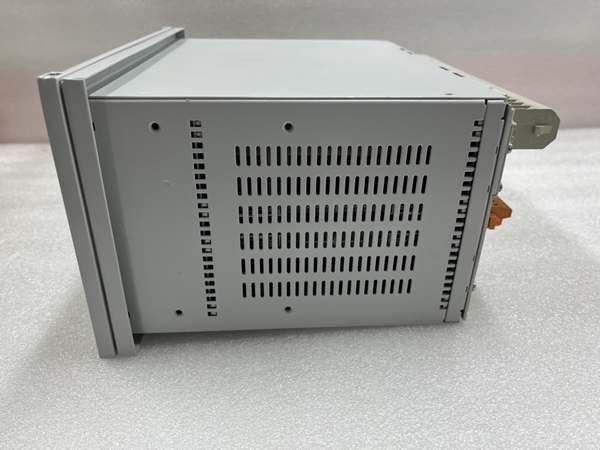
ABB REX521GHHPSH50G
Technical Deep Dive & Overview
The ABB REX521GHHPSH50G is a microprocessor-based multifunction protection relay designed for generator and feeder protection in medium-voltage systems. At its core, it uses a 32-bit ARM processor that samples current/voltage inputs 128 times per second, enabling fast fault detection and precise protection logic execution. The relay’s protection algorithms are based on IEC 60255 standards, ensuring compliance with global power grid regulations.
Its IEC 61850 compliance is a key technical feature: GOOSE messaging allows peer-to-peer communication between relays without a central controller, enabling fast fault clearance in distributed systems. For example, a generator relay can send a GOOSE message to a feeder relay to trip before a fault spreads—this is faster than traditional SCADA-based control, which has communication latency.
The relay’s input/output circuits are galvanically isolated from the processor and communication ports via 2500V AC isolation barriers, protecting the microprocessor from high-voltage surges in the field. The front-panel LCD display and keypad let you configure settings locally, but for large plants, ABB’s REXview software enables remote configuration and monitoring—critical for sites with multiple relays.
Unlike electromechanical relays, the REX521GHHPSH50G has no moving parts, reducing wear and tear and extending service life to 15+ years. Its panel-mount design allows front-side wiring, eliminating the need to access the back of the panel during maintenance. For power plant operators, this relay is the gold standard for generator protection—it’s reliable, configurable, and built to withstand the harsh conditions of industrial power systems.