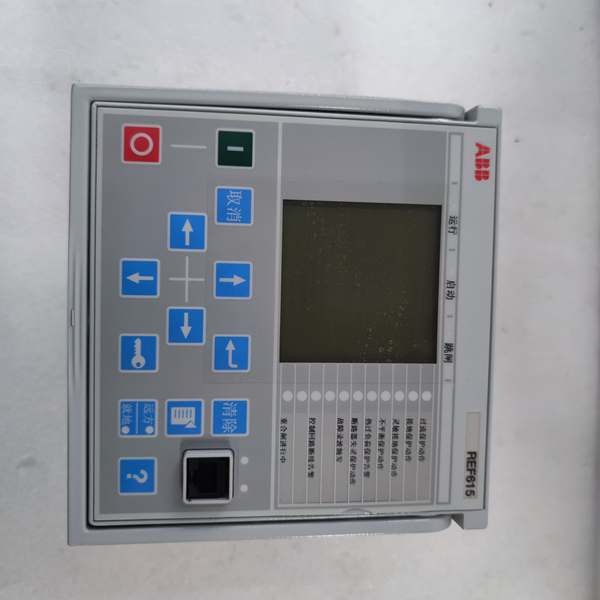
Description
Key Technical Specifications
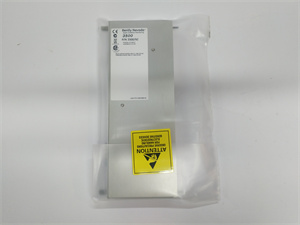
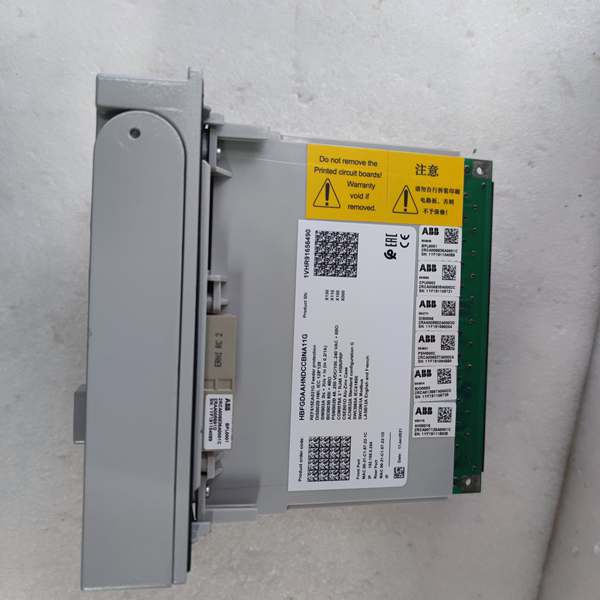
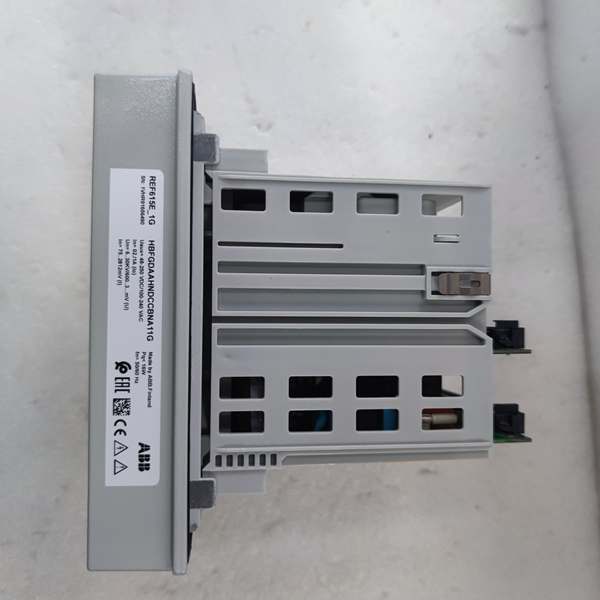
- Model Number: REF615E HBFNAEAGAAC1BNA11G
- Manufacturer: ABB Power Grids
- Protection Functions: Directional overcurrent, non-directional overcurrent, ground fault, thermal overload, arc flash detection, high-impedance fault detection, auto-reclosing (optional)
- Protocol Support: IEC 61850 (GOOSE/MMS), DNP3.0, Modbus RTU/TCP, IEC 60870-5-103
- Current Input Rating: 1A or 5A (configurable), 50/60Hz
- Voltage Input Rating: 100–120V or 200–240V AC/DC (auxiliary power)
- Operating Temperature: -40°C to +70°C (-40°F to +158°F)
- Isolation Rating: 5kV AC (current/voltage inputs to logic circuits), 2kV AC (communication ports to logic)
- Fault Recording: Up to 100 events, 10 waveform records (64 samples/cycle)
- Physical Design: Draw-out chassis, IP54 front panel, IP20 rear terminals
- Time Synchronization: IEEE 1588 v2 Precision Time Protocol (PTP)
- Certifications: IEC 61850-3, IEC 60255-22-1, UL 891, CE

ABB REF615E HBFNAEAGAAC1BNA11G
Field Application & Problem Solved
In 1–35kV distribution grids—whether industrial plant substations, urban utility networks, or mining power systems—the biggest headache is isolating faults fast enough to prevent cascading outages and minimizing downtime for critical loads. Legacy electromechanical relays are slow, lack communication capabilities, and can’t distinguish between harmless transients and dangerous faults (e.g., arc flash or high-impedance ground faults). I’ve seen a paper mill lose 8 hours of production because a legacy relay failed to trip a high-impedance fault on a 12kV feeder, leading to a transformer burnout.
You’ll find this relay installed in switchgear cubicles, protecting overhead lines feeding pump stations, conveyor belts, and motor control centers (MCCs). It’s also a staple in ring-main distribution networks, where fast fault isolation is critical to maintaining supply to non-faulted sections. Its core value is integrated protection + communication + diagnostics—it doesn’t just trip faults; it sends detailed fault data to the SAS, logs waveform records for root-cause analysis, and supports remote configuration via IEC 61850. At a Texas refinery, retrofitting old relays with this model cut feeder outage time by 60%—technicians could diagnose faults remotely instead of driving to the field, and auto-reclosing reduced unplanned downtime for critical cooling pumps.
Another unspoken value is its draw-out design: you can replace the relay without rewiring the cubicle, which is a lifesaver during scheduled maintenance or emergency swaps. This eliminates hours of wiring work and reduces the risk of human error during reinstallation.
Installation & Maintenance Pitfalls (Expert Tips)
- CT/VT Wiring Polarity Is Non-Negotiable: Rookies reverse the current transformer (CT) secondary wiring, which breaks directional overcurrent protection. The relay’s directional logic relies on correct phase and polarity—if you swap the CT leads, the relay will trip for faults on the wrong side of the feeder or fail to trip at all. Always verify polarity with a phase meter before commissioning; I’ve fixed three miswired relays this year alone in a single wind farm substation.
- Arc Flash Detection Requires Proper Sensor Placement: The relay’s arc flash function only works if you mount the optical sensors inside the switchgear cubicle, near busbars and circuit breakers. Mounting them outside or too far from potential arc sources will result in missed detections or false trips. A food plant had two false arc flash trips because sensors were mounted near fluorescent lights—relocating them to the cubicle interior solved the problem.
- Communication Configuration Must Match SAS Settings: Mismatched IEC 61850 GOOSE IDs or DNP3 point maps are the #1 cause of integration failures. Don’t assume the default settings work—cross-check the relay’s communication parameters with the SAS engineer’s configuration sheet. I spent 12 hours troubleshooting a refinery’s SAS integration because the relay’s GOOSE dataset didn’t match the substation’s SCADA system; a 10-minute parameter tweak fixed it.
- Backup Configuration Regularly: The relay stores settings in non-volatile memory, but I’ve seen firmware updates corrupt configurations. Always back up the relay’s settings to a USB drive after commissioning and before any firmware updates. A mining operation lost all protection settings after a botched firmware update—they had to rebuild the configuration from scratch, costing 4 hours of downtime.
ABB REF615E HBFNAEAGAAC1BNA11G
Technical Deep Dive & Overview
The REF615E is a microprocessor-based relay that combines protection, control, and communication in a single draw-out unit. At its core, a 32-bit ARM processor runs ABB’s proprietary protection algorithms, processing CT/VT inputs in real time to detect faults within milliseconds. The relay uses a combination of current magnitude, phase angle, and voltage data to distinguish between normal transients (e.g., motor starts) and actual faults, reducing false trips. Its arc flash detection uses optical sensors to detect the light from an arc, triggering a trip before the arc can cause catastrophic damage to switchgear.
Communication is handled via dual Ethernet ports, supporting IEC 61850 GOOSE for fast inter-relay communication and MMS for SCADA integration. The draw-out design separates the relay’s core electronics from the wiring terminals, allowing hot-swapping without disrupting the feeder’s wiring. The local LCD HMI lets technicians view fault records, adjust settings, and test protection functions without a laptop—critical for field troubleshooting in remote locations with no Wi-Fi. Unlike legacy relays, this model doesn’t require external fault recorders or communication gateways; everything is integrated, reducing cabinet space and system complexity. It’s a workhorse for medium-voltage distribution, built to survive the harsh conditions of power plants, refineries, and industrial substations.