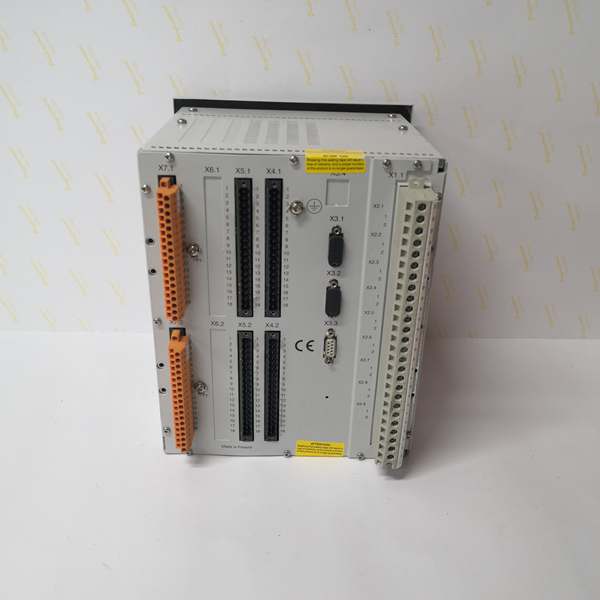
Description
Key Technical Specifications
-
Model Number: REF543KB127AAAA
-
Manufacturer: ABB
-
Protection Functions: Overcurrent, ground fault, phase imbalance, overvoltage, undervoltage, thermal overload
-
Input Voltage Range: 57.7V/100V (phase), 100V/173V (line) AC; 24-48V DC control supply
-
Current Rating: 5A or 1A CT input (configurable)
-
Protocol Support: IEC 61850, Modbus RTU/TCP, IEC 60870-5-103
-
Operating Temperature: -40°C to 70°C (-40°F to 158°F)
-
Protection Rating: IP65 (front panel), IP20 (terminal compartment)
-
Isolation: 2.5kV AC (current/voltage inputs to logic); 1kV AC (communication ports)
-
Trip Time: <10ms (high-priority faults like short circuit)
-
Certifications: IEC 61508 (SIL 2), UL 508, CE, IECEx, ATEX Zone 2
-
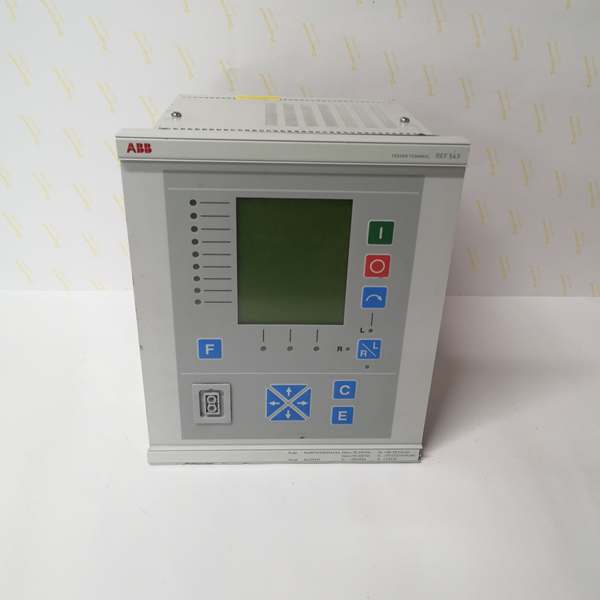
Display: 3.5” color LCD with keypad for local configuration

ABB REF543KB127AAAA
Field Application & Problem Solved
In refineries and power plants, the biggest headache with medium-voltage motors (10-35kV) and capacitor banks is “blind protection”—legacy electromechanical relays that fail silently or trip on false alarms, leading to unplanned downtime or catastrophic failures. I saw a 2022 incident where a 2000HP pump motor burned out because an old relay missed a phase imbalance; the repair cost $120k and took 3 days. The REF543KB127AAAA solves this by combining digital precision with self-diagnostics—no more guessing if the relay is working.
You’ll find this relay in three key spots: mounted on switchgear for 10kV pump motors in petrochemical plants, protecting无功补偿 (VAR) capacitor banks in solar farms, and integrated into substation automation systems for municipal power grids. In one paper mill retrofit, we replaced 12 electromechanical relays with 4 REF543KB127AAAA units—each handling 3 motors—cutting maintenance checks from weekly to monthly.
Its core value is “predictable protection.” Unlike old relays, it logs fault data (current, voltage, timestamp) to the cloud via IEC 61850, so you don’t just fix the tripped motor—you fix the root cause. In a Texas refinery, the relay’s thermal overload pre-alarm let us replace a failing bearing before the motor seized, saving 8 hours of downtime. It turns reactive troubleshooting into proactive maintenance.
Installation & Maintenance Pitfalls (Expert Tips)
CT Wiring: Never Mix 1A and 5A Inputs
Rookies hook 5A current transformers (CTs) to the 1A input terminals—this fries the relay’s current sensing circuit. The REF543KB127AAAA has jumpers to set CT rating (1A/5A); verify the CT nameplate (e.g., “5A secondary”) before configuring. Always short CT secondary terminals during wiring—open CTs generate lethal voltages that destroy the relay. I carry a set of 4mm shorting plugs specifically for this; don’t use wire nuts—they come loose under vibration.
Grounding: Single-Point Shield Ground Only
Dual-point grounding (relay and CT ends) creates ground loops, causing false overcurrent trips. Run shielded cable for CT/VT inputs, and ground the shield only at the relay’s ground terminal—insulate the shield at the CT/VT end. In a Florida solar farm, we fixed weekly false trips by re-grounding 12 relay cables; the issue was a 2V potential difference between the relay cabinet and CT junction box.
IEC 61850 Configuration: Match Dataset Attributes
Technicians often upload generic IEC 61850 configurations, leading to communication failures with the SCADA system. The relay’s IED name and dataset attributes (e.g., “MeasuredValues” for current) must exactly match the SCADA’s IEC 61850 client setup. Use ABB’s PCM600 software to export the relay’s ICD file and import it into the SCADA—don’t manually type attributes. In a California substation, this mistake delayed commissioning by 2 days; the fix took 15 minutes once we used the ICD file.
Control Supply: Stabilize Voltage for DC Inputs
The 24V DC control supply is sensitive to voltage spikes from nearby contactors. A steel mill had relays tripping randomly until we added a 24V DC surge protector (ABB 1SVR405600R0000) in the power feed. Set the under-voltage threshold to 19.2V (not lower)—going lower risks erratic behavior during brownouts.
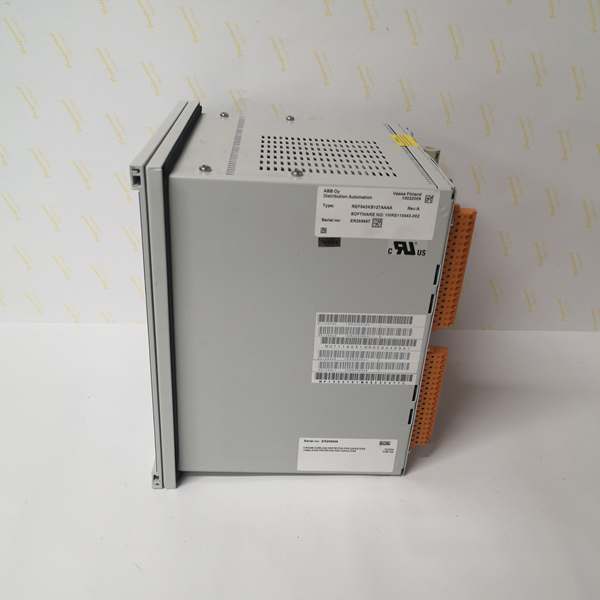
ABB REF543KB127AAAA
Technical Deep Dive & Overview
The REF543KB127AAAA is a digital multifunctional relay that acts as the “brain” for protecting medium-voltage electrical assets. At its core, a 32-bit microprocessor samples CT and VT inputs 1000 times per second, comparing real-time values to user-configured thresholds (e.g., 120% of motor rated current for overload). It uses a dedicated protection logic engine—separate from the communication processor—to ensure trip signals aren’t delayed by data transmission.
What makes it industrial-grade is its hardware redundancy: dual power supplies (AC/DC) and separate I/O circuits for protection and control. The IP65 front panel means it can be mounted directly on switchgear in dusty cement plants or humid wastewater facilities—no need for a separate control cabinet. The IEC 61850 protocol support lets it integrate with modern smart grids, while Modbus compatibility keeps it working with legacy SCADA systems—a critical bridge during upgrades.
Local configuration via the LCD keypad is intuitive, but always lock the keypad after setup—plant operators love to “tweak” settings, leading to false trips. The relay stores 100 fault records, including pre-fault and post-fault waveforms, which I’ve used to prove that a “faulty” motor was actually a bad CT. It’s not just a protection device—it’s a diagnostic tool that pays for itself in reduced downtime.