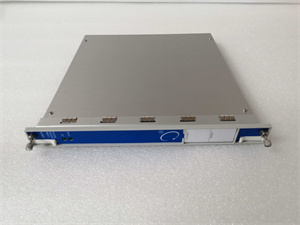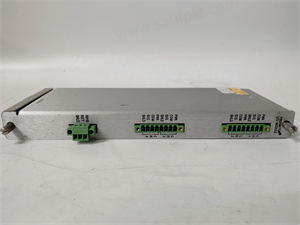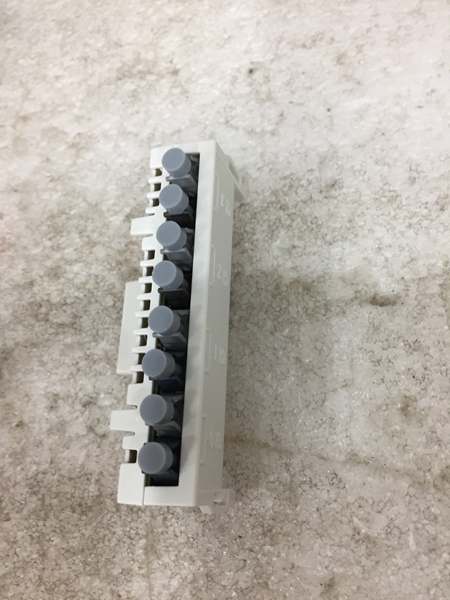
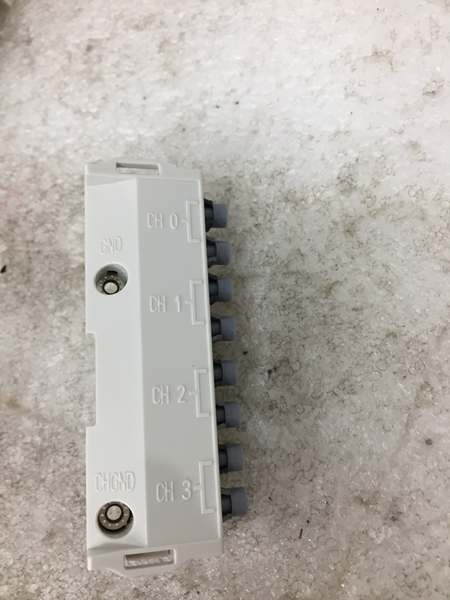
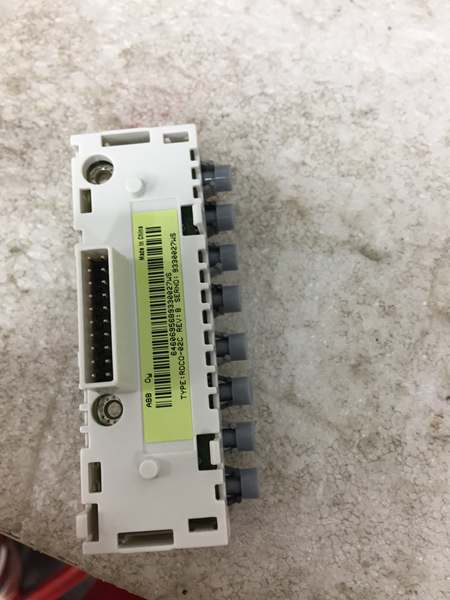
Description
Key Technical Specifications
- Model Number: RDCO-02
- Manufacturer: ABB Drives & Controls
- Communication Interfaces: 1× multi-mode fiber optic port (ST connector), 1× PROFIBUS DP port (D-sub 9-pin)
- Protocol Support: PROFIBUS DP-V0 (process data exchange), ABB DriveBus (fiber optic internal communication)
- Data Transfer Rate: Up to 12 Mbps (PROFIBUS DP); 2 Mbps (fiber optic DriveBus)
- Fiber Optic Distance: Up to 2 km (multi-mode fiber; 62.5/125 µm or 50/125 µm)
- Isolation Rating: 2500V AC (fiber optic port to drive control board; PROFIBUS port to drive chassis)
- Power Supply: 24VDC ±10% (derived from ACS800 drive internal power; 0.1A max current draw)
- Operating Temperature: -10°C to +50°C (14°F to 122°F)
- Storage Temperature: -40°C to +85°C (-40°F to +185°F)
- Protection Rating: IP20 (module; depends on drive enclosure for field protection)
- Certifications: UL 508C, CE, IEC 61800-5-1

ABB RDCO-02
Field Application & Problem Solved
In heavy industrial environments—mines, steel mills, and large water treatment plants—the biggest challenge with motor drive communication is noise immunity and long-distance connectivity. Traditional copper PROFIBUS cables get swamped by EMI from high-voltage motors, welders, and variable frequency drives, leading to dropped communication, incorrect speed commands, and unplanned drive trips. A Midwest steel mill once lost 12 hours of production when copper PROFIBUS cables on a rolling mill drive were hit by EMI, causing the drive to default to full speed and damage equipment.
The RDCO-02 solves this by offering a dual-interface design: fiber optic for noise-free long-distance links, and PROFIBUS DP for direct connection to PLC/DCS systems. You’ll find it in mine hoist drives (fiber links span 1.5 km from the control room to the shaft bottom), steel mill rolling drives (EMI immunity prevents speed fluctuations), and water treatment plant pump drives (fiber connects remote pump stations to the central DCS). Its core value is fiber optic’s inherent resistance to EMI—unlike copper, fiber doesn’t conduct electrical noise, so communication stays stable even next to 480V motor leads. At the steel mill, replacing copper PROFIBUS with RDCO-02 fiber links eliminated 100% of EMI-induced drive faults.
Another critical value is hot-swappability: in a 24/7 water treatment plant, we replaced a faulty RDCO-02 in 5 minutes without powering down the drive—critical for avoiding pump downtime that would have flooded a treatment basin. The module also acts as a bridge between the drive’s internal DriveBus and the plant’s PROFIBUS network, translating drive status data (current, torque, fault codes) into PLC-readable values for real-time monitoring.
Installation & Maintenance Pitfalls (Expert Tips)
Fiber Optic Cable Termination Requires Clean Connections: Rookies skip cleaning fiber connectors before plugging them into the RDCO-02, causing signal loss and communication drops. Use a lint-free fiber cleaning wipe soaked in isopropyl alcohol to clean the ST connector’s ferrule—even a tiny dust particle blocks the light signal. A mine hoist drive’s “random communication loss” issue was fixed by cleaning the RDCO-02’s fiber port; the problem was a single grain of coal dust.
PROFIBUS Termination Resistor Must Match Bus Position: The RDCO-02 has a built-in 120-ohm termination resistor jumper—enable it only if the module is the first or last device on the PROFIBUS bus. Leaving it enabled in the middle of the bus creates signal reflections; disabling it at the end causes data corruption. A water treatment plant’s pump drive network outage was traced to all RDCO-02 modules having termination enabled—fixing the jumpers restored communication instantly.
Fiber Optic Link Distance Must Stay Within Limits: Technicians run fiber optic cables beyond the 2 km max distance for multi-mode fiber, causing signal attenuation. For distances over 2 km, use single-mode fiber with a media converter—don’t stretch the multi-mode link. A mine tried to run a 3 km multi-mode fiber to a hoist drive; adding a media converter paired with the RDCO-02 fixed the signal dropouts.
Drive Firmware Compatibility Is Non-Negotiable: Rookies install the RDCO-02 in an ACS800 drive with outdated firmware, leading to “module not recognized” faults. The RDCO-02 requires ACS800 firmware version 2.0 or higher—check the drive’s firmware via the control panel before installation. A cement plant wasted 4 hours troubleshooting a new RDCO-02, only to find the drive was running firmware 1.5; updating the firmware solved the problem.
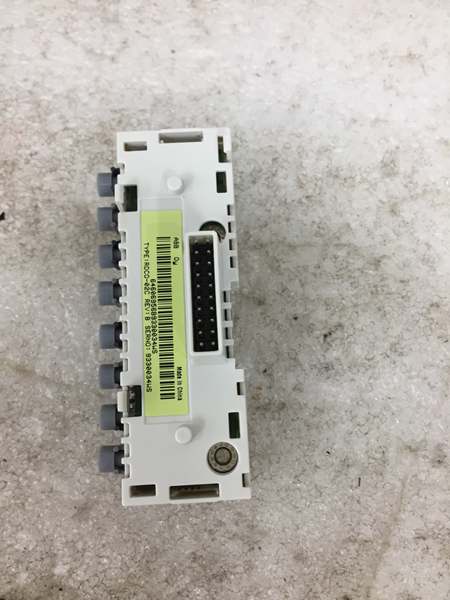
ABB RDCO-02
Technical Deep Dive & Overview
The ABB RDCO-02 is a dual-interface communication module engineered specifically for the ACS800 drive series, bridging the gap between industrial drives and plant control systems. At its core, a dedicated microprocessor handles two critical tasks: translating the drive’s internal DriveBus protocol to PROFIBUS DP for the PLC/DCS, and converting electrical PROFIBUS signals to optical signals for long-distance, noise-free transmission. The fiber optic port uses light pulses to send data, so it’s immune to EMI—this is the module’s biggest advantage over copper-only communication modules.
The module’s 2500V AC galvanic isolation protects the drive’s control board from voltage surges on the PROFIBUS network, a common issue in plants with unstable power grids. The hot-swap capability is enabled by a plug-and-play design that draws power from the drive’s internal 24VDC supply—no external power needed, and no drive shutdown required for replacement.
Unlike generic communication modules, the RDCO-02 integrates seamlessly with ABB’s DriveWindow software, letting technicians configure PROFIBUS parameters, monitor drive status, and troubleshoot faults remotely. The fiber optic port supports point-to-point connections between drives, or daisy-chaining multiple drives on a single fiber link—ideal for large plants with multiple drives spread across a site. Built with industrial-grade components, the RDCO-02 is rated for 15+ years of operation in harsh environments, making it a workhorse for heavy industrial drive communication.