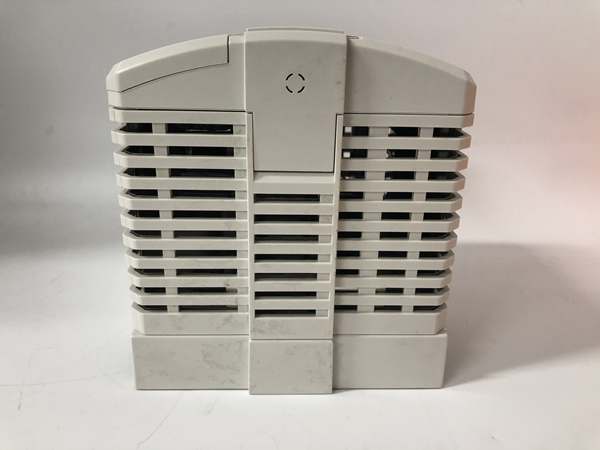
Description
Product Introduction
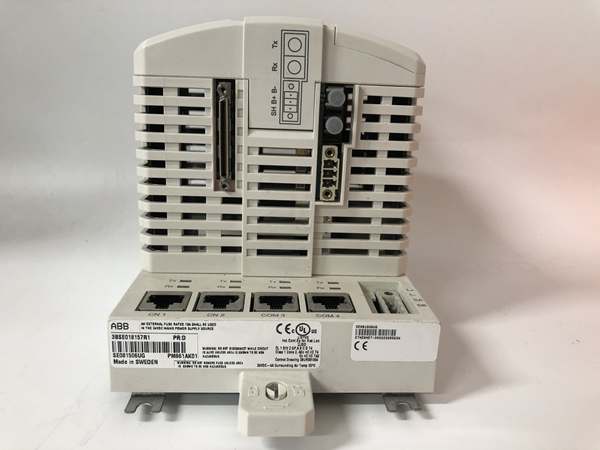
The is a central processing unit (CPU) belonging to ABB’s AC 800M controller family, serving as a core component in the System 800xA distributed control system (DCS). It is designed to execute complex control applications (Logic, PID, Sequential) and manage data exchange between field I/O modules and operator stations.
The “K01” suffix indicates this is typically supplied as a Kit, which includes the PM861A CPU board, the TP830 baseplate (DIN-rail mount), and necessary terminators (TB850, TB807, TB852). The “A” in AK01 often denotes hardware revision, and “K” implies it is prepared for or includes features beneficial for specific environments (like conformal coating readiness). It utilizes an MPC860 processor running at 48 MHz with 16 MB of RAM (approx. 7.15 MB user available) and 8 MB Flash for firmware/apps. Connectivity includes 2 Ethernet ports (CN1/CN2) for the control network and 2 RS-232 serial ports (COM3/COM4) .
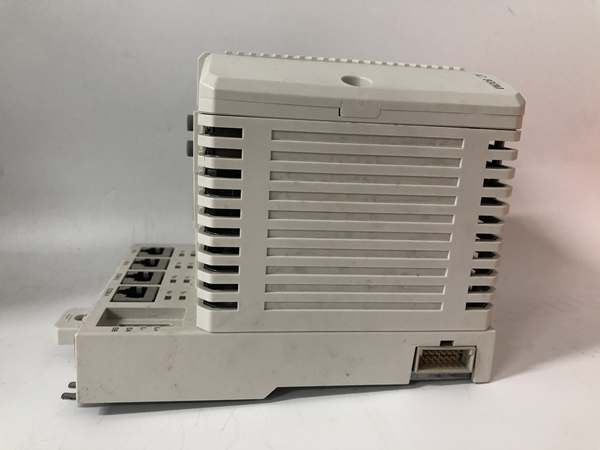
PM861AK01
Key Technical Specifications
- Processor: MPC860 (32-bit RISC), 48 MHz
- Memory (RAM): 16 MB Total (Approx. 7.15 MB for Applications)
- Flash Memory: 8 MB (Firmware & App Storage)
- Storage Expansion: CompactFlash (CF) Card Interface (for app backup/loading)
- Network Interfaces:
- CN1, CN2: 2 x RJ45 Ethernet (10 Mbit/s, Control Network)
- COM3: RS-232 (Modem signals, general use)
- COM4: RS-232 (Isolated, for Service/Config tools)
- Power Supply: 24 V DC (Range 19.2 – 30 V DC)
- Power Consumption: Typ. 6.0 W / Max 10.3 W
- Redundancy: Supports 1:1 CPU Redundancy (Pair with another PM861A unit via TK851/TK855 cables, <10ms switchover)
- Indicators: RUN, FAIL, Status LEDs, INIT Button
- Mounting: TP830 Baseplate (DIN Rail compatible)
- Temp Range: 0°C to +60°C (Operational, typical)
- Protection: IP20
- Kit Contents: PM861A CPU, TP830 Base, TB850 (CEX Term), TB807 (ModBus Term), TB852 (RCU Term), Battery
Quality Control Process (Engineer’s Perspective)
- Incoming Verification: Match (3BSE018157R1) to packing slip. Inspect the PM861A board for leaking batteries (common on aged units) or cracked capacitors. Check the TP830 baseplate for bent backplane pins.
- Bench Boot Test: Mount on DIN rail with 24V DC. Observe RUN LED. It should blink during boot, then steady. A solid FAIL LED with no display indicates corrupt Flash—requires CF card recovery.
- Port Check: Plug a laptop into CN1 (Ethernet). Link LED must illuminate. Test COM4 via serial cable; entering ‘
?‘ in terminal should return BIOS/Loader prompt. - Redundancy Sync Test: If pairing, connect two units via TK851 (RCU Link). Both should show “Active/Standby” status via LEDs once synchronized in a test rig.
- Final QC & Packaging: Ensure battery holder is secure. Pack kit components (CPU, Base, Terminators) in anti-static foam/bag. Label “QC Passed – Boot/Sync OK”.
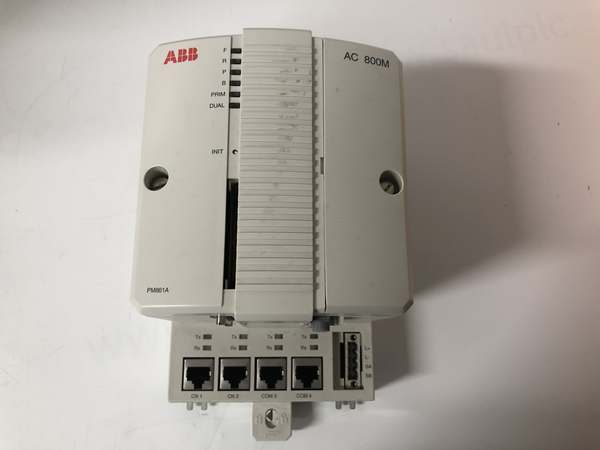
PM861AK01
Replacement Pitfall Guide
❗ Kit vs. Board Only: is a Kit (includes TP830 base). If you only need to replace a faulty CPU board in an existingrack, you might just need the PM861A (spare part) to snap into the existing base. Ordering the “K01” kit when you don’t need a new base wastes cost and requires transferring wiring.
❗ Firmware/Application Mismatch: The PM861A stores the OS and App in Flash/CF. Swapping hardware does not automatically restore the control program. You must either:
- Insert the old CompactFlash card into the new CPU (if compatible).
- Or Download the Application from Control Builder M / 800xA Engineering Workplace after installation.
Failure to do this results in “Empty Processor” and the plant won’t start.
❗ Redundancy Cabling (Critical): In a redundant pair (Primary/Backup), ensure the TK851 (RCU Link Cable) and TK855/TK856 (Data/Control Links) are correctly connected to bothCPUs. Swapping just one CPU but leaving old sync cables disconnected will cause the system to lose redundancy (run Simplex) or toggle alarms.
❗ Baseplate Compatibility: The “K01” kit comes with . This is for Single CPU or Redundant pairs on separate DIN rails. Do not confuse this with TP831 (for Compact units) or older bases. Ensure the physical footprint matches the panel cutout/wiring.
❗ Battery Risk: The has a Lithium battery (usually 3.6V/AA size) for RAM retention (setpoints/time). If this battery is dead (>3.0V is safe), replacing the CPU withouta CF card backup will result in loss of all retentive variables (e.g., totalizer counts, tuned parameters) upon power loss.
Keep these in mind and you’ll cut 90% of rework time.
Compatibility Matrix & Benchmarks
- → : Component Relationship— “K01” is the Kit containing the “A” board. Electrically identical; K01 is the procurement package.
- → ABB PM861AK02: Upgrade Path— “AK02” is the Redundant Kit (contains two CPUs prepped for redundancy). You can build redundancy with two “AK01” kits, but “AK02” is the factory paired set.
- → ABB AC 800M / 800xA: Direct— Core controller for S800 I/O (via ModuleBus) and CEX-Bus communication modules (CI854, CI871, etc.).
- → ABB PM866/PM867: Migration— Newer CPUs (PM866/67) offer faster clocks (100MHz+) and more RAM (64MB+), but require code re-compilation/validation in Control Builder.
- Task Cycle: 1 ms (Minimum, for fast logic)
- I/O Capacity: Up to 96 S800 I/O modules (Local Bus)
- Switchover Time: < 10 ms (Redundant CPU Failover)