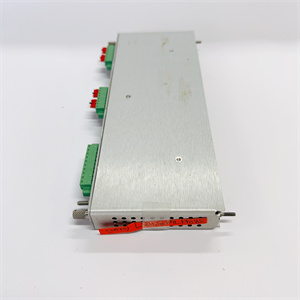
Description
Product Introduction
The ABB is a mid-range CPU module within the AC 800M family, designed for medium-complexity process control and automation tasks. It serves as the “brain” of the control node, executing control strategies (PID, Logic) and communicating with S800 I/O modules via the internal ModuleBus.
This unit () includes a TP830 baseplate with two RJ45 Ethernet ports and two serial ports. Notably, the PM851 series is a non-redundant controller (single unit), meaning it does not support hot-standby CPU pairing like the PM856 or PM866. It is a cost-effective choice for applications where full hardware redundancy is not critical .
Key Technical Specifications
| Parameter | Value |
|---|---|
| Order Code | 3BSE066485R1 |
| Processor | MPC860 (32-bit) |
| Clock Speed | 24 MHz |
| Memory (RAM) | 12 MB Total (Approx. 6.25 MB avail. for app) |
| Flash Storage | 2 MB (Firmware) + CompactFlash Support |
| Performance | 0.46 ms / 1000 boolean operations |
| Power Supply | 24 V DC (Range 19.2 – 30 V DC) |
| Power Dissipation | Typ. 4.32 W / Max 7.2 W |
| Ethernet Ports | 2 x RJ45 (CN1 Active, CN2 inactive/restricted) |
| Serial Ports | 2 x RJ45 (COM3: RS-232, COM4: Isolated Service) |
| Redundancy | Not Supported (Single CPU only) |
| Backup Battery | 3.6 V Lithium (Built-in, for RAM retention) |
| Mounting | DIN Rail (Slide & Lock mechanism) |
| Protection | IP20 |
Quality Control Process (Engineer’s Perspective)
- Incoming Verification: Verify the
3BSE066485R1label matches the laser-etched on the PCB. Check the TP830 baseplate Ethernet label for the unique MAC/Node address. Inspect RJ45 ports for bent pins. - Live Boot Test: Seat in a 24 Vdc powered rack. Monitor the “STAT” and “RUN” LEDs. It should pass self-test and reach “Run” mode (or “Idle” if no program loaded) within 30 seconds.
- Memory & Storage Check: Connect via Control Builder M. Verify the RAM allocation (should see ~6.25 MB free) and attempt a CompactFlash read/write test to ensure the slot contacts are good.
- I/O Bus Scan: Attach a dummy S800 I/O module (e.g., DI810) on the ModuleBus. The CPU must detect the unit ID without “Unit Failure” errors. Check 24V/5V rail stability with a Fluke.
- Final QC & Packaging: Check the battery status in software (should be >3.0V). Clean contacts. Wrap in ESD foam with desiccant. Label “QC Passed – Boot Test OK”.
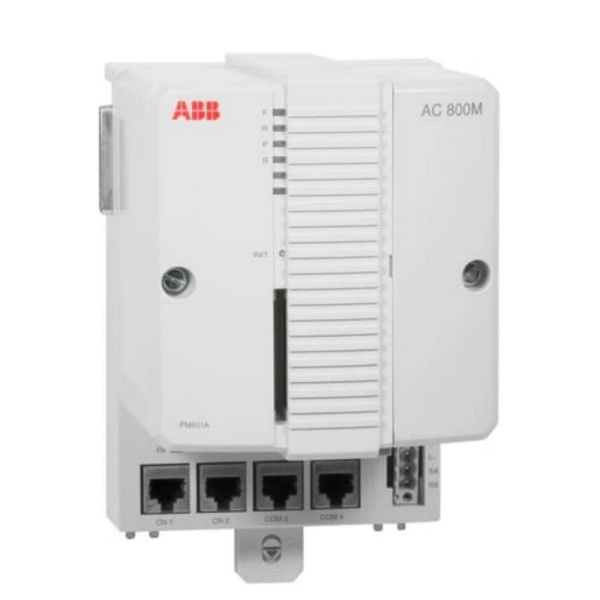
ABB PM851AK01
Replacement Pitfall Guide
❗ No Redundancy: The is Single (Non-Redundant). You cannot pair two of them for High Availability (as you would with PM856/PM866). If the CPU fails, the process stops until replaced. Ensure your HA strategy accounts for this.
❗ Ethernet Port Limit: While it has two RJ45s (CN1, CN2), the PM851 only actively uses CN1 for the Control Network. CN2 is restricted/inactive in this model. Do not design the network expecting dual-port teaming or redundant paths on a single PM851.
❗ Battery Backup: The internal 3.6V battery retains RAM data (retentive variables) during power loss. If replacing a faulty CPU, transfer the old CF card to the new unit. If the battery died, the RAM data is lost, and the controller will perform a “Cold Start” (may reset setpoints to zero).
❗ Baseplate Compatibility: implies it ships with the TP830 baseplate. Ensure your cabinet DIN rail has space for the combined height (CPU + Base: ~186mm). Mixing with older TP807 bases may require DIP switch re-settings.
❗ Firmware Alignment: The new module’s firmware version (e.g., v5.1 FP4) must match the Control Builder M project version. A mismatch causes a “Code/Config Mismatch” fault and prevents running.
Keep these in mind and you’ll cut 90% of rework time.
Compatibility Matrix & Benchmarks
- Upgrade — PM856 adds Redundancy support (Hardware/CPU level). Requires changing baseplates (TP830→TP831) and project config.
- Upgrade — Significant performance jump (100MHz+ vs 24MHz), adds Redundancy, more RAM. Requires new baseplate (TU8xx series) and project migration.
- Direct — Native ModuleBus communication.
- Boolean Speed: 0.46 ms / 1000 ops (Entry-Mid level performance)
- Task Cycle: Down to 1 ms (Minimum task interval)
- Event Resolution: < 1 ms (SOE – Sequence of Events)