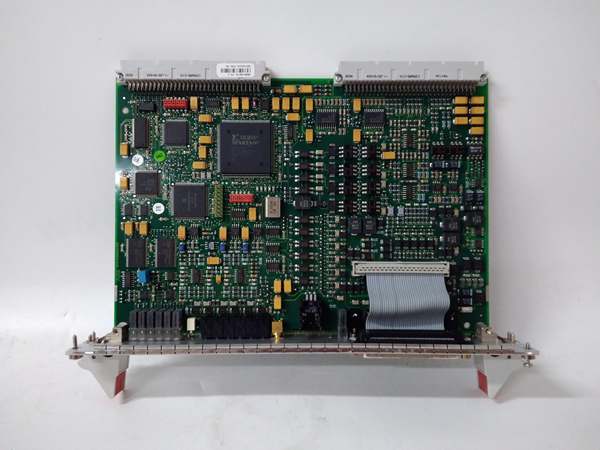
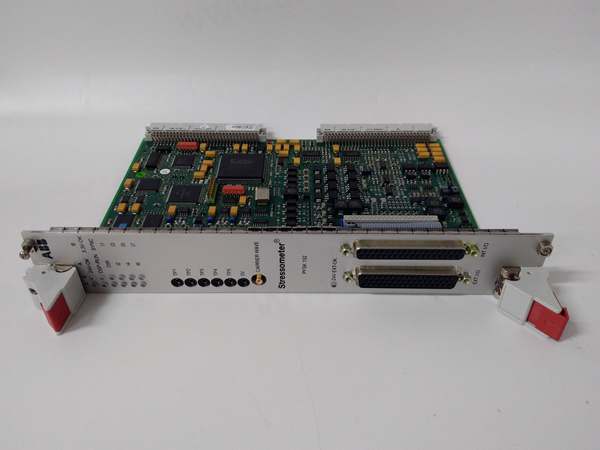
Description
Hard-Numbers: Technical Specifications
- Power Supply: 24V DC (±10%)
- Power Consumption: ≤8W nominal
- Processing Core: 32-bit ARM Cortex-R4F or equivalent industrial microcontroller
- Clock Speed: 200MHz
- Memory: 1MB Flash, 256KB RAM
- Signal Resolution: 16-bit
- Cycle Time: ≤0.5ms
- ESD Protection: 4kV
- Isolation Voltage: 3750V DC
- Operating Temperature: -25°C to +70°C
- Storage Temperature: -40°C to +85°C
- Humidity Range: 5% to 95% (non-condensing)
- Dimensions: 160mm × 100mm × 25mm
- Weight: 0.5 kg

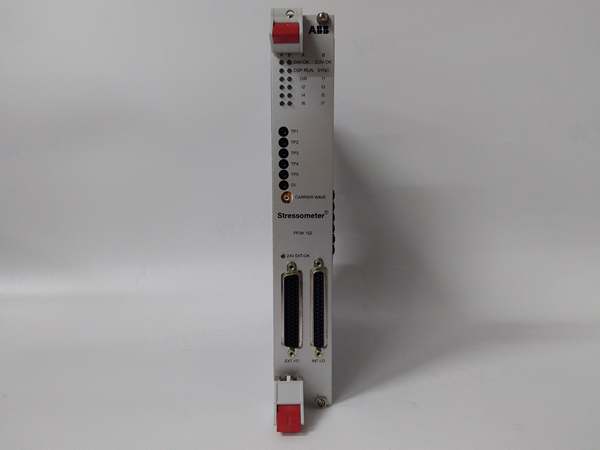
ABB PFSK152 3BSE018877R1
The Real-World Problem It Solves
Running individual signal cables from dozens of force measurement sensors to a central processor creates a wiring nightmare in rolling mill environments where cable trays are already packed with power conductors. The PFSK152 sits near the measurement array, aggregates multiple sensor signals onto a single communication link to the DSP-UP processor, reducing field wiring by consolidating signals at the source instead of pulling every conductor back to the control cabinet.
Where you’ll typically find it:
- Steel mill flatness measurement systems (Stressometer 6.0/7.0/8.0 FSA series)
- Aluminum rolling mills requiring tension and flatness feedback control
- Process lines where distributed force sensors feed a central processing unit
- Strip processing lines needing real-time measurement data aggregation
This board cuts your field installation time in half because you terminate sensor locally and run one bus cable instead of twenty individual shielded pairs.
Hardware Architecture & Under-the-Hood Logic
The PFSK152 functions as a front-end signal concentrator for the DSP-UP measurement processor. It doesn’t make control decisions—it samples, conditions, and multiplexes analog signals from measurement sensors into a digital stream that the DSP-UP can process. The board handles signal scaling, isolation, and communication timing so the main processor focuses on calculations.
Internal Signal Flow:
- Raw analog signals arrive from force measurement sensors via terminal block connections
- Input conditioning circuitry filters and amplifies signals to measurable levels
- 16-bit ADC converts analog signals to digital values at high sampling rate
- Microprocessor processes and buffers data in RAM with sub-millisecond cycle time
- Data packets are formatted according to DSP-UP (PLD 1.0/1) communication protocol
- Processed signals transmit via dedicated communication interface to DSP-UP processor
- Watchdog circuit monitors board health and signals fault if communication fails
- Feedback from DSP-UP can configure channel parameters dynamically during operation
ABB PFSK152 3BSE018877R1
Field Service Pitfalls: What Rookies Get Wrong
Skip the Shield Termination on Sensor Inputs
I’ve seen techs leave the shield drain wire floating on analog input channels “because it worked on the bench.” In a rolling mill with VFDs everywhere, that floating shield acts as an antenna and your force measurements drift all over the place. The DSP-UP processor compensates, but you’re introducing noise that masks real measurement issues.
Field Rule: Terminate the cable shield drain wire to the PE terminal block at the PFSK152, and only at the PFSK152—don’t ground both ends or you create ground loops. Use the specified shield clamp, not a wire nut shoved under a screw terminal.
Ignore the 24V Power Supply Ground Reference
Young engineers power the board from an isolated 24V supply without tying the 0V reference to cabinet ground. The PFSK152 works, but your analog measurements drift relative to ground potential variations in the mill. When a heavy motor starts, your flatness readings jump 15% even though nothing changed at the roll stack.
Quick Fix: Bond the negative terminal of your 24V DC supply to the cabinet ground rail at the power supply output. Use a star-washer on the bonding screw to bite into the metal. Verify ground continuity between the 24V return and the cabinet before you calibrate the system.
Mix Up the Sensor Input Wiring Order
The PFSK152 doesn’t auto-detect which sensor is on which channel—it assumes you wired them in the order you configured in the DSP-UP software. Techs swap two sensor cables and spend days wondering why “Channel 3 shows negative flatness” when the strip is actually bowed the other direction. The board reports exactly what it sees—garbage in, garbage out.
Quick Fix: Label every sensor cable at both ends during installation. Verify channel mapping with a known load (place a test weight on Sensor 1, confirm Channel 1 reads the expected value). Don’t rely on “the cable jacket color matches the diagram”—cable colors change between suppliers, but your labels don’t.
Forget the Isolation Barrier Rating
This board provides 3750V DC isolation, but techs treat it like a standard PLC input module. If you connect sensors from a high-voltage potential zone without proper isolation, you can breach that rating and fry the board—or worse, put fault current back into the measurement system.
Quick Fix: Verify that any sensors powered from different sources have their own isolation barriers. If you’re connecting to sensors on a drive output cabinet, use isolation amplifiers or check that the sensor manufacturer provides adequate isolation. Never assume “it’s just a 4-20mA signal, so it’s safe” when the sensor reference sits at 480V AC potential.
Commercial Availability & Pricing Note
Please note: The listed price is for reference only and is not binding. Final pricing and terms are subject to negotiation based on current market conditions and availability.