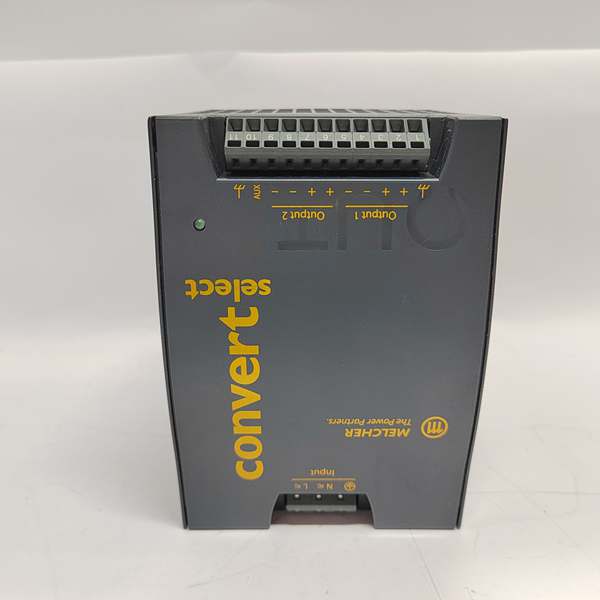
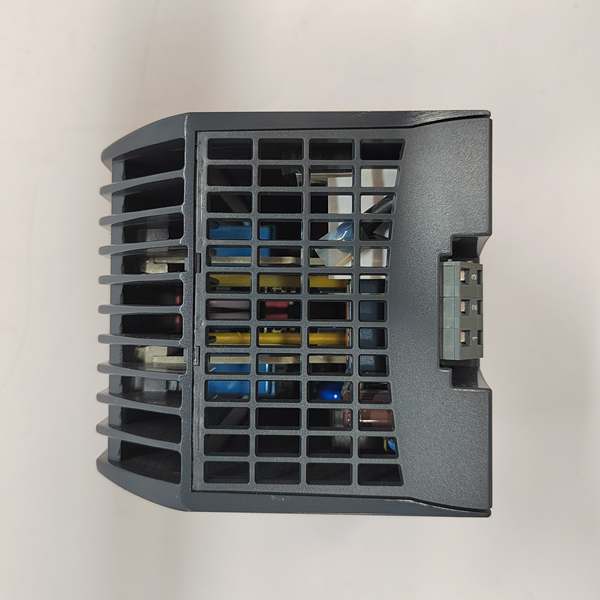
Description
Key Technical Specifications
-
Model Number: LWN2660-6E 3BHL000986P7000
-
Manufacturer: ABB Process Automation
-
Port Configuration: 6 x 10/100/1000 Mbps auto-sensing Ethernet ports (RJ45)
-
Switching Capacity: 12 Gbps
-
Forwarding Rate: 8.9 Mpps
-
Redundancy Protocols: Rapid Spanning Tree Protocol (RSTP, IEC 61158), STP, Link Aggregation (LACP)
-
Industrial Protocols: PROFINET RT/IRT, Modbus TCP/IP, DNP3.0 over Ethernet
-
Power Supply: 24VDC ±20% (dual redundant inputs; 0.5A max per input)
-
Operating Temperature: -40°C to +70°C (-40°F to +158°F)
-
Storage Temperature: -40°C to +85°C (-40°F to +185°F)
-
Shock & Vibration: IEC 60068-2-27 (50g shock), IEC 60068-2-6 (10g vibration)
-
Isolation Rating: 1500V AC (power inputs to Ethernet ports)
-
Certifications: UL 508, CE, ATEX Zone 2, IECEx
-
Mounting: DIN-rail mount (EN 50022) or panel mount

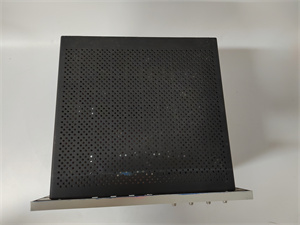
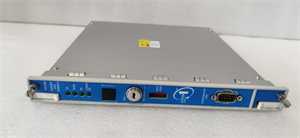
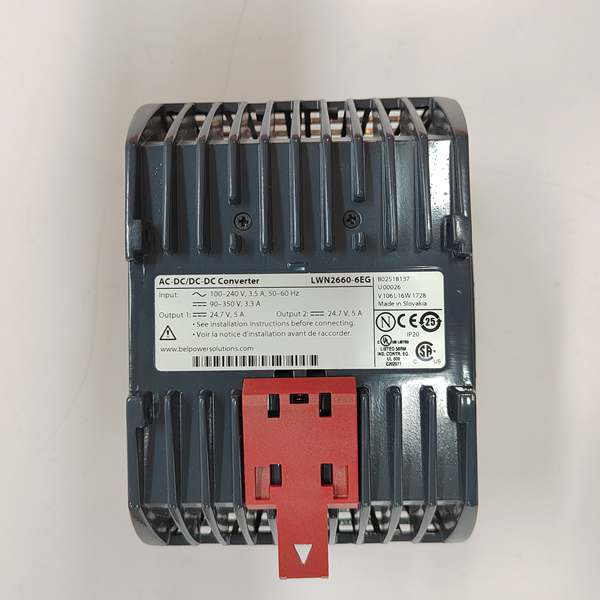
ABB LWN2660-6E 3BHL000986P7000
Field Application & Problem Solved
In legacy Advant OCS DCS environments—common in refineries and power plants built in the 1990s and 2000s—industrial Ethernet switches face two fatal flaws: poor tolerance to harsh conditions and lack of rapid redundancy. Generic commercial switches fail within 6-12 months in turbine halls, where temperatures swing from -10°C to +65°C and vibration is constant. Worse, traditional STP-based switches take 30+ seconds to recover from a cable break—long enough for the DCS to lose communication with critical I/O, triggering a unit shutdown that costs $500k+ per hour.
The LWN2660-6E solves both issues. It’s the backbone of Advant OCS communication networks, typically deployed in control cabinets near process skids to connect I/O modules, controllers, and HMIs. I’ve used it in a North Sea offshore platform where ambient temperatures drop to -35°C—generic switches failed weekly, but this unit ran for 5 years without a glitch. Its RSTP support cuts network recovery time to <1 second; during a recent cable damage incident at a California refinery, the switch rerouted traffic in 800ms, and the DCS never missed a control signal.
Its core value is rugged reliability paired with industrial protocol compatibility. For a Louisiana petrochemical plant upgrading from legacy RS-485 networks to Ethernet, this switch was non-negotiable—it handles PROFINET IRT traffic for high-speed valve control while supporting Modbus TCP for legacy flow meters. The dual power inputs are another lifesaver; in plants with unstable 24VDC supplies, switching to the redundant power feed prevents unexpected switch downtime. Unlike commercial switches, it doesn’t require fan cooling—critical for dusty cement plant control cabinets where fans clog and fail.
Installation & Maintenance Pitfalls (Expert Tips)
RSTP Configuration Requires Consistent Priority Settings: Rookies set random priority values (0-61440) on switches in a ring, causing RSTP to elect the wrong root bridge and create forwarding loops. All switches in the network must have a clear priority hierarchy—set the core switch to priority 0 (root bridge), distribution switches to 4096, and edge switches to 8192. Use ABB’s Network Manager software to visualize the ring; a forwarding loop will show 100% port utilization and packet loss. I fixed a Texas power plant’s network outage by reconfiguring priority settings—this is the #1 mistake with RSTP.
Dual Power Inputs Must Come From Separate Sources: The switch has two power inputs, but rookies connect both to the same 24VDC supply. If that supply fails, the switch goes down—defeating redundancy. Connect Input 1 to the main control cabinet power and Input 2 to a dedicated UPS or backup supply. At a refinery, I once saw both inputs connected to the same feed; a blown fuse took down 12 I/O racks. Separate sources cost $200 in wiring but prevent $1M+ downtime.
PROFINET IRT Requires Strict Cable Length Limits: For PROFINET IRT (isochronous real-time) traffic—used for high-speed control like turbine speed regulation—cable length between switches must not exceed 100 meters. Rookies run 150-meter cables, causing signal degradation and IRT cycle violations. Use shielded Cat6A cable for PROFINET, and test with a cable analyzer to verify impedance (100Ω ±20%) and attenuation. If you need longer runs, add a mid-span switch—don’t stretch the cable.
Ignoring Port Mirroring Risks Blind Troubleshooting: When network faults occur (e.g., intermittent Modbus timeouts), you need to capture packet data. Rookies don’t configure port mirroring, leaving them guessing what’s causing the issue. Mirror the port connected to the problematic I/O module to a spare port, then connect a laptop with Wireshark. This lets you see if the switch is sending/receiving packets or if the fault is in the I/O. I used this to diagnose a faulty sensor that was flooding the network with bad data—saved 8 hours of troubleshooting.
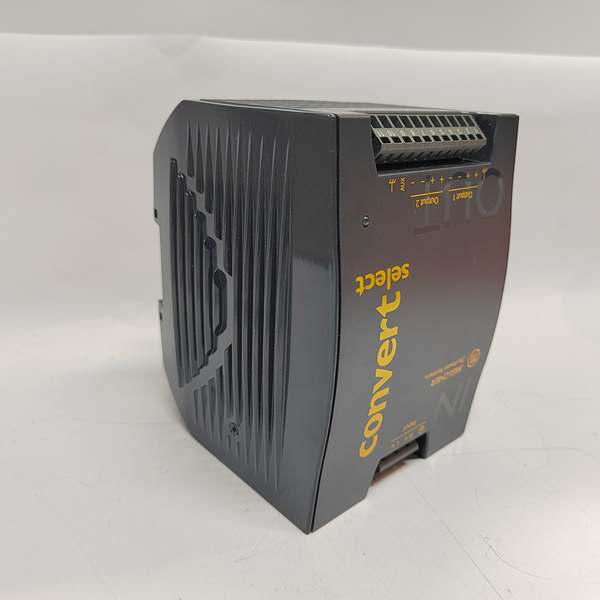
ABB LWN2660-6E 3BHL000986P7000
Technical Deep Dive & Overview
The ABB LWN2660-6E 3BHL000986P7000 is a managed industrial Ethernet switch built specifically for Advant OCS DCS, optimized for harsh process environments. At its core is a 32-bit ARM processor that handles switching logic and protocol processing, with dedicated hardware for PROFINET IRT to ensure deterministic real-time communication (cycle times as low as 1ms). The 12 Gbps switching capacity ensures no bottlenecks, even when all 6 ports are running at 1Gbps.
Its rugged design sets it apart from commercial switches: a fanless aluminum housing dissipates heat without moving parts, and the circuit board uses conformal coating to resist dust and moisture. The dual power inputs feed separate power supplies inside the switch; if one fails, the other takes over in <10ms with no packet loss. RSTP works by continuously monitoring port status—if a link fails, it calculates the shortest alternate path and updates the forwarding table in milliseconds, far faster than legacy STP.
For PROFINET, the switch supports both RT (real-time) and IRT modes. RT uses priority tagging to ensure control traffic gets precedence, while IRT uses time-division multiplexing to reserve bandwidth for critical signals—critical for applications like CNC machines or turbine control where jitter must be <1µs. The switch also integrates with ABB’s System 800xA for centralized management, letting technicians configure settings, monitor port status, and receive alarms from a single HMI.
This switch isn’t flashy, but it’s indispensable for Advant OCS users. It’s built to outlast the DCS itself—many units I installed 10 years ago are still running. The key to its longevity is simplicity: no unnecessary features, just reliable switching, redundancy, and protocol support. In the field, it’s the kind of component you install and forget about—until a generic switch fails, and you’re glad you chose industrial-grade.