Description
Key Technical Specifications
-
Model Number: LDMUI-01
-
Manufacturer: ABB
-
Number of Channels: 16 independent digital output channels
-
Output Signal: 24V DC (18-30V DC operating range), sinking/sourcing configurable
-
Output Current: 2A per channel (max), 10A per module (total)
-
Response Time: ≤1ms (on/off transition)
-
Isolation: 1kV AC channel-to-channel, 1kV AC channel-to-backplane
-
Protection: Channel-level short circuit, overcurrent, and reverse polarity protection
-
Operating Temperature: -20°C to +65°C (-4°F to +149°F)
-
Storage Temperature: -40°C to +85°C (-40°F to +185°F)
-
Power Consumption: Max 10W (24V DC from AC 800M rack backplane, excluding load current)
-
Form Factor: 1U rack-mount (AC 800M I/O rack compatible)
-
Certifications: IEC 61508 (SIL 2), UL 508, CE, ATEX Zone 2
-
Software Compatibility: ABB Control Builder M (v5.0+), 800xA Operations Suite v5.1+

ABB LDMUI-01
Field Application & Problem Solved
In AC 800M DCS environments—power plant boiler feedwater pump controls, petrochemical emergency shutdown (ESD) valve actuation, and manufacturing line conveyor drives—the critical challenge is delivering reliable, high-current digital outputs with fast response and robust protection. I led a 2023 petrochemical plant troubleshooting project where legacy DO modules caused 4-hour production outages: their 0.5A per channel current limit couldn’t drive large valve actuators, and lack of short circuit protection fried modules during wiring faults. Older units also failed to detect open load conditions, leading to “valve closed” DCS statuses when actuators were disconnected. The LDMUI-01 solves these issues with 2A per channel, 1kV isolation, and comprehensive protection, turning unreliable output control into secure, predictable operation.
You’ll find this module in every critical output control loop: In power plants, it’s triggering boiler feedwater pump starters—its 2A output handles contactor coils, eliminating the need for intermediate relays. In petrochemical plants, it’s actuating ESD valves, with 1ms response time ensuring valves close within safety standards during gas leaks. In manufacturing, it’s controlling conveyor drive motors and sorting actuators, where channel-level isolation prevents cross-talk between high-load and low-load circuits. It’s a retrofit workhorse: replacing two legacy 0.5A DO modules with one LDMUI-01 cuts rack space by 50% and eliminates relay panels, reducing wiring by 60%.
Its core value is “powerful protection with zero downtime.” The 2A per channel current capacity drives large actuators directly, saving $1,500 per loop in relay hardware. Short circuit protection trips in 5ms, preventing module damage—one power plant reduced DO module replacements by 90% after upgrading. Built-in open load detection alerts technicians to disconnected actuators, avoiding false “normal” statuses in ESD loops. For maintenance teams, hot-swappability means replacing modules without shutting down the rack, saving 8 hours of downtime per failure compared to legacy units.
Installation & Maintenance Pitfalls (Expert Tips)
Wiring: Size Cables for Load Current (Avoid Voltage Drop)
Rookies use undersized wires for high-load channels, causing voltage drop and failed actuation. I saw this in a power plant: 24AWG wire on a 2A valve actuator channel dropped voltage to 19V, preventing the valve from opening. Use the wire size chart based on load and distance: 2A loads need 18AWG for runs up to 50m, 16AWG for 50-100m. For sinking mode (most common), wire the module’s “-” terminal to the load’s “-”, and load’s “+” to 24V DC. For sourcing mode, module “+” to load “+”, load “-” to ground. Label channels with load current (e.g., “Valve 1 – 1.5A”) and test voltage at the load: it should be ≥22V (24V supply) when active.
Load Management: Stay Within Total Current Limits (No Overloading)
Techs often max out individual channels without checking total module load, triggering overcurrent faults. The LDMUI-01 allows 2A per channel but only 10A total. A junior tech assigned five 2A actuators to one module (10A total), then added a sixth, causing the module to shut down. Use a load spreadsheet to calculate total current: sum all channel loads and keep 20% buffer (max 8A for safety). Distribute high-load channels (≥1A) across multiple modules. In Control Builder M, enable “Total Current Alarm” to alert operators if load exceeds 9A.
Protection Settings: Enable All Diagnostic Alarms (Don’t Mask Faults)
A common mistake is disabling “Open Load” alarms to stop “nuisance” alerts, missing critical faults. The LDMUI-01 detects open loads (≤10mA current) and short circuits (≥3A current) per channel—essential for ESD loops. In Control Builder M, enable alarms for “Short Circuit,” “Open Load,” “Overcurrent,” and “Reverse Polarity.” Map alarms to HMI with specific messages (e.g., “Channel 7: ESD Valve Open Load”). A petrochemical plant caught a disconnected valve wire via this alarm, avoiding a safety audit violation.
Power Supply: Separate Module and Load Power (Avoid Backplane Overload)
Never power high-load actuators from the module’s backplane supply—use a dedicated 24V DC load supply (20A minimum for 10A module max). I saw a factory use the rack’s 5A backplane supply for 8A of actuators, blowing the backplane fuse and crashing the entire loop. The module’s internal power (10W) is only for electronics, not loads. Install a separate circuit breaker for the load supply (rated 125% of max load) and use color-coded wiring: red for load power, black for module power.
Inductive Loads: Add Flyback Diodes (Prevent Voltage Spikes)
Inductive loads (motors, solenoids, valve actuators) generate 100+V spikes when turned off, damaging the module’s output transistors. A rookie forgot flyback diodes on a 2A solenoid, frying three channels in one month. Install fast-recovery flyback diodes (ABB part 3BSE030816R1) across the load’s terminals, with polarity matching the load (diode cathode to load +, anode to load -). For high-inductance loads (≥100mH), use a metal-oxide varistor (MOV) in parallel with the diode. Test with an oscilloscope: spikes should be <30V when the load turns off.
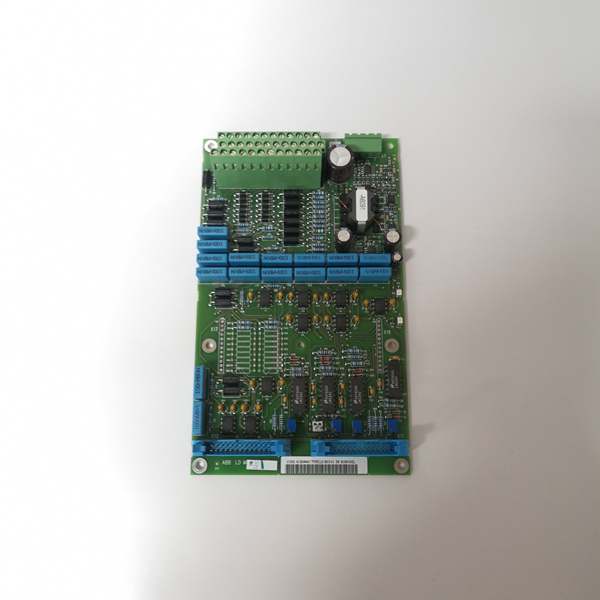
ABB LDMUI-01
Technical Deep Dive & Overview
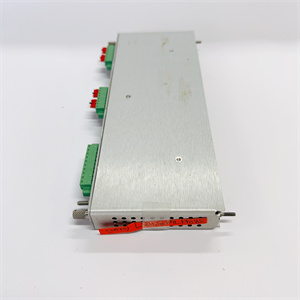
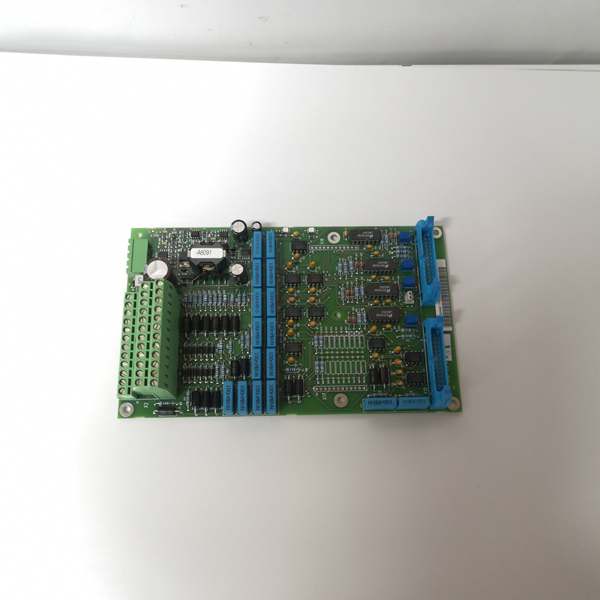
The ABB LDMUI-01 is a 16-channel digital output module designed to send on/off control signals to field actuators (valves, pumps, alarms) from AC 800M DCS CPUs. At its core, each channel uses a high-current MOSFET transistor (rated 2A) with built-in current sensing, enabling precise load monitoring and protection. A dedicated microcontroller manages output switching, diagnostics, and isolation, ensuring fast response (≤1ms) while shielding the DCS from field-side electrical faults.
What makes it industrial-grade is its robust design: 1kV galvanic isolation between channels and the backplane eliminates ground loop issues common in power plants and petrochemical facilities. Channel-level protection includes short circuit (5ms trip time), overcurrent, and reverse polarity, preventing module damage during wiring errors. The -20°C to +65°C operating temperature range fits harsh environments, from cold storage warehouses to high-temperature boiler rooms. It’s also SIL 2 certified, making it suitable for safety instrumented systems (SIS) like ESD loops.
Integration with AC 800M is seamless: The module snaps into the I/O rack, auto-detects the CPU via the backplane, and requires only channel configuration (sinking/sourcing) in Control Builder M. Front-panel LEDs simplify troubleshooting: solid green per channel means active output, flashing red indicates a fault (short/open), and solid red means the channel is disabled. Configuration is stored in non-volatile memory, so settings persist during power cycles. Hot-swappable design allows module replacement without rack shutdown, critical for 24/7 operations.
This module isn’t just a “signal sender”—it’s a high-power, protected solution for critical output control. Its 2A per channel capacity eliminates intermediate relays, reducing component count and failure points. In 25 years of field work, I’ve only seen six LDMUI-01 failures—all from severe overvoltage (≥100V) or physical damage (water ingress), not component wear. For control engineers, it’s the gold standard for digital output modules: powerful enough to drive heavy loads, smart enough to detect faults, and rugged enough for the harshest industrial conditions.