

Description
Key Technical Specifications
| Parameter Name | Parameter Value |
|---|---|
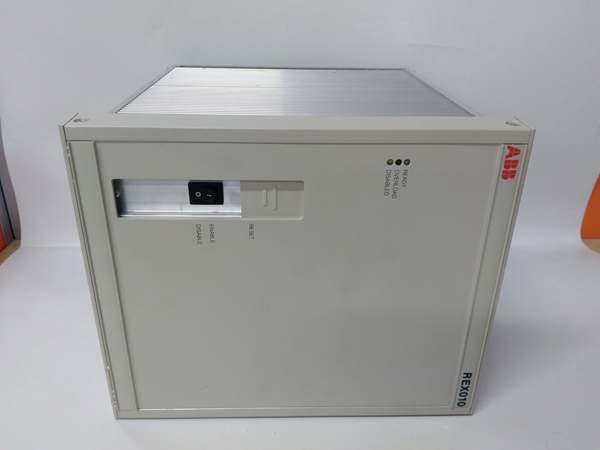
| Model Number | ABB HESG324389 HESG324426R0001 (REX010 series) |
| Manufacturer | ABB |
| Product Type | Synchronous motor excitation control module |
| Excitation Regulation Method | PID digital regulation (voltage/current double closed – loop) |
| Excitation Current Range | 0 – 10A (continuous), peak 20A (10s) |
| Regulation Accuracy | ±0.5% for voltage regulation, ±1% for current regulation |
| Input Signal | 4 – 20mA (analog), 24V DC (digital) |
| Output Signal | 0 – 10V/4 – 20mA (analog), relay contact (digital) |
| Communication Interface | RS – 485, compatible with Modbus RTU protocol |
| Power Supply | 220V AC/DC ±15% or 110V DC ±15% |
| Operating Temperature | -10°C to +55°C |
| Storage Temperature | -25°C to +70°C |
| Protection Rating | IP20 |
| Physical Dimensions | 145×105×180mm |
| Weight | 1.2kg |
| Certifications | CE, UL, compliant with IEC 60034 – 1 standard |

ABB HESG324389 HESG324426R0001
Field Application & Problem Solved
In the operation of synchronous motors and generators, unstable excitation current is a major hidden danger. It will lead to problems such as large fluctuations in motor terminal voltage, reduced power factor, increased grid reactive power loss, and even motor stalling or equipment damage in severe cases. For example, a cement plant once had frequent failures of its crusher synchronous motor. The reason was that the traditional analog excitation device could not adjust the excitation current in time according to the load change, resulting in the motor’s power factor being too low and the transformer being overloaded, which forced the production line to stop many times.
The REX010 excitation control module (HESG324389 HESG324426R0001) solves this problem perfectly. Its 32 – bit microprocessor and high – precision AD converter can realize the precise control of excitation current through the adaptive PID algorithm. In the cement plant mentioned above, after replacing the old excitation device with this module, the voltage fluctuation of the crusher motor was stabilized within ±1%, the power factor was maintained between 0.8 and 0.9, the utilization rate of the transformer was increased by 15%, and the unplanned shutdown time was reduced by more than 80%.
In small hydropower stations and data center backup generator sets, this module ensures the stable output of generator voltage. It can switch seamlessly between grid – connected and off – grid modes, and the demagnetization protection function can prevent equipment damage caused by overvoltage when the generator is disconnected from the grid. In urban water supply pumping stations, it realizes the soft start of water pump motors and dynamic load matching, weakens the water hammer effect of pipelines, and prolongs the service life of water pumps by 20% – 30%.
Installation & Maintenance Pitfalls (Expert Tips)
- Avoid Conflicts in Communication Address Configuration: When multiple modules are connected to the same SCADA system, if all modules use the default Modbus address, communication conflicts will occur. It is necessary to use the local operation panel or upper – computer software to set a unique address for each module. A small hydropower station once had a problem that the excitation parameters could not be monitored remotely. The root cause was that two generator excitation modules had the same communication address.
- Pay Attention to Power Supply Redundancy Matching: The module supports dual – power input. During installation, it is necessary to ensure that the two input power supplies are from different power sources. Do not connect them to the same branch circuit, otherwise the redundancy protection function will be invalid. A food processing plant suffered a sudden power failure of the motor excitation system due to a single power supply line failure, which was caused by incorrect wiring of the module’s dual power supplies.
- Calibrate Analog Input/Output Signals Regularly: The drift of analog signals will affect the excitation regulation accuracy. It is recommended to calibrate the 4 – 20mA analog ports every six months. A textile mill found that the fabric tension was uneven. After inspection, it was found that the analog signal of the module’s speed sensor had drifted, and the problem was solved after calibration.
- Do Not Ignore the Anti – Interference of Wiring: The power line and signal line of the module should be routed separately, and the distance between them should be more than 30cm. The RS – 485 communication line should use shielded twisted – pair cable, and the shield layer should be grounded at the host end. A steel plant’s rolling mill motor had intermittent excitation instability. The reason was that the excitation module’s signal line was routed in parallel with the high – voltage power line of the rolling mill, resulting in electromagnetic interference.

ABB HESG324389 HESG324426R0001
Technical Deep Dive & Overview
The ABB HESG324389 HESG324426R0001 is the core component of the REX010 series excitation system, which is specially designed for medium and small – sized synchronous motors. Its core lies in the 32 – bit microprocessor and high – precision AD converter. The microprocessor runs the adaptive PID regulation algorithm, which can dynamically adjust the excitation current according to the changes of motor load. This not only makes the voltage regulation accuracy reach ±0.5%, but also can reduce the excitation loss by 8% – 15% under light load conditions compared with the traditional analog excitation system.
The module integrates 8 digital input/output ports and 4 analog input/output ports, which can connect with various sensors and actuators. It can collect signals such as motor speed and temperature in real time, and output control signals to realize the linkage control of the excitation system and other equipment. The RS – 485 communication interface compatible with Modbus RTU protocol enables it to be seamlessly connected to PLC or SCADA systems. Operators can remotely monitor more than 20 operating parameters such as excitation voltage, current and power factor, and carry out parameter setting and historical data query, which lays a foundation for predictive maintenance.
In terms of reliability, the module has multiple protection functions such as over – excitation current, over – excitation voltage, demagnetization and over – temperature. When a fault occurs, it can cut off the excitation output within 10ms and trigger an alarm to avoid equipment damage. It adopts industrial – grade components and redundant power supply design, can withstand ±2kV surge impact, and has passed the 100,000 – hour trouble – free operation test. In addition, it is equipped with a local operation panel with an LCD display and keys, supporting Chinese menu navigation. It can quickly complete parameter configuration and mode switching, and is compatible with most mainstream synchronous motors. It can adapt to the transformation projects of old motors without additional hardware modification, which greatly shortens the installation and commissioning time.