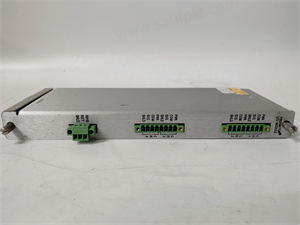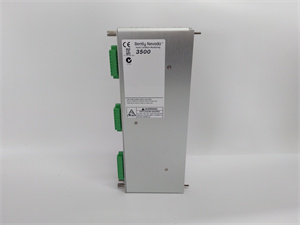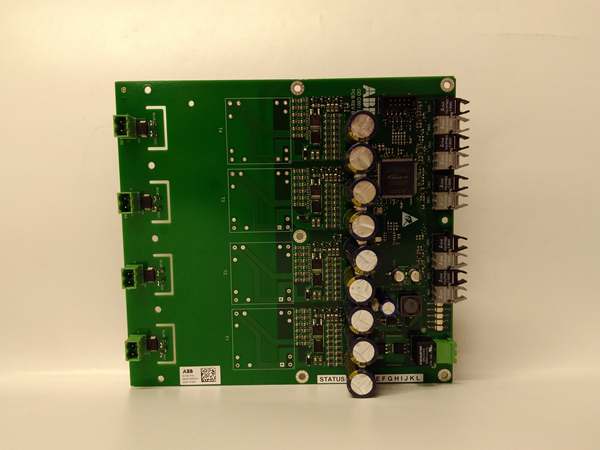
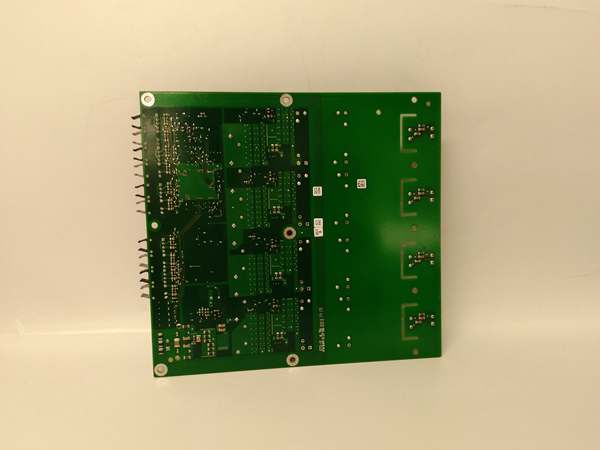
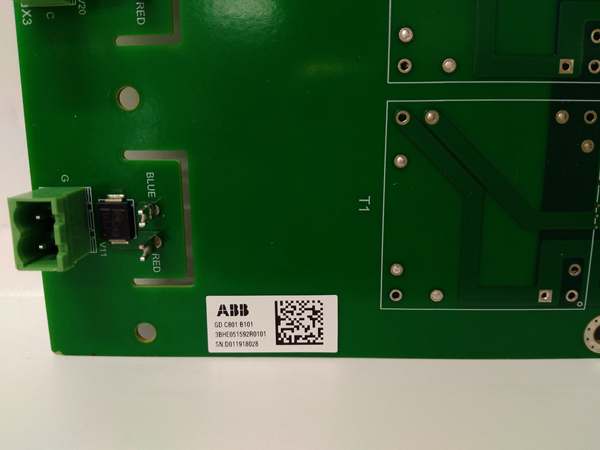
Description
Key Technical Specifications
- Model Number: ABB GDC801B101
- Manufacturer: ABB
- Module Type: Digital generator excitation controller
- Control Mode: Voltage regulation, field current control, power factor control (selectable)
- Input Voltage Range: 110-220V DC (power supply)
- Field Current Range: 0-1000A (via external power stage)
- Voltage Regulation Accuracy: ±0.2% of rated voltage
- Response Time: ≤10ms (field current step response)
- Operating Temperature: -20°C to 70°C (-4°F to 158°F)
- Storage Temperature: -40°C to 85°C (-40°F to 185°F)
- Isolation: 2kV AC (control circuit to power circuit, 1-minute withstand)
- Communication Protocols: MODBUS RTU, IEC 61850, DNP3.0
- Mounting: Panel mounting (DIN rail compatible with adapter)
- Power Consumption: 35W (max load)
- Dimensions: 210mm x 170mm x 80mm
- Weight: 1.8kg
- Protection Features: Overexcitation protection, underexcitation limiter, overvoltage/overcurrent trip

GDC801B101
Field Application & Problem Solved
In power generation—utility power plants, industrial cogeneration systems, and backup generator sets—synchronous generators rely on stable excitation to maintain voltage output and grid compatibility. The challenge? Legacy analog excitation controllers lack precision, struggle with grid code compliance (e.g., fault ride-through), and can’t integrate with modern digital control systems. Others have slow response times, causing voltage fluctuations during load changes or grid disturbances—leading to generator tripping or grid instability. The ABB GDC801B101 solves these critical issues with digital precision, fast response, and grid-compliant control logic.
You’ll find this module in applications like regulating excitation for 1-50MW synchronous generators in natural gas-fired power plants, maintaining voltage stability for backup generators in data centers, or controlling cogeneration units in chemical plants. It’s a core component in ABB’s generator control systems, where it works alongside rectifier modules (e.g., GFD series) to deliver controlled DC power to the generator’s rotor field. In grid-connected systems, it ensures compliance with IEC 61000 and NERC standards—critical for avoiding penalties for voltage deviations. For isolated generator sets (e.g., mining sites), it provides tight voltage regulation to protect sensitive equipment from power surges.
Its core value is reliability and grid compliance. The digital control architecture eliminates drift common in analog controllers, ensuring consistent voltage regulation (±0.2% accuracy) across load ranges. The fast 10ms response time mitigates voltage dips during sudden load increases or grid faults, preventing generator tripping. Built-in overexcitation/underexcitation limiters protect the generator from thermal damage, while integration with IEC 61850 allows seamless communication with plant SCADA systems. For operators, this means reduced downtime, compliance with grid codes, and simplified remote monitoring—critical in 24/7 power generation environments.
Installation & Maintenance Pitfalls (Expert Tips)
- Power Supply Polarity (Reverse Wiring = Instant Damage): The module’s 110-220V DC power supply has strict polarity requirements, but rookies often mix positive and negative terminals. Reverse wiring fries the internal power module, rendering the controller inoperable. Always use a multimeter to confirm polarity before connecting—red lead to positive (+), black to negative (-)—and double-check against the wiring diagram. Never rely on wire color alone (site wiring may not follow standards).
- Control Mode Configuration (Mismatch = Instability): The GDC801B101 supports three control modes (voltage regulation, field current control, power factor control), but rookies often leave it in default mode (voltage regulation) regardless of the application. For grid-connected generators, power factor control is required to meet grid code; for isolated sets, voltage regulation is ideal. Use ABB’s Control Panel or PC software to select the correct mode, and configure setpoints (e.g., target voltage, power factor) to match the generator’s rated parameters. A mismatched mode causes erratic voltage or current output.
- Analog Input Calibration (Skipping = Inaccurate Control): The module’s analog inputs (for voltage transducers, current transformers) require calibration to match the generator’s CT/VT ratios, but rookies often skip this step. Incorrect calibration leads to misreadings—e.g., the controller thinks the generator voltage is low when it’s actually normal, causing overexcitation. After wiring, use the module’s built-in calibration tool to zero and span the inputs, using a precision signal generator to simulate CT/VT outputs. Verify calibration with a handheld multimeter at multiple points (25%, 50%, 100% of rated value).
- Communication Protocol Conflicts (Duplicate Addresses = No Data): When integrating with SCADA via MODBUS or IEC 61850, rookies often assign duplicate communication addresses to the module. This causes data collisions, leading to lost telemetry or incorrect control commands. Assign a unique address (1-247 for MODBUS) and ensure baud rate (9600-19200 bps) and parity settings match the SCADA master. Test communication with a MODBUS scanner before commissioning to confirm data is transmitted/received correctly.
GDC801B101
Technical Deep Dive & Overview
The ABB GDC801B101 is a digital excitation controller designed to regulate the rotor field current of synchronous generators, ensuring stable voltage output and compliance with grid standards. Its core is a 32-bit ARM-based microprocessor that executes control algorithms at 1kHz—enabling the fast 10ms response time critical for handling load transients and grid faults. The module uses a closed-loop control system: it samples generator terminal voltage (via voltage transformers) and field current (via current transducers), compares these values to user-configured setpoints, and adjusts the output to the rectifier module (e.g., GFD series) to maintain stability.
The module’s power supply is a ruggedized switch-mode design that accepts 110-220V DC, with built-in surge protection (up to 2kV) to withstand voltage transients common in power plant environments. Internal isolation (2kV AC) separates the low-voltage control circuits from the high-voltage power circuits, preventing ground loops and ensuring operator safety. The control logic includes adaptive PID algorithms that auto-tune based on load conditions, eliminating the need for manual parameter adjustments during operation.
Communication is handled via a dedicated Ethernet port (for IEC 61850/DNP3.0) and a serial port (for MODBUS RTU), allowing integration with both modern and legacy SCADA systems. The module stores critical fault data (e.g., overexcitation events, voltage dips) in non-volatile memory, enabling post-fault analysis. A front-panel LCD and keypad provide local access to setpoints, diagnostics, and calibration tools—eliminating the need for a PC during basic configuration.
Built for industrial ruggedness, the GDC801B101 features a metal housing with IP54 protection, shielding against dust and water spray. It withstands vibration (up to 5g at 10-2000Hz) and temperature extremes (-20°C to 70°C), making it suitable for harsh power plant environments. The module’s hot-swappable design (when used with ABB’s excitation skid) allows replacement without shutting down the generator—though strict lockout-tagout procedures are required due to high-voltage connections. Its long service life (15 years typical) aligns with generator maintenance intervals, reducing lifecycle costs and downtime.