Description
Key Technical Specifications
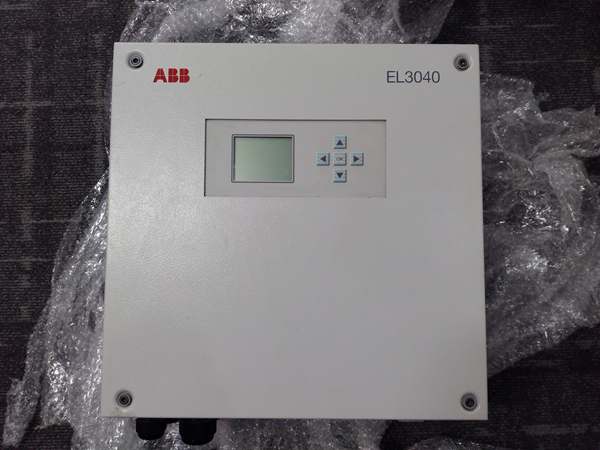
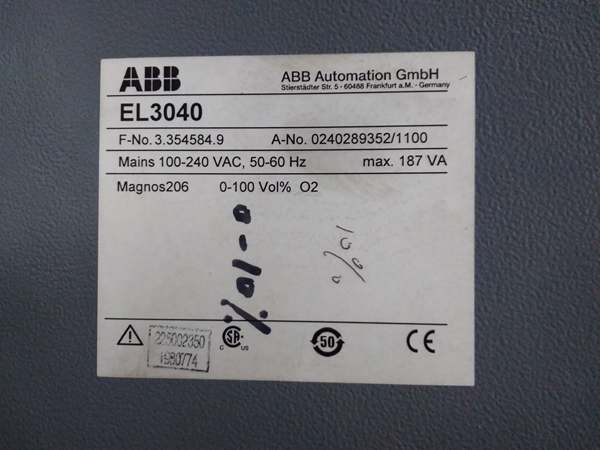
- Model Number: ABB EL3040
- Manufacturer: ABB
- Input Type: Universal (4-20mA current, RTD [Pt100/Pt1000/Ni100], 0-10V DC/±10V DC voltage)
- Number of Channels: 4 (individually isolated)
- Supply Voltage: 24V DC ±10% (from AC 500 I/O rack backplane)
- Input Range (Current): 4-20mA (2-wire/4-wire, loop-powered compatible)
- Input Range (RTD): Pt100 (0-200°C), Pt1000 (0-400°C), Ni100 (0-150°C)
- Input Range (Voltage): 0-10V DC, ±10V DC, 0-5V DC (software-selectable)
- Accuracy: ±0.1% of full scale (current/voltage), ±0.2% of full scale (RTD)
- Operating Temperature: -25°C to 70°C (-13°F to 158°F)
- Storage Temperature: -40°C to 85°C (-40°F to 185°F)
- Isolation: 500V AC (channel-to-channel, channel-to-backplane, 1-minute withstand)
- Diagnostics: Open circuit, short circuit, overrange/underrange detection
- Mounting: AC 500 I/O rack (compatible with PM554/PM564/PM583/PM590 CPUs)
- Power Consumption: 0.6W (standby), 1.0W (full load)
- Connector Type: Spring-cage terminal block (3 terminals per channel)
- Sampling Rate: 10Hz per channel (configurable up to 100Hz for fast processes)

ABB EL3040
Field Application & Problem Solved
In industrial automation—chemical plants, food processing facilities, and packaging lines—accurate measurement of continuous process variables is critical for quality control and efficiency. The challenge? Many analog input modules force users to choose between specific input types (e.g., only current or only RTD), requiring multiple modules for mixed-sensor setups. Others lack channel isolation, leading to cross-talk from nearby high-voltage equipment, or fail to provide actionable diagnostics—leaving technicians guessing when a sensor wire breaks or a transmitter fails. The ABB EL3040 solves these pain points with universal input compatibility, individual channel isolation, and built-in fault detection.
You’ll typically find this module in applications like monitoring temperature via Pt100 RTDs in food processing ovens, measuring line pressure with 4-20mA transmitters in chemical pipelines, or tracking liquid level with 0-10V sensors in storage tanks. It’s a workhorse in AC 500-based control systems, where it consolidates inputs from diverse sensors into a single 4-channel module—reducing rack space and wiring complexity. In packaging lines, it’s used to monitor web tension (via strain gauges) and conveyor speed (via analog encoders), relying on its configurable sampling rate to capture fast process changes. It also excels in retrofits of older AC 500 systems, replacing obsolete single-type input modules with a more flexible solution.
Its core value is flexibility and reliability. The universal input eliminates the need to stock multiple module types, simplifying inventory and installation. Channel isolation blocks electrical noise and prevents fault propagation—if one channel shorts, the other three remain operational. Built-in diagnostics (open circuit, overrange) immediately flag issues, allowing technicians to resolve problems before they cause process drift or downtime. For plant operators, this translates to lower maintenance costs, fewer unplanned outages, and tighter control over critical processes.
Installation & Maintenance Pitfalls (Expert Tips)
- Input Type/Range Mismatch (Software vs. Sensor): The EL3040’s channels are software-configurable, but rookies often set the input type (e.g., RTD) incorrectly for the connected sensor (e.g., 4-20mA transmitter). This leads to nonsensical readings (e.g., negative temperatures for pressure data) or no data at all. After wiring, use ABB’s Control Builder Plus software to confirm each channel’s input type, range, and sensor model (Pt100 vs. Pt1000). Cross-reference with the sensor’s datasheet—never assume the default configuration works.
- RTD Wiring Errors (3-Wire Lead Resistance): For 3-wire RTDs (the most common industrial type), rookies often use different gauge wires for the sense lead than the excitation leads. This creates lead resistance imbalance, causing temperature offset errors (e.g., reading 5°C high). Use the same gauge (18-22 AWG) and length for all three RTD wires. Follow ABB’s wiring diagram: connect excitation leads to “+” and “-” terminals, and the sense lead to the “S” terminal—never swap sense and excitation wires.
- Loop Power Overlap for 2-Wire Transmitters: The EL3040 provides 24V DC loop power for 2-wire 4-20mA transmitters, but rookies sometimes connect external power to these sensors. This creates a voltage conflict that damages the module’s loop power circuit or the transmitter. Check if your transmitter is 2-wire (loop-powered) or 4-wire (external power required). For 2-wire units, use the module’s internal loop power (no external supply); for 4-wire, disable loop power in software and wire the transmitter’s power separately.
- Poor Cable Routing (EMI = Fluctuating Readings): Analog signals are sensitive to electromagnetic interference, but rookies often run sensor cables parallel to high-voltage power lines (3-phase, 480V) or motor wiring. This induces noise, causing fluctuating readings that mimic process variations. Keep sensor cables at least 50cm away from power lines, use shielded twisted-pair (STP) cable, and ground the shield at the module end only (single-point grounding) to avoid ground loops. For runs over 100 meters, add a signal conditioner to boost noise immunity.
ABB EL3040
Technical Deep Dive & Overview
The ABB EL3040 is a universal analog input module engineered for ABB’s AC 500 PLC series, serving as the interface between analog field sensors and the PLC’s CPU. Its core design centers on four independently configurable channels, each capable of handling current, RTD, or voltage inputs—eliminating the need for specialized modules. The module converts continuous analog signals into digital values the CPU can process for control logic, data logging, or SCADA integration.
Each channel features 500V AC isolation from the others and the backplane, a critical safeguard in noisy industrial environments. Isolation prevents ground loops (a common source of signal noise) and ensures a fault in one channel doesn’t affect the entire module. The module’s signal conditioning circuitry includes low-pass filters to reduce high-frequency noise, with filter cutoff adjustable via software (1Hz to 100Hz) to match process speed.
The EL3040 draws 24V DC power directly from the AC 500 I/O rack’s backplane, with no external power required. For 2-wire 4-20mA transmitters, the module provides regulated loop power (24V DC, max 25mA per channel), simplifying wiring. The analog-to-digital (A/D) conversion uses 16-bit resolution for high precision, with built-in linearization for RTD sensors to compensate for their non-linear resistance-temperature characteristics.
Diagnostics are implemented via current and voltage monitoring: an open circuit (e.g., broken RTD wire) is detected when input current drops below 1mA, while overrange/underrange faults trigger when signals exceed the configured input range. These diagnostic flags are transmitted to the PLC’s CPU, where they can be mapped to alarms or maintenance notifications.
Built for industrial ruggedness, the EL3040 withstands extreme temperatures (-25°C to 70°C), vibration (up to 5g at 10-2000Hz), and humidity (10-95% non-condensing). Its compact 1-slot design maximizes I/O density in the AC 500 rack, and the spring-cage terminals simplify wiring and reduce installation time. The module is hot-swappable (when used with compatible AC 500 racks), allowing replacement without shutting down the PLC system—minimizing downtime during maintenance.
Communication with the AC 500 CPU occurs via the rack’s backplane bus, which prioritizes real-time data transfer with minimal latency. The module’s configuration is stored in non-volatile memory, retaining settings even if power is lost. It’s fully compatible with ABB’s Control Builder Plus software, which provides a user-friendly interface for configuring input types, ranges, and diagnostics.