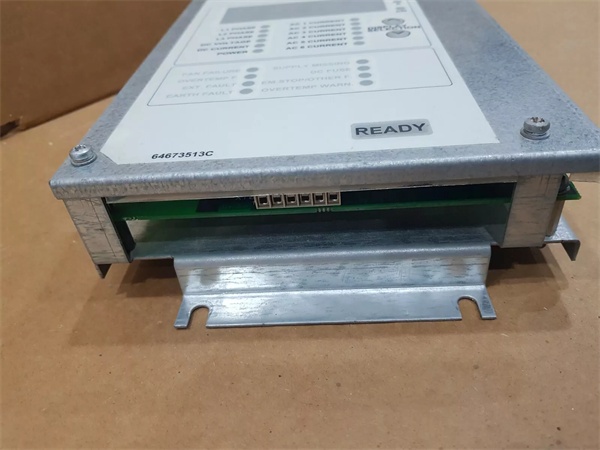
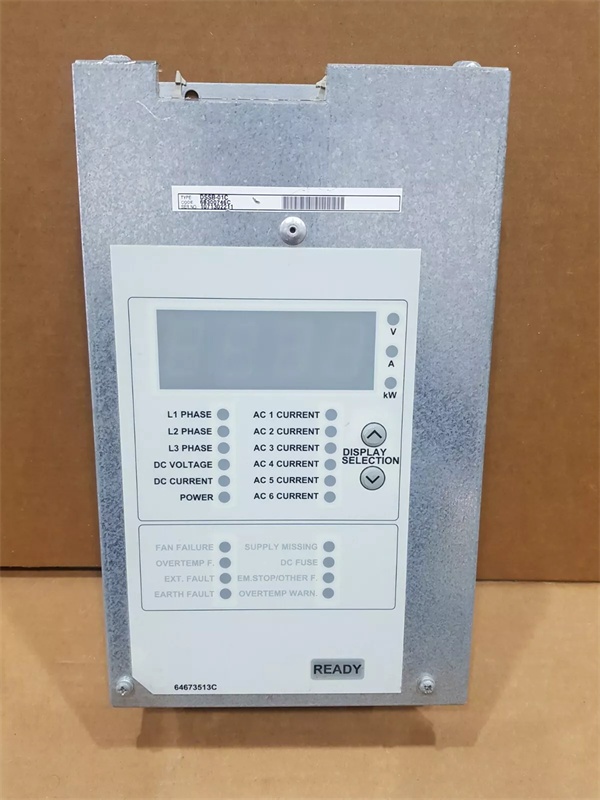
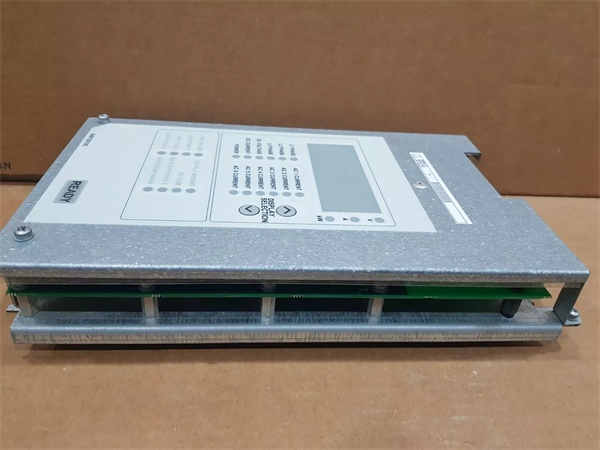
Description
Key Technical Specifications
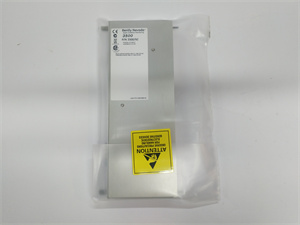
- Model Number: ABB DSSB-01C 3AFE68300746
- Manufacturer: ABB Industrial Automation Division
- Channel Configuration: 16 digital inputs (sinking/sourcing configurable), 16 digital outputs (sourcing)
- Input Rating: 24VDC ±10%, 3-10mA active current; <1ms response time
- Output Rating: 24VDC ±10%, 2A continuous per channel; 8A total module load
- Protection Features: ±2kV surge (IEC 61000-4-5), short-circuit (auto-reset), reverse polarity protection
- Power Supply: 24VDC from DCS backplane; 0.3A typical current draw
- Operating Temperature: -25°C to +65°C (-13°F to +149°F)
- Isolation Rating: 500V AC (channel-to-channel); 1kV AC (I/O to backplane)
- Compatibility: ABB AC800M PM860/PM861/PM864 CPUs, Advant OCS racks, Control Builder M software
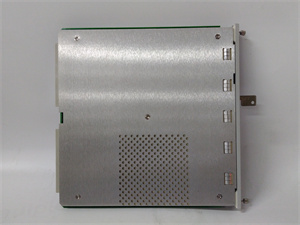
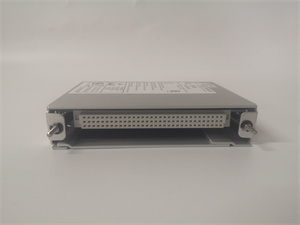
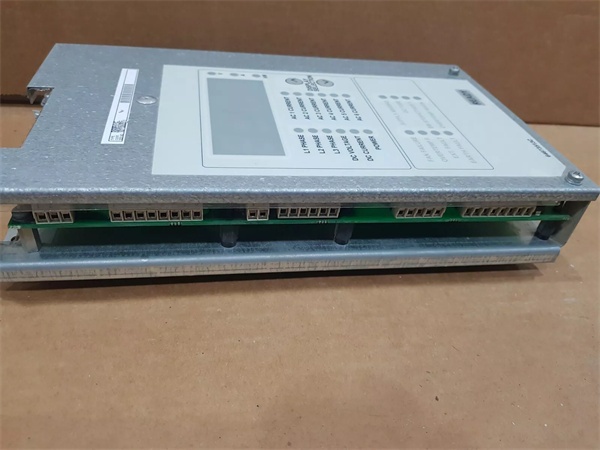
- Mechanical Design: Rack-mount (3U height), conformal-coated PCB, metal housing (IP20)
- Certifications: IEC 61010-1, CE, UL 508, RoHS 2.0, ATEX Zone 2
- Redundancy Support: Compatible with AC800M 1+1 CPU redundancy (no additional hardware required)

DSSB-01C
Field Application & Problem Solved
In process industries—refineries, chemical plants, paper mills—digital I/O modules are the backbone of sensor/actuator communication, but generic modules fail due to poor DCS integration and inadequate protection. A Louisiana refinery lost $170k in a single shift when a third-party I/O module couldn’t sync with the AC800M CPU, cutting off safety interlock signals and triggering an emergency shutdown. Legacy modules also lack channel density: a Wisconsin chemical plant needed two separate modules for 16DI/16DO, cluttering the cabinet and increasing wiring failures that cost 3 hours of monthly downtime.
You’ll find this module in AC800M racks controlling critical equipment: pressure sensor inputs on Texas refinery distillation columns, valve actuator outputs on Ohio chemical reactors, and conveyor interlocks on Minnesota paper mills. Its core value is ABB-native integration + compact versatility. The plug-and-play compatibility fixed the Louisiana refinery’s sync issues—zero communication failures in 2 years. At the Wisconsin plant, the 32-channel density replaced two generic modules, reducing wiring by 50% and eliminating module-to-module faults.
For a Florida wastewater treatment plant, the ±2kV surge protection survived a lightning-induced transient that fried three generic modules, avoiding $90k in replacement costs. Its conformal coating also withstood corrosive hydrogen sulfide vapors, outlasting uncoated modules by 3x (6 years vs. 2 years).
Installation & Maintenance Pitfalls (Expert Tips)
- Input Configuration—Match to Sensor Type (No Defaults!): Rookies leave inputs set to sinking mode but use sourcing (PNP) sensors, resulting in no signal detection. A North Carolina plant delayed reactor startup by 5 hours due to this mistake. Use Control Builder M to configure each DI channel, label terminals (SINK = common -, SOURCE = common +), and test with a multimeter: active inputs should draw 3-10mA.
- Overloading DO Channels Burns Contacts: Driving 3A motors directly through 2A outputs melts internal MOSFETs. A Pennsylvania refinery did this with a 2.5A pump valve, costing $400 in module repairs and 2 hours of downtime. Use ABB’s 1SBL161001R8001 contactors for loads >2A, and add 2A fuses (1SFA616001R1000) per channel as a backup.
- Grounding—Single Point to Cabinet Ground Bar: Daisy-chaining grounds creates noise loops that cause false DI signals. A Michigan paper mill’s conveyor system randomly tripped until we ran dedicated 4mm² ground wires for each DSSB-01C. Never share the module’s ground with power modules—this couples EMI into input channels.
- Firmware Mismatch Breaks Redundancy: Outdated module firmware (pre-v5.3) with redundant AC800M CPUs causes sync failures. A Texas petrochemical plant had intermittent I/O loss until updating the DSSB-01C to v6.1. Always match module firmware to CPU firmware (check ABB’s release notes) and use Control Builder M to batch update.
DSSB-01C
Technical Deep Dive & Overview
The ABB DSSB-01C 3AFE68300746 is a dual-purpose digital I/O module engineered for seamless integration with ABB’s AC800M DCS, designed to handle harsh industrial environments. At its core, a 16-bit microcontroller processes I/O signals independently of the CPU, reducing backplane traffic and ensuring <1ms response time. The 16 DI channels use configurable pull-up/pull-down resistors, enabling compatibility with both sinking (NPN) and sourcing (PNP) sensors without external hardware.
The 16 DO channels feature rugged MOSFET switches (instead of mechanical relays) for fast, reliable switching, with auto-reset short-circuit protection that cuts current to faulty channels without affecting the rest. Surge protection relies on metal-oxide varistors (MOVs) that clamp overvoltage spikes to <2kV in <10ns, protecting against lightning, motor transients, and ESD—critical for refineries and chemical plants.
Ruggedization features include a conformal-coated PCB that repels dust, moisture, and chemical vapors, and a wide operating temperature range (-25°C to +65°C) that handles unconditioned cabinets. The module’s native AC800M integration means no custom drivers—Control Builder M automatically detects it, assigns I/O addresses, and syncs with redundant CPUs.
What sets it apart from generic I/O modules is the balance of integration, protection, and density. It eliminates the need for separate DI/DO modules, reduces wiring complexity, and withstands the harshest industrial conditions. For process plants where downtime costs $10k+/minute, this module isn’t just an I/O interface—it’s a reliable link that keeps critical control loops running safely and continuously.