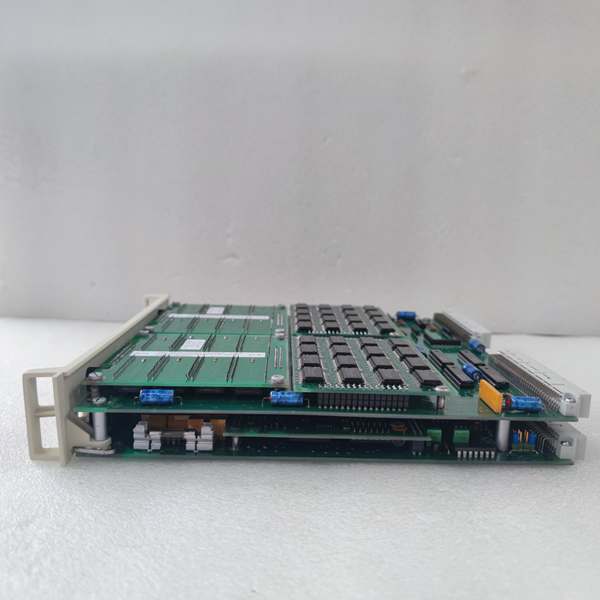
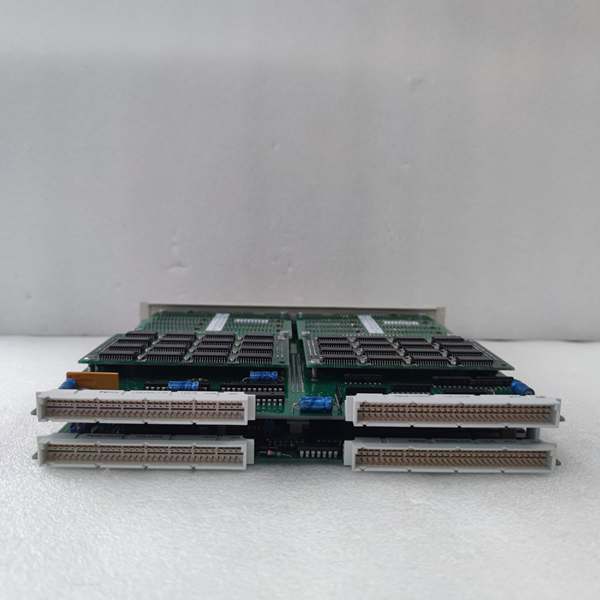
Description
Key Technical Specifications
- Model Number: ABB DSPC174 3BSE005461R1
- Manufacturer: ABB
- I/O Configuration: 16 digital inputs (DI), 16 digital outputs (DO), 4 analog inputs (AI), 2 analog outputs (AO)
- Digital Input Type: 24V DC sinking (4mA max current per channel)
- Digital Output Type: 24V DC sourcing (2A max current per channel)
- Analog Input Range: 4-20mA, 0-10V DC (software-selectable)
- Analog Output Range: 4-20mA, 0-10V DC (software-selectable)
- Operating Temperature: -25°C to 70°C (-13°F to 158°F)
- Storage Temperature: -40°C to 85°C (-40°F to 185°F)
- Isolation: 500V AC (channel-to-channel, channel-to-backplane, 1-minute withstand)
- Response Time: ≤1ms (digital I/O), ≤5ms (analog I/O)
- Power Supply: 24V DC ±10% (21.6V DC to 26.4V DC), from AC 800M backplane
- Power Consumption: 4.5W (standby), 7.8W (full load)
- Mounting: AC 800M I/O rack (compatible with PM850/PM860/PM861/PM865 CPUs)
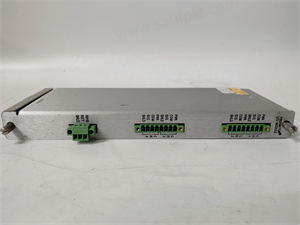
- Connector Type: 4 x spring-cage terminal blocks (digital/analog dedicated)
- Protection Features: Short-circuit protection (outputs), ESD protection (±15kV air)

DSPC174 3BSE005461R1
Field Application & Problem Solved
In industrial process control—chemical batch processing, pharmaceutical manufacturing, and water treatment—AC 800M controllers require integrated I/O modules that handle mixed discrete and analog signals without sacrificing speed or reliability. The challenge? Most modules force separation of digital and analog I/O, requiring multiple rack slots and complex wiring that increases installation time and failure points. Third-party modules often lack synchronization with the AC 800M backplane, causing control logic delays that disrupt process stability. Others offer limited I/O density, forcing operators to oversize control cabinets. The ABB DSPC174 solves these pain points with integrated mixed I/O, backplane synchronization, and high-density design.
You’ll typically find this module in applications like controlling batch reactors (analog for temperature/pressure, digital for valve positions) in chemical plants, monitoring and adjusting filling pumps (analog for flow rate, digital for on/off control) in pharmaceutical facilities, or managing filtration systems (analog for level sensors, digital for pump starters) in water treatment plants. It’s a workhorse in compact control cabinets, where its combined 38 I/O points (16DI/16DO/4AI/2AO) eliminate the need for separate digital and analog modules. In food processing lines, it syncs conveyor speed (analog) with product detection sensors (digital), relying on backplane synchronization to maintain process timing. It also excels in retrofits, upgrading older AC 800M systems to handle mixed-signal processes without full cabinet redesign.
Its core value is integration and efficiency. By combining discrete and analog I/O in a single slot, it reduces rack space usage by 50% compared to separate modules. Backplane synchronization ensures digital and analog signals are processed in lockstep, preventing control logic mismatches. For plant operators and integrators, this means faster installation, simpler wiring, and tighter process control—critical in batch processes where timing and signal accuracy directly impact product quality.
Installation & Maintenance Pitfalls (Expert Tips)
- Analog I/O Range Mismatch (Software vs. Sensor): Rookies often configure analog channels for 4-20mA but connect 0-10V sensors (and vice versa), leading to no data or distorted readings. This is a common mistake in mixed-signal setups. After wiring, use Control Builder M to confirm each analog channel’s input/output range matches the sensor/actuator specs. Test with a signal generator: for 4-20mA inputs, simulate 4mA (0%) and 20mA (100%) to verify the module registers the full range.
- Digital Output Overloading (Ignoring 2A Limit): The module’s digital outputs are rated for 2A per channel, but rookies often connect high-current loads (e.g., 3A solenoids) directly. This trips short-circuit protection and damages the output driver over time. Use external relays for loads exceeding 2A, and never daisy-chain multiple loads on a single channel. Check load current with a multimeter before commissioning—even small overdraws (2.1-2.5A) shorten output lifespan.
- Backplane Insertion (Partial Seating = Intermittent Faults): The module connects to the AC 800M backplane via a edge connector, but rookies often don’t seat it fully. Partial insertion causes intermittent communication drops or I/O signal loss—faults that are hard to replicate. Align the module with the rack guides, apply even pressure until it clicks, and secure with locking screws. Tug gently on the module to confirm it’s seated; if it moves, reinsert and verify with a backplane continuity tester.
- Grounding Separation (Mixed Signal Grounds = Noise): Digital and analog signals have different noise tolerances, but rookies often connect them to the same ground point. Digital noise bleeds into analog channels, causing fluctuating readings (e.g., erratic pressure measurements). Use separate ground buses for digital and analog devices, then connect both to the main system ground at a single point. Keep analog wiring at least 30cm away from digital wiring, and use shielded twisted-pair cable for analog signals—ground the shield at the module end only.
DSPC174 3BSE005461R1
Technical Deep Dive & Overview
The ABB DSPC174 3BSE005461R1 is an integrated process control module engineered for ABB’s AC 800M controller series, combining discrete and analog I/O in a single rack slot. Its core design centers on a 32-bit microcontroller that handles real-time I/O processing and backplane communication, ensuring synchronization with the AC 800M CPU. This eliminates latency between digital and analog signals, critical for processes where discrete actions (e.g., valve opening) depend on analog measurements (e.g., pressure thresholds).
The module’s digital I/O section includes 16 sinking inputs (for sensors like photoeyes and limit switches) and 16 sourcing outputs (for actuators like solenoids and contactors). Digital circuits feature debouncing filters (configurable via software) to reduce noise from factory floor vibration. Short-circuit protection on outputs triggers within 10ms of overcurrent, isolating faulty channels to prevent cascading failures.
Analog circuits use 16-bit ADCs for inputs and 16-bit DACs for outputs, delivering ±0.1% full-scale accuracy. Inputs support both 4-20mA current and 0-10V DC voltage signals, with software-selectable ranges to match common industrial sensors. Outputs provide proportional control signals for valves, pumps, and variable-speed drives, with built-in current limiting to protect against load shorts.
Communication with the AC 800M CPU occurs via the rack’s high-speed backplane bus, which operates at 100Mbps to support real-time control. The module’s microcontroller caches I/O data locally, updating the CPU at 1ms intervals for digital signals and 5ms for analog—ensuring fast response to process changes. Configuration is stored in non-volatile memory, retaining settings during power loss.
Built for industrial ruggedness, the DSPC174 features a metal housing with 500V AC isolation between channels and the backplane, blocking electromagnetic interference from motors, transformers, and high-voltage equipment. It withstands vibration (up to 5g at 10-2000Hz) and temperature extremes (-25°C to 70°C), making it suitable for harsh process environments. The spring-cage terminals simplify tool-less wiring, reducing installation time and human error.
As an OEM module, it integrates seamlessly with ABB’s Control Builder M software, allowing drag-and-drop I/O mapping and control logic programming. Its compact 1-slot design maximizes I/O density, while compliance with IEC 61131-2 ensures compatibility with global industrial standards.