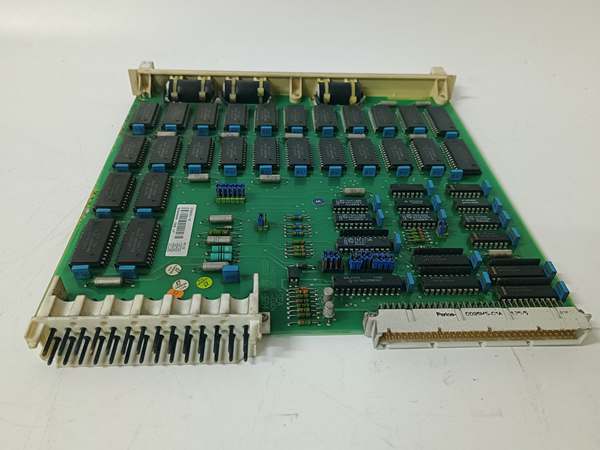
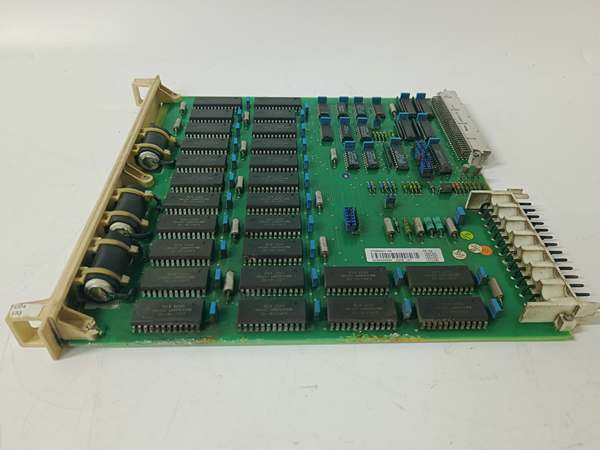
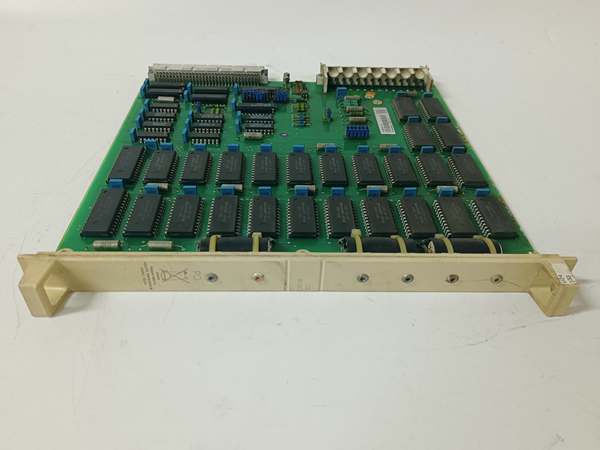
Description
Key Technical Specifications
- Model Number: ABB DSMB127 57360001-HG
- Manufacturer: ABB
- I/O Configuration: 16 digital inputs (DI), 16 digital outputs (DO) – discrete
- Digital Input Type: 24V DC sinking (3mA max current per channel)
- Digital Output Type: 24V DC sourcing (2A max current per channel)
- Operating Temperature: -25°C to 70°C (-13°F to 158°F)
- Storage Temperature: -40°C to 85°C (-40°F to 185°F)
- Isolation: 500V AC (channel-to-channel, channel-to-backplane, 1-minute withstand)
- Response Time: ≤1ms (input and output)
- Power Supply: 24V DC ±10% (21.6V DC to 26.4V DC), from AC 800M backplane
- Power Consumption: 3.0W (standby), 6.5W (all outputs energized)
- Mounting: AC 800M I/O rack (compatible with PM850/PM860/PM861/PM865 CPUs)
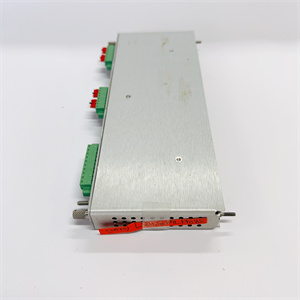
- Connector Type: 4 x spring-cage terminal blocks (2 for inputs, 2 for outputs)
- Protection Features: Short-circuit protection (outputs), ESD protection (±15kV air), reverse polarity protection
- Compatibility: ABB AC 800M controllers (firmware ≥4.0)

ABB DSMB127
Field Application & Problem Solved
In industrial process control—refineries, pulp mills, and batch manufacturing—AC 800M controllers often require expanded discrete I/O to interface with hundreds of sensors, valves, and switches. The challenge? Low-density I/O modules consume valuable rack space, forcing control cabinets to be oversized and increasing wiring complexity. Many modules lack channel isolation, leading to cross-talk from high-voltage equipment or fault propagation (a short in one channel takes down the entire module). Third-party expansion modules cause synchronization delays with the AC 800M backplane, leading to inconsistent control logic. The ABB DSMB127 solves these pain points with 32-channel high density, robust isolation, and native backplane integration.
You’ll typically find this module in applications like monitoring valve position switches in oil refinery distillation columns, controlling pump starters in wastewater treatment plants, or interfacing emergency stop circuits in chemical batch facilities. It’s a workhorse in large-scale control systems, where its 32-channel design (16DI/16DO) reduces rack space usage by 50% compared to 16-channel modules. In pulp and paper mills, it’s used to sync dryer section sensors and actuators, relying on its 1ms response time to maintain process consistency. It also excels in retrofits of older AC 800M systems, adding I/O capacity without requiring cabinet redesign or complex software modifications.
Its core value is space efficiency and reliability in high-I/O environments. The high-density design maximizes I/O per rack slot, reducing cabinet footprint and installation costs. Channel isolation prevents fault spread and noise interference, ensuring stable operation in harsh industrial settings. For plant operators, this means lower infrastructure costs, faster troubleshooting, and consistent process control—critical in facilities where hundreds of discrete signals must be monitored and controlled simultaneously.
Installation & Maintenance Pitfalls (Expert Tips)
- Output Overloading (Ignoring 2A Channel Limit): Rookies often daisy-chain multiple loads (e.g., two 1.5A solenoids) on a single 2A output channel. This exceeds the current rating, tripping short-circuit protection and damaging the output driver over time. Calculate total load current per channel and use external relays for loads exceeding 2A. If a channel shuts down, disconnect the load, power-cycle the module, and verify current draw with a multimeter before reconnecting.
- Terminal Block Wiring (Mixing Input/Output Terminals): The module uses four dedicated terminal blocks (two for inputs, two for outputs), but rookies often wire inputs to output terminals (and vice versa) due to rushed installation. This causes permanent damage to the module’s I/O circuits or connected devices. Label wires clearly and cross-reference with ABB’s wiring diagram: inputs are assigned to terminals 1-16 (blocks 1-2), outputs to terminals 1-16 (blocks 3-4). Use a continuity tester to verify terminal assignments before powering on.
- Backplane Firmware Mismatch (Outdated Controller Firmware): The DSMB127 requires AC 800M controller firmware ≥4.0, but rookies often install it in controllers with older firmware. The controller won’t recognize the module, displaying “Unsupported I/O Module” errors. Use ABB’s Control Builder M to check firmware version—update the controller via the backplane if outdated. Never force the module into a system with incompatible firmware, as this can corrupt controller settings.
- Poor Grounding (Shared Grounds = Signal Noise): Discrete inputs are sensitive to ground noise, but rookies often connect sensor grounds to the same bus as high-power equipment (e.g., motors). This induces noise, leading to false input triggers (e.g., a “closed” valve reading as “open”). Connect all sensor grounds to a dedicated digital ground bus, then bond it to the main system ground at a single point. Keep input wiring at least 30cm away from power cables and use shielded wire for runs over 50 meters.
ABB DSMB127
Technical Deep Dive & Overview
The ABB DSMB127 57360001-HG is a 32-channel digital I/O module engineered for high-density discrete signal processing in ABB’s AC 800M control systems. Its core design centers on a dedicated 32-bit microcontroller that handles I/O signal processing and backplane communication, ensuring real-time synchronization with the AC 800M CPU. This eliminates latency, critical for processes where discrete actions (e.g., valve actuation) depend on immediate sensor feedback.
The module’s 16 sinking inputs accept 24V DC signals from proximity sensors, limit switches, and photoeyes. Each input features debouncing filters (configurable via software) to suppress noise from factory floor vibration and electromagnetic interference (EMI). The 16 sourcing outputs deliver 24V DC power to solenoids, contactors, and alarm horns, with short-circuit protection that triggers within 10ms to isolate faulty channels.
Channel isolation (500V AC) is a key design feature, achieved via optocouplers between the control circuit and I/O terminals. This prevents ground loops and fault propagation—if one channel shorts, the other 31 remain operational. Reverse polarity protection on inputs and outputs shields the module from wiring mistakes, a common cause of field failures.
Communication with the AC 800M CPU occurs via the rack’s high-speed backplane bus (100Mbps), enabling sub-1ms data transfer. The module’s microcontroller caches I/O states locally, updating the CPU at 1ms intervals to maintain control logic consistency. Configuration is stored in non-volatile memory, retaining settings during power loss or module replacement.
Built for industrial ruggedness, the DSMB127 features a metal housing that withstands vibration (up to 5g at 10-2000Hz) and temperature extremes (-25°C to 70°C). The spring-cage terminals simplify tool-less wiring, reducing installation time and human error. Its compact 1-slot design maximizes I/O density in AC 800M racks, while compliance with IEC 61131-2 ensures compatibility with global industrial standards.
As an OEM module, it integrates seamlessly with ABB’s Control Builder M software, supporting drag-and-drop I/O mapping and logic programming. The module’s high-channel count and robust protection features make it ideal for large-scale process control applications, where reliability and space efficiency are paramount.