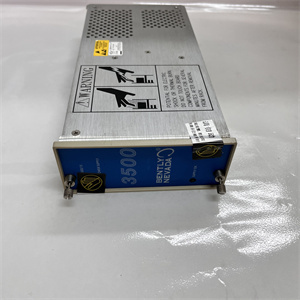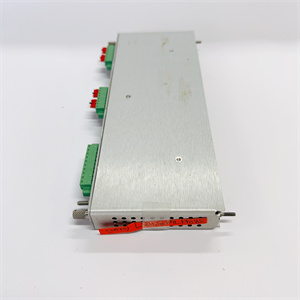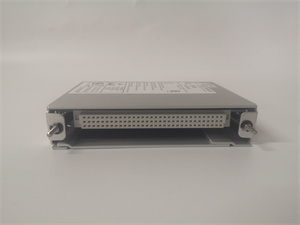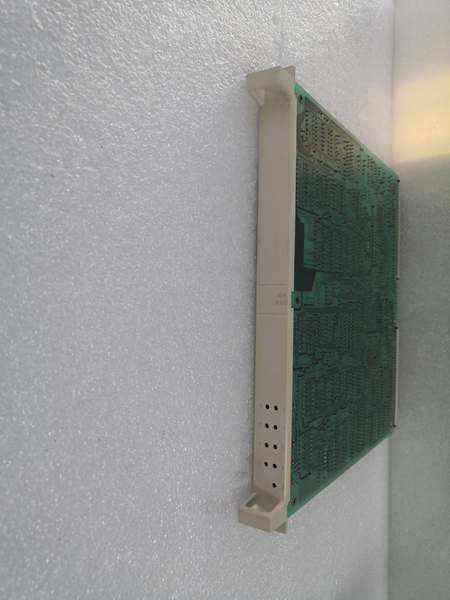
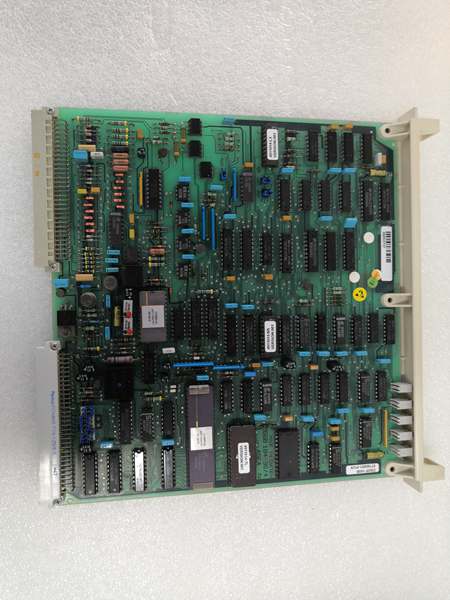
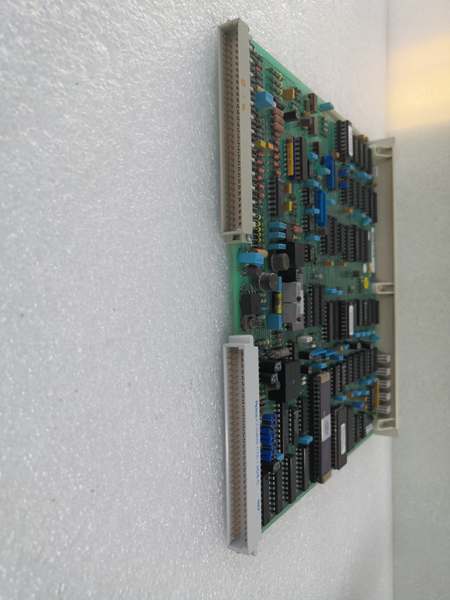
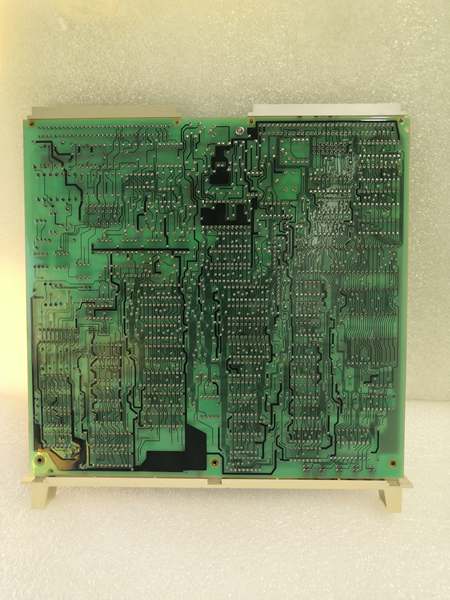
Description
Key Technical Specifications
- Model Number: ABB DSDP140B
- Manufacturer: ABB
- Input Type: Discrete digital (24V DC sinking, 2-wire/3-wire sensor compatible)
- Number of Input Channels: 8 (individually isolated)
- Input Voltage Range: 19.2V DC to 28.8V DC (24V DC ±10%)
- Input Current: 2.5mA (typical), 4mA (max) per channel
- Operating Temperature: -25°C to 70°C (-13°F to 158°F)
- Storage Temperature: -40°C to 85°C (-40°F to 185°F)
- Isolation: 500V AC (channel-to-channel, channel-to-backplane, 1-minute withstand)
- Response Time: ≤0.5ms (fast mode), ≤1ms (standard mode)
- Power Supply: 24V DC ±10% (21.6V DC to 26.4V DC), from AC 800M backplane
- Power Consumption: 0.8W (standby), 1.2W (full load)
- Mounting: AC 800M I/O rack (compatible with PM850/PM860/PM861/PM865 CPUs)
- Connector Type: 1 x spring-cage terminal block (8 channels + common)
- Protection Features: Short-circuit protection (per channel), ESD protection (±15kV air)
- Compatibility: ABB AC 800M controllers (firmware ≥3.0)

ABB DSDP140B
Field Application & Problem Solved
In industrial process control—small to mid-scale manufacturing, packaging lines, and auxiliary plant systems—monitoring a limited number of discrete sensors requires compact, reliable input modules. The challenge? Many 8-channel modules lack individual channel isolation, leading to cross-talk from nearby motors or fault propagation if one sensor shorts. Others have slow response times that miss quick sensor state changes (e.g., a jammed part in a small conveyor) or fragile terminals that fail under vibration. Third-party modules often struggle with AC 800M backplane synchronization, causing delayed sensor data that disrupts control logic. The ABB DSDP140B solves these pain points with isolated channels, fast response, and rugged industrial design.
You’ll typically find this module in applications like detecting part presence with proximity sensors in electronics assembly lines, monitoring valve position switches in small chemical batch reactors, or triggering safety interlocks in packaging machinery. It’s a go-to for compact control cabinets, where its 8-channel design and 1-slot footprint save space. In food processing facilities, it monitors door interlocks and level switches on small tanks, relying on channel isolation to withstand noise from nearby mixers. It also excels in retrofits of older AC 800M systems, adding reliable input capacity for new sensors without overcrowding existing racks.
Its core value is reliability and space efficiency for small-scale discrete sensing. Individual channel isolation prevents a single sensor fault from disabling the entire module, while fast response ensures critical state changes are captured instantly. For plant operators, this means consistent sensor data, simplified troubleshooting, and minimized downtime—critical in applications where even a single missed sensor signal can halt a small production line.
Installation & Maintenance Pitfalls (Expert Tips)
- Common Wire Miswiring (Shared Common = Cross-Channel Interference): The module uses a single common terminal for all channels, but rookies often connect sensor commons to different ground points instead of the module’s dedicated common. This creates ground loops, leading to false input triggers or no signals. Connect all sensor negative leads to the module’s common terminal (not the chassis or external ground). Use a multimeter to verify continuity between the module’s common and sensor commons before powering on.
- Response Mode Misconfiguration (Slow Mode for Fast Sensors): Rookies often leave the module in standard mode (1ms response) for high-speed sensors (e.g., photoeyes on fast-moving conveyors). This causes the module to miss rapid state changes, leading to process jams. Configure fast mode (0.5ms) in Control Builder M for high-speed applications. Test response time with a signal generator: simulate a 1ms pulse and confirm the module registers the state change.
- Terminal Over-Tightening (Damaged Spring-Cage Terminals): The spring-cage terminals are tool-less, but rookies often over-tighten wires to “ensure a good connection.” Excessive force damages the terminal’s spring, leading to intermittent connections. Insert wires fully until they click, then gently tug to verify retention—no additional force is needed. Use stranded wire with ferrules to prevent fraying, which can cause short circuits between terminals.
- Ignoring Short-Circuit Diagnostics (Unresolved Faults = Module Degradation): The module’s per-channel short-circuit protection triggers an alarm, but rookies often reset the alarm without troubleshooting the root cause. A persistent short (e.g., damaged sensor cable) strains the input circuitry over time. When an alarm occurs, disconnect the affected sensor, check for continuity between the input terminal and common (a short shows 0Ω), and repair/replace the sensor or cable before re-enabling the channel.
ABB DSDP140B
Technical Deep Dive & Overview
The ABB DSDP140B is an 8-channel digital input module engineered for discrete sensor monitoring in ABB’s AC 800M control systems. Its core design centers on isolated input circuitry that converts sensor on/off states into digital signals for the AC 800M CPU. Each channel features 500V AC isolation from the others and the backplane, achieved via optocouplers that block electromagnetic interference (EMI) and prevent fault propagation.
The module uses sinking input logic, where the sensor completes the circuit to the module’s common terminal when active. This is compatible with most 2-wire (e.g., proximity switches) and 3-wire (e.g., photoeyes) 24V DC discrete sensors. Per-channel current-limiting resistors protect against short circuits, triggering a diagnostic flag if current exceeds 4mA. ESD protection (±15kV air discharge) shields the module from static damage during installation or maintenance.
Communication with the AC 800M CPU occurs via the rack’s high-speed backplane bus (100Mbps), enabling real-time data transfer. The module’s internal microcontroller caches input states and updates the CPU at intervals matching the selected response mode (0.5ms fast/1ms standard). Configuration settings (response mode, input filtering) are stored in non-volatile memory, retaining data during power loss or module replacement.
Built for industrial ruggedness, the DSDP140B withstands vibration (up to 5g at 10-2000Hz) and temperature extremes (-25°C to 70°C). Its compact 1-slot design maximizes I/O density in AC 800M racks, while the single spring-cage terminal block simplifies wiring. Compliance with IEC 61131-2 ensures compatibility with global industrial standards.
As an OEM module, it integrates seamlessly with ABB’s Control Builder M software, supporting drag-and-drop I/O mapping and diagnostic monitoring. Its focus on reliability and space efficiency makes it ideal for small-scale discrete sensing applications where consistent, timely sensor data is critical for process control.