Description
Key Technical Specifications
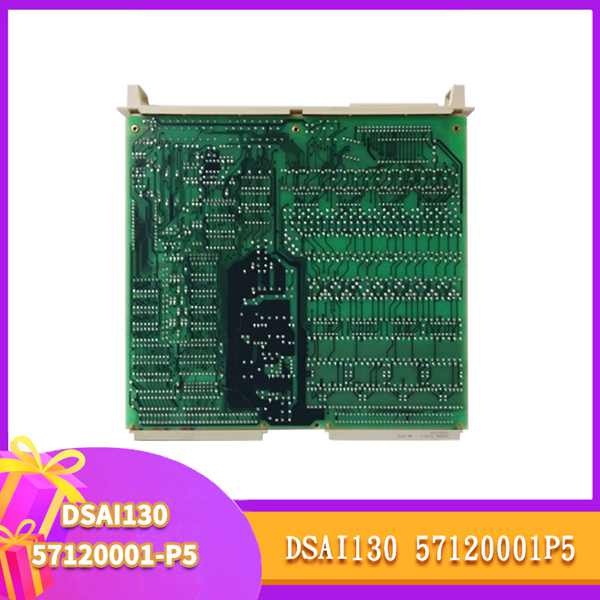
- Model Number: DSAI130-57120001-P5
- Manufacturer: ABB
- Device Type: Industrial Analog Input Module
- Compatible Systems: ABB AC 800M DCS, Compact Control Builder (CCB)
- Number of Channels: 4 independent, isolated channels
- Input Types (Universal): 4–20mA DC, 0–20mA DC, 0–10V DC, ±10V DC, thermocouple (J/K/T/E/R/S/B/N), RTD (Pt100/Pt1000/Ni100)
- Resolution: 16-bit (0.003% of full scale)
- Input Impedance: >1MΩ (voltage inputs), <10Ω (current inputs)
- Operating Temperature: -20°C to +60°C (-4°F to +140°F)
- Storage Temperature: -40°C to +85°C (-40°F to +185°F)
- Isolation: 2.5kV AC (channel-to-channel, channel-to-backplane)
- Power Supply: 24V DC (150mA typical, derived from system backplane or external)
- Sampling Rate: 10 samples/second per channel (configurable up to 100 samples/sec)
- Dimensions (W x H x D): 80mm x 140mm x 115mm
- Weight: Approx. 350g
- Compliance: IEC 61131-2, IEC 61000-4 (EMC), UL 508
- Status Indicators: Power (PWR), Channel Activity (1–4), Fault (RED)
- Mounting: DIN rail (35mm) via system base unit, backplane-connected
- Protection Features: ESD protection (±25kV), over-voltage protection (up to 30V DC), short-circuit protection
- Signal Conditioning: Integrated cold junction compensation (thermocouple), linearization (RTD)
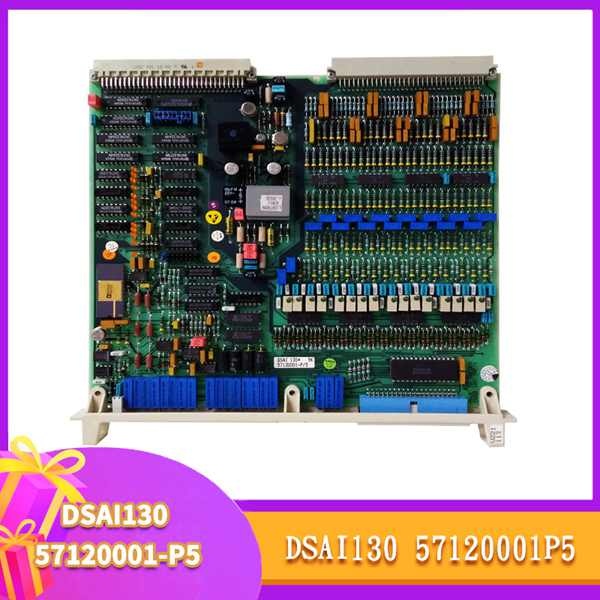
ABB DSAI130-57120001-P5
Field Application & Problem Solved
In process industries—refineries, chemical plants, and power stations—the biggest challenge is accurately measuring critical process variables (temperature, pressure, flow, level) in harsh, noisy environments. Traditional analog modules suffer from poor noise immunity, limited input flexibility, or low resolution, leading to inaccurate readings that compromise process control or trigger false alarms. This module solves that by combining universal input compatibility, high precision, and robust noise filtering—delivering reliable data even in EMI-heavy settings.
You’ll typically find this module integrated into ABB AC 800M DCS systems, monitoring key processes like reactor temperature in chemical plants, steam pressure in power stations, or crude oil flow in refineries. It’s also used in water treatment plants, where it measures pH levels and turbidity, and in pulp mills, tracking digester pressure and cooking liquor temperature. For retrofits, it replaces outdated analog modules in legacy DCS systems, upgrading measurement precision without requiring full system overhauls.
Its core value is accuracy and versatility. The universal input design eliminates the need for multiple specialized modules—one DSAI130-57120001-P5 handles thermocouples, RTDs, current, and voltage signals, reducing inventory and installation complexity. The 16-bit resolution and integrated signal conditioning ensure measurements are precise enough for tight process control (e.g., ±0.1°C temperature accuracy). For plant operators, this translates to stable process performance, fewer false alarms, and better quality control—critical in industries where product consistency and safety are non-negotiable.
Installation & Maintenance Pitfalls (Expert Tips)
Input Type Configuration Mismatch
Rookies often wire a sensor to the module without matching the software-configured input type (e.g., 4–20mA vs. thermocouple). This causes distorted readings or no data at all. Always confirm the sensor’s output type (e.g., Pt100 RTD, 4–20mA pressure transmitter) and configure the channel in Compact Control Builder to match. Test the input with a signal generator before connecting the sensor—this catches configuration errors early.
Poor Shield Grounding Ruins Noise Immunity
The module’s noise filtering works only if sensor cable shields are grounded correctly. Technicians frequently ground shields at both ends, creating ground loops that amplify EMI (common near motors or transformers). Ground the shield at the module end only, and keep shielded cables at least 15cm (6 inches) away from power cables. For long runs (over 50m), use twisted-pair shielded cable to further reduce noise pickup—this prevents erratic readings in refinery or power plant environments.
Overlooking RTD Lead Resistance
When using 2-wire RTDs, technicians often ignore lead resistance, which adds to the sensor’s resistance and skews temperature readings. Use 3-wire or 4-wire RTD connections whenever possible—these compensate for lead resistance. If 2-wire is unavoidable, enter the lead resistance value into the module’s configuration software to offset the error. A 1Ω lead resistance error can cause a 0.3°C temperature 偏差 (deviation) with a Pt100 sensor—critical in precision processes.
Terminal Torque & Wire Gauge Errors
Loose terminal connections or undersized wires cause intermittent readings or signal loss. The module’s terminals require 0.6–0.8Nm torque—use a torque screwdriver to avoid under-tightening (vibration loosens connections) or over-tightening (strips terminals). For current signals (4–20mA), use 18–22AWG wire for runs up to 100m; smaller gauge wire increases resistance, reducing signal integrity. For thermocouples, use matching thermocouple wire (e.g., Type K wire for K-type thermocouples)—using standard wire introduces measurement errors.
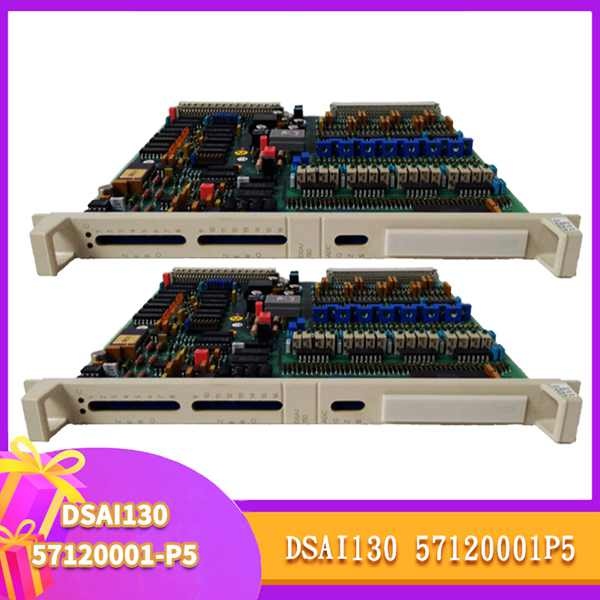
ABB DSAI130-57120001-P5
Technical Deep Dive & Overview
The ABB DSAI130-57120001-P5 is a high-precision analog input module designed for integration with ABB’s AC 800M DCS and industrial control systems. It’s part of the DSAI series, engineered to deliver accurate, reliable measurement of process variables in harsh industrial environments.
At its core, the module uses 16-bit analog-to-digital converters (ADCs) per channel, ensuring high resolution and low drift over temperature. The universal input design allows each channel to be independently configured for different sensor types (current, voltage, thermocouple, RTD) via software, eliminating the need for separate modules and simplifying system design. Integrated signal conditioning—including cold junction compensation for thermocouples and linearization for RTDs—converts raw sensor signals into calibrated process values, reducing the load on the central controller.
The module’s isolation (2.5kV AC between channels and backplane) prevents ground loops and protects against voltage transients, a common issue in industrial settings with multiple grounded devices. Built-in ESD and over-voltage protection shields the module from electrical hazards, while noise filtering (low-pass and digital filtering) minimizes interference from nearby power cables or motor drives.
Communication with the AC 800M controller happens via the system backplane, ensuring fast data transfer (up to 100 samples/sec per channel) for time-sensitive processes. The front-panel LEDs provide at-a-glance status: channel activity LEDs confirm signal reception, while the fault LED alerts to over-voltage, short-circuits, or configuration errors. The DIN rail mounting and compact form factor make it easy to integrate into existing control cabinets, even in space-constrained installations.
Overall, the DSAI130-57120001-P5 is a workhorse analog input module—combining flexibility, precision, and ruggedness to meet the demands of process control. Its universal inputs, noise immunity, and seamless DCS integration make it a trusted choice for plant operators who rely on accurate data to maintain safe, efficient operations.