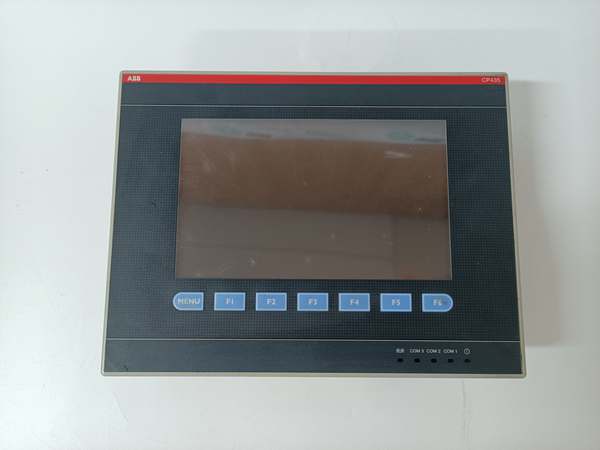
Description
Key Technical Specifications
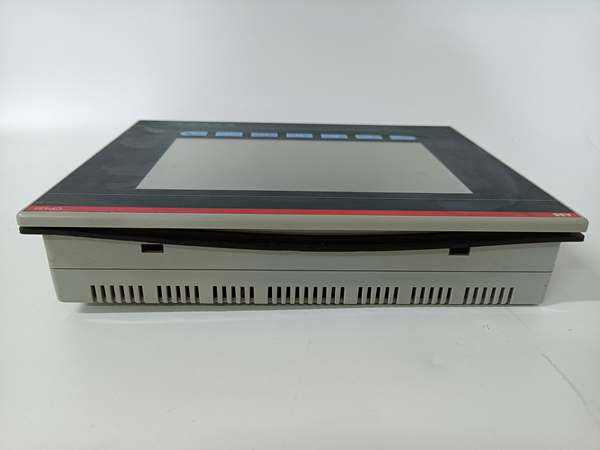
- Model Number: CP435T 1SBP260193R1001
- Manufacturer: ABB Industrial Automation Division
- Display: 7″ TFT LCD, 800×480 pixels, 16.7M colors, resistive touchscreen
- Operating Voltage: 24VDC ±20% (19.2-28.8VDC); 20W max power consumption
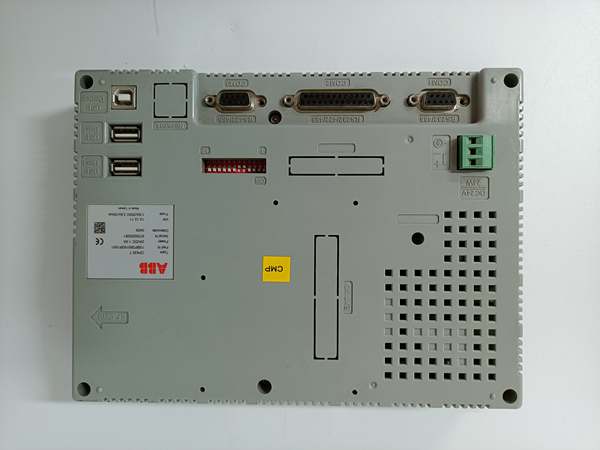
- Communication Interfaces: 1× 10/100Mbps Ethernet (RJ45), 3× configurable serial ports (RS232/RS422/RS485 via DIP switches)
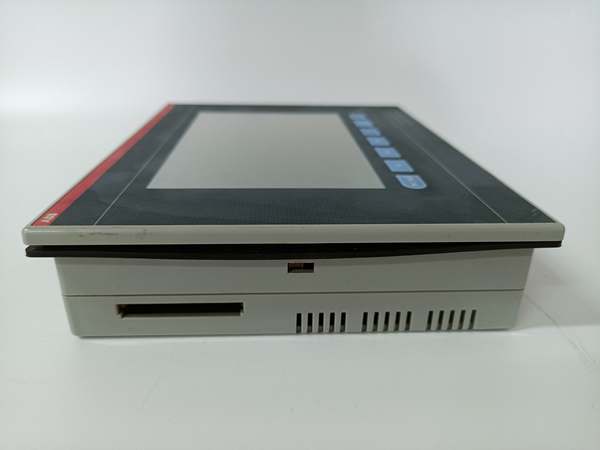
- Expansion Ports: 2× USB 2.0 (front/rear), CF card slot (for data logging/storage)
- Protection Rating: IP65 (front panel); IP20 (rear housing)
- Operating Temperature: 0°C to +55°C (32°F to +131°F)
- Storage Temperature: -20°C to +70°C (-4°F to +158°F)
- Mechanical Dimensions: 231mm (W) × 176mm (H) × 45.8mm (D); cutout size: 220.8×165.8mm
- Weight: 1.2kg (2.6lbs)
- Certifications: CE, UL 508, IEC 61131-2, RoHS 2.0, NEMA 4X
- Compatibility: ABB Freelance DCS, AC800M PLC, third-party PLCs (Siemens, Allen-Bradley), Modbus RTU/TCP, Profibus DP
- User Controls: 1 menu key + 6 programmable function keys, touchscreen calibration utility

ABB CP435T 1SBP260193R1001
Field Application & Problem Solved
In industrial operations—refinery pump stations, paper mill machine control, water treatment plants—operators need reliable, rugged HMIs that withstand dust, moisture, and electrical noise. Generic consumer-grade touchscreens fail constantly: a Texas refinery lost $45k in a 2-hour outage when a cheap HMI shorted during a washdown, halting a crude transfer pump. Legacy HMIs also lack flexible communication, forcing facilities to use expensive gateways to connect to mixed PLC/DCS systems—a Pennsylvania paper mill spent $30k annually on gateway maintenance for their old operator terminals.
This HMI solves both issues. You’ll find it in: small-to-medium process skids, packaging lines, remote pump stations, and plant floor control panels where space is limited. It’s the go-to for retrofits of legacy systems, as it talks to both ABB and third-party controllers without adapters.
Its core value is ruggedness + multi-protocol flexibility + low maintenance. Unlike consumer displays, its IP65 front resists washdowns and dust, while the configurable serial ports eliminate gateway costs. For a Florida water treatment plant, the CP435T’s ability to connect to both an ABB AC800M and a legacy Allen-Bradley PLC cut integration time by 50% and eliminated 12 hours of monthly downtime from gateway failures.
Installation & Maintenance Pitfalls (Expert Tips)
- Touchscreen Calibration: Do It Post-Installation (and Annually): Rookies skip calibration, leading to unresponsive or misaligned touch inputs. A Michigan packaging plant’s operators struggled for weeks until calibration was run—use the built-in utility via the menu key. Recalibrate after temperature swings or physical impacts (common in plant environments).
- Power Supply: Use Regulated 24VDC—No Unfiltered Sources: Unregulated power causes flickering displays or random reboots. An Ohio steel mill’s HMI crashed hourly until they replaced a generic power supply with an ABB-regulated unit. Verify voltage with a multimeter (19.2-28.8VDC) before wiring.
- Serial Port DIP Switches: Match to Device Protocol: Rookies leave switches on default (RS232) when connecting to RS485 devices, causing communication failures. A North Carolina food plant’s Modbus sensors didn’t communicate until DIP switches 1-3 were set for RS485. Keep a copy of the switch configuration chart in the control cabinet.
- Ventilation: Don’t Block Rear Airflow: The CP435T dissipates heat through the rear—stacking cables or tools around it triggers overheating. A Louisiana refinery’s HMI shut down daily during summer until clearance was increased to 50mm. Ensure rear access is unobstructed.
- Software Updates: Use CP400Soft—Not Generic Tools: Rookies use third-party software to upload applications, corrupting the HMI’s embedded OS. A Wisconsin machine shop bricked two units before switching to ABB’s CP400Soft. Always use factory-approved software for configuration and firmware updates.
ABB CP435T 1SBP260193R1001
Technical Deep Dive & Overview
The ABB CP435T 1SBP260193R1001 is a purpose-built industrial HMI designed to bridge operators and control systems in harsh environments. At its core, a 32-bit RISC processor handles graphics rendering and protocol translation, offloading communication tasks from the connected PLC/DCS to ensure responsive operation. The 7″ resistive touchscreen uses a 4-wire design that works with gloves—critical for refineries and food plants where operators wear PPE.
Unlike generic HMIs, it features three configurable serial ports (via DIP switches) that support RS232, RS422, and RS485, enabling direct connection to legacy and modern devices without adapters. The Ethernet port supports Modbus TCP and Profinet, integrating seamlessly with ABB’s Freelance DCS and AC800M PLCs. The IP65 front panel uses a gasket seal to repel water jets and dust, while the rugged plastic housing withstands vibration (0.5mm displacement at 10-55Hz) common in plant environments.
What sets it apart is its embedded Linux-based OS, which provides stable performance with a 50,000-hour backlight life—far exceeding consumer displays. The CF card slot and USB ports enable local data logging and application backups, reducing downtime during system failures. For facilities needing a reliable, low-maintenance operator interface, this HMI isn’t just a display—it’s a rugged, flexible link that keeps industrial processes running smoothly.