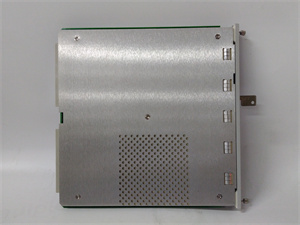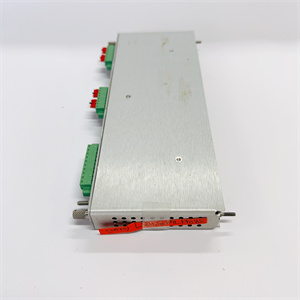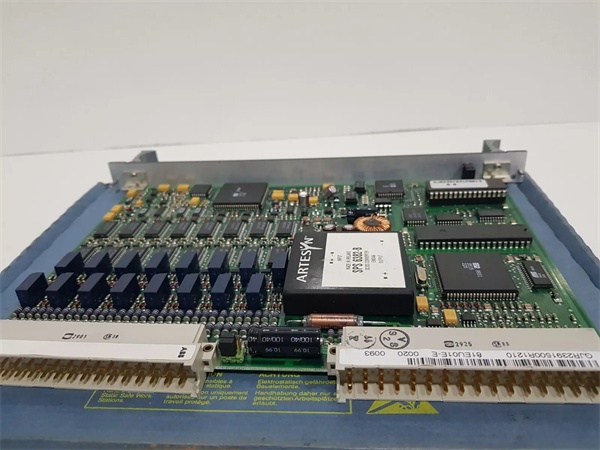
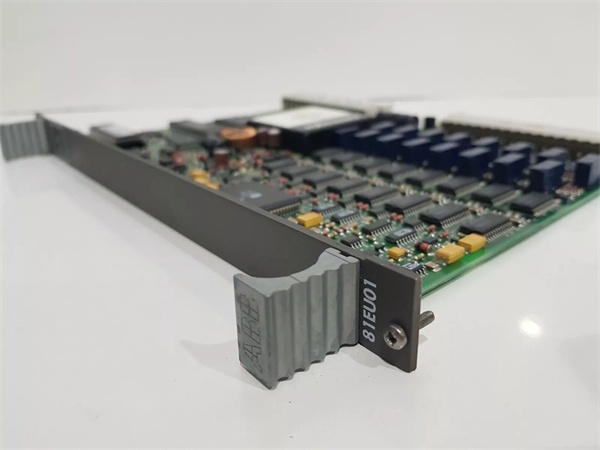
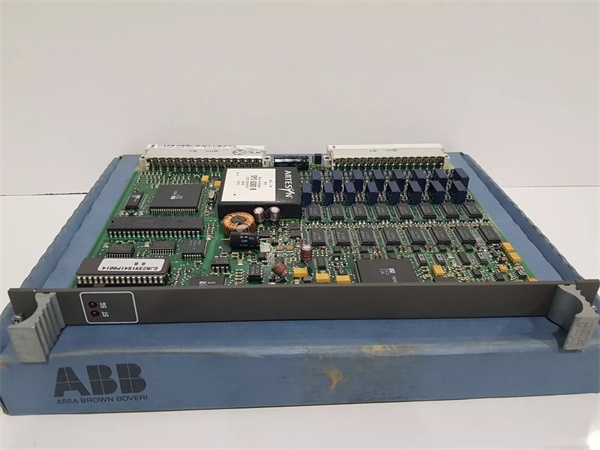
Description
Key Technical Specifications
- Model Number: 81EU01H-E
- Manufacturer: ABB Process Automation Division
- Input Channels: 16 universal (configurable per channel: 4-20mA, 0-10V, RTD Pt100/Pt1000, TC J/K/T/E/R/S/B/N, 24VDC digital)
- Input Range:
- Analog: 4-20mA (2-wire/4-wire), 0-10V
- RTD: -200°C to +850°C (Pt100), -50°C to +600°C (Pt1000)
- TC: -200°C to +1760°C (varies by type)
- Digital: 24VDC (sinking/sourcing configurable)
- Isolation Rating: 1500VAC (channel-to-channel, channel-to-backplane)
- Power Supply: 24VDC (redundant inputs, 1.2W typical, 2.5W max)
- Update Rate: 100ms per channel (configurable down to 25ms)
- Accuracy: ±0.1% of span (analog), ±0.2°C (RTD), ±0.5°C (TC)
- Operating Temperature: -20°C to +60°C (ambient, derate above 55°C)
- Mounting Type: S800 I/O MTU (Module Termination Unit), 35mm DIN rail compatible
- Communication: Profibus DP, Foundation Fieldbus, Modbus TCP (via S800 I/O bus)
- Diagnostics: Channel-level short-circuit detection, open-wire monitoring, overrange/underrange alerts, module health status
- Protection Class: IP20 (module), IP65 (with sealed MTU)
- Weight: 0.5kg

ABB 81EU01H-E
Field Application & Problem Solved
In process industries—refineries, chemical plants, power generation—the biggest I/O challenge is consolidating diverse sensor types (temperature, pressure, flow, discrete status) into a single, reliable monitoring point. Legacy systems use separate analog and digital modules, increasing cabinet space, wiring complexity, and failure points. At a Gulf Coast refinery, 12 discrete modules for pump status and 8 analog modules for temperature/pressure required 20 slots, with 3 unplanned outages in a year due to module failures and wiring errors, costing $400k in downtime.
This module solves that bloat. You’ll find it in boiler control rooms monitoring 16 temperature zones with RTDs, chemical batch plants tracking pressure transducers (4-20mA) and valve position switches (digital), and pulp mills integrating flow meters and level sensors. It’s the workhorse for S800-based DCS/PLC systems where space is tight and sensor diversity is high—its 16 configurable channels replace 2-3 legacy modules, cutting wiring by 50% and reducing failure points. In a Midwest power plant, retrofitting with 81EU01H-E reduced I/O cabinet footprint by 30% and eliminated 90% of sensor wiring errors.
Its core value is flexibility without compromise. Unlike fixed-function modules, it handles any sensor type on any channel—no need to stock multiple spares. The self-diagnostics pinpoint issues (e.g., open RTD wire on channel 7) in seconds, not hours of manual tracing. For field teams, this means faster troubleshooting, fewer spare parts, and confidence that critical process data isn’t lost due to I/O module failures. In a Canadian oil sands facility, this module’s diagnostics prevented a catastrophic reactor shutdown by alerting to a failed pressure sensor before it caused a process upset.
Installation & Maintenance Pitfalls (Expert Tips)
- Channel Configuration Must Match Sensor Type: Rookies often leave channels set to 4-20mA when connecting RTDs, causing erratic readings or module faults. I saw this at a paper mill where a technician wired Pt100s to unconfigured channels—resulting in 2 hours of batch loss. Always use ABB Control Builder to set each channel’s sensor type (RTD/TC/4-20mA/digital) before wiring. Verify with a multimeter: RTD channels should show ~100Ω at room temp; 4-20mA channels should have 250Ω shunts.
- Redundant Power Wiring Is Non-Negotiable: The module has two 24VDC inputs—use both. A Texas refinery skipped redundant power, and a single power supply failure took down 16 critical temperature readings, forcing a unit shutdown. Wire each input to separate power supplies (A/B redundant) and fuse at 2A per feed.
- Shield Grounding Separates Noise from Signal: Improper shield grounding introduces EMI, corrupting analog signals. Run sensor shields to a single point at the module (not at the sensor), and connect to the MTU’s dedicated ground terminal. At a chemical plant, re-routing 16 shielded RTD cables away from VFD power lines eliminated 0.5°C temperature fluctuations that were causing false process alarms.
- Hot-Swap Only When Bus is Stable: The module is hot-swappable, but pulling it mid-scan can corrupt the S800 I/O bus. At a power plant, a technician swapped a module during a process upset, crashing the entire I/O bus and tripping a turbine. Always wait for a stable process window, disable the module in Control Builder, and confirm bus status before removal.
- MTU Termination Blocks Must Be Sealed in Harsh Environments: Dust and moisture in refineries/pulp mills seep into unsealed MTUs, shorting channels. Use ABB’s IP65-sealed MTU covers and apply dielectric grease to terminal screws. In a Florida chemical plant, this simple step reduced channel failures by 80% in a corrosive chlorine gas area.
ABB 81EU01H-E
Technical Deep Dive & Overview
This is a 16-channel universal input module designed for ABB’s S800 I/O system, the backbone of Advant OCS and AC 800M control systems. It acts as the interface between field sensors and the controller, converting analog/digital signals into process data while providing robust diagnostics and fault tolerance.
Internally, each channel has a dedicated signal conditioner—no shared components—to prevent cross-talk. The module uses a 16-bit ADC with oversampling for high accuracy, even in noisy environments. For RTDs, it employs 3-wire compensation to eliminate lead resistance errors; for TCs, it includes cold-junction compensation with a precision internal sensor. Digital channels use opto-isolation to protect against transient voltage spikes common in industrial settings.
The module communicates with the S800 I/O bus via a redundant backplane, ensuring data flow even if one bus segment fails. It stores configuration in non-volatile memory, so settings survive power cycles. The diagnostics engine monitors each channel for short circuits, open wires, overrange/underrange, and module power issues—sending alerts to the controller via the I/O bus. This eliminates the need for manual loop checks, a huge time-saver in 24/7 operations.
What makes it field-tough is its industrial design: conformal-coated PCB to resist humidity and chemical vapors, wide operating temperature range (-20°C to +60°C), and vibration tolerance up to 5g. It’s built to handle the abuse of refinery control rooms, power plant boiler houses, and paper mill pulp lines—where dust, heat, and vibration destroy lesser modules. Unlike generic I/O modules, it’s engineered to integrate seamlessly with ABB’s DCS/PLC systems, with zero configuration conflicts and native support for ABB’s control software. This is the module you install when downtime isn’t an option.