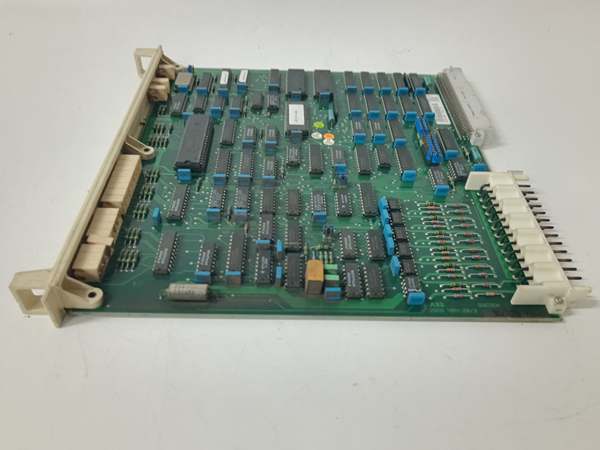
Description
Key Technical Specifications
- Model Number: 70AA02B-E
- Manufacturer: ABB Power Generation Automation Division
- Output Channels: 4 independent, galvanically isolated channels
- Output Ranges: Configurable per channel: 4-20mA (sink/source), 0-10V, -10V to +10V
- Load Capacity: 500Ω max for 4-20mA, 10kΩ min for voltage outputs
- Power Supply: 24VDC ±10% (redundant inputs, 1.2W typical, 2.0W max current draw)
- Response Time: ≤50ms (0-100% step change)
- Accuracy: ±0.1% of span (25°C), ±0.2% over operating temperature range
- Resolution: 12 bits (4096 steps)
- Isolation Rating: 1500VAC (channel-to-channel, channel-to-backplane, channel-to-power)
- Operating Temperature: 0°C to 55°C (ambient, derate above 50°C)
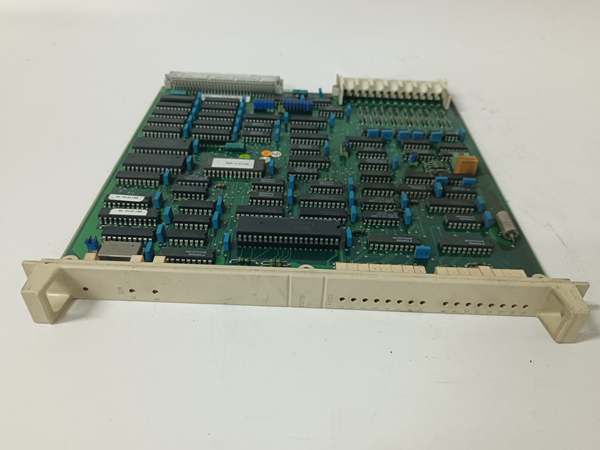
- Mounting Type: Procontrol P13 I/O rack (3U subrack, card-edge connector)
- Diagnostic Features: Channel-level short-circuit detection, open-load monitoring, overcurrent protection, power supply monitoring
- Protection Class: IP20 (rack-mounted in control cabinet)
- Weight: 0.45kg
- Compliance: IEC 61010-1, IEC 61326-1 (EMC)

ABB DSCS131 57310001-LM
Field Application & Problem Solved
In power generation—coal, gas, nuclear, hydro—the biggest control challenge is precise, reliable actuation of final control elements (valves, dampers, governors) in harsh environments. Legacy analog output modules lack isolation and redundancy, leading to signal cross-talk, single-point failures, and inaccurate control. At a coal-fired power plant in Ohio, outdated non-isolated modules caused 2 turbine trips in 8 months due to ground loops and signal interference from generator electromagnetic noise, costing $2.2M in downtime.
This module solves those reliability gaps. You’ll find it in boiler control systems regulating fuel flow valves (4-20mA), turbine speed governors maintaining 3600 RPM, and emission control systems adjusting NOₓ injection dampers. It’s the backbone of Procontrol P13 DCS systems where control precision and fault tolerance are non-negotiable—its 4 isolated channels prevent cross-talk, while redundant power inputs eliminate single-point power failures. In a Texas gas-fired plant, retrofitting with 70AA02B-E reduced control-related outages by 95% and improved turbine speed regulation accuracy from ±0.5% to ±0.1%.
Its core value is robust control in noisy environments. Unlike generic analog output modules, it’s engineered for power plant electromagnetic interference (EMI) from generators, motors, and high-voltage switchgear. The galvanic isolation breaks ground loops that plague non-isolated modules, while the short-circuit protection prevents damage from wiring errors or failed actuators. For field teams, this means fewer false alarms, faster troubleshooting (diagnostics pinpoint issues in seconds), and confidence that valve positions and turbine speeds are controlled accurately—even during electrical transients. In a Canadian nuclear plant, this module’s diagnostics prevented a reactor shutdown by alerting to a failed steam flow control valve before it caused a process upset.
Installation & Maintenance Pitfalls (Expert Tips)
- Redundant Power Wiring Is Mandatory: Rookies often skip connecting the second power input, creating a single-point failure. At a Florida power plant, a power supply failure took down 4 critical valve control channels, forcing a unit load reduction. Always wire both power inputs to separate 24VDC supplies (A/B redundant) and fuse at 2A per feed. Verify with a multimeter: both inputs should show 24VDC ±10% with no voltage drop under load.
- Load Resistance Must Match Output Type: Connecting a 4-20mA output to a load >500Ω causes signal degradation; connecting a voltage output to a load <10kΩ burns out the output driver. I saw this at a Pennsylvania paper mill where a technician wired a 4-20mA channel to a 1000Ω damper actuator—resulting in erratic control and a 3-hour shutdown. Use a multimeter to measure load resistance before wiring: 4-20mA channels need 250-500Ω; voltage channels need ≥10kΩ.
- Grounding Separates Noise from Signal: Improper grounding introduces EMI, causing jitter in analog outputs. Mount the I/O rack on a grounded steel chassis, connect the module’s safety ground to the rack ground, and keep output wiring 30cm away from power cables (especially generator stator cables). At a Midwest power plant, re-routing 4-20mA valve control wiring away from 480V motor cables eliminated 0.5% output fluctuations that were causing steam pressure instability.
- Configuration Must Match Actuator Type: Leaving channels set to voltage when connecting current actuators (or vice versa) causes complete control failure. A rookie at a California gas plant made this mistake with a fuel control valve—resulting in a 2-hour unplanned outage. Always use ABB Procontrol Engineering Tool to set each channel’s output type (4-20mA/0-10V/-10V to +10V) before wiring. Verify with a signal generator: 4-20mA channels should source current; voltage channels should output stable DC voltage.
- Post-Maintenance Functional Testing Is Critical: Technicians often skip testing after replacing a module to save time. At a New York power plant, a skipped test led to a non-functional boiler feedwater valve control channel that wasn’t discovered until a load increase—causing a turbine trip. Always test each channel with a loop calibrator: inject a 4mA, 12mA, and 20mA signal (for current outputs) or 0V, 5V, and 10V (for voltage outputs) and verify actuator response. Document test results in the maintenance log.
ABB DSCS131 57310001-LM
Technical Deep Dive & Overview
This is a 4-channel universal analog output module designed for ABB’s Procontrol P13 DCS, the workhorse of power generation control systems worldwide. It acts as the interface between the DCS controller and final control elements (valves, dampers, governors), converting digital control signals into precise analog outputs while providing robust diagnostics and fault tolerance.
Internally, each channel has a dedicated DAC (digital-to-analog converter) and output driver—no shared components—to prevent cross-talk and ensure independent operation. The module uses a precision 12-bit DAC with linearization to maintain accuracy over temperature and load variations. For 4-20mA outputs, it employs a current-source topology that maintains constant current regardless of load resistance (within 500Ω). For voltage outputs, it uses a high-impedance buffer to ensure stable voltage even with varying load.
The module communicates with the Procontrol P13 controller via a redundant backplane bus, ensuring data flow even if one bus segment fails. It stores configuration in non-volatile EEPROM, so settings survive power cycles and module replacement. The diagnostics engine monitors each channel for short circuits (current outputs), open loads (voltage outputs), overcurrent, and power supply issues—sending alerts to the controller via the backplane. This eliminates the need for manual loop checks, a huge time-saver in 24/7 power plant operations.
What makes it field-tough is its industrial design: conformal-coated PCB to resist humidity and chemical vapors, wide operating temperature range (0°C to 55°C), and vibration tolerance up to 3g. It’s built to handle the abuse of power plant control rooms—where EMI, temperature swings, and mechanical vibration destroy lesser modules. Unlike generic analog output modules, it’s engineered to integrate seamlessly with Procontrol P13’s control logic, with zero configuration conflicts and native support for ABB’s control software. This is the module you install when turbine speed, steam pressure, and power output can’t afford to be wrong.