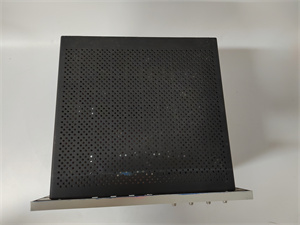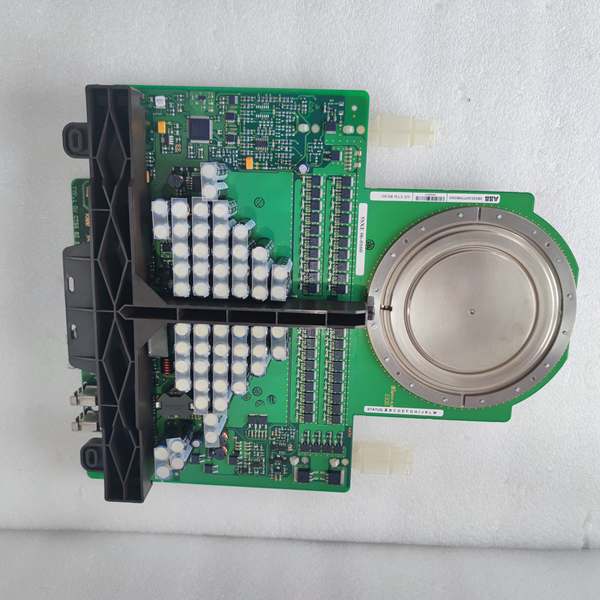
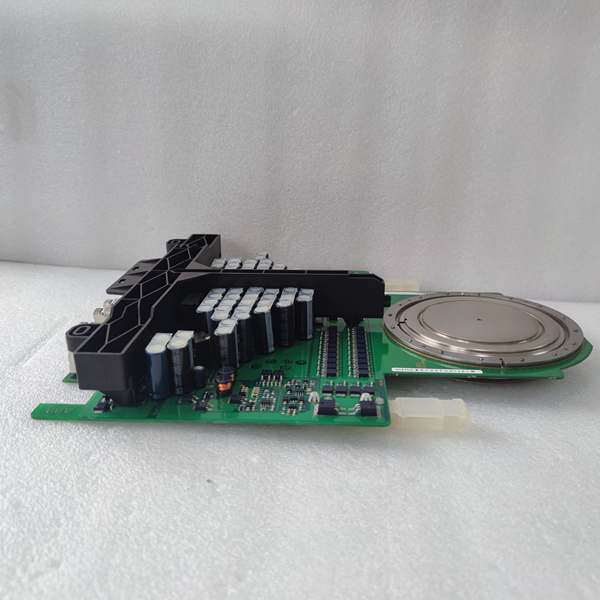
Description
Key Technical Specifications
- Model Number: 5SHX1960L0006 (3BHB016120R0002)
- Manufacturer: ABB Power Semiconductor Division, Switzerland
- Blocked Voltage (VDRM): 4500V DC (unidirectional)
- Continuous Current (ITGQM): 1900A RMS
- Surge Current (ITSM): 18kA (10ms)
- Switching Characteristics: ≤3.2μs turn-on; ≤6.0μs turn-off (unbuffered)
- On-State Voltage Drop: 2.2V (typical at rated current)
- Cooling Requirements: Forced liquid cooling (50/50 deionized water/glycol mix, 8L/min minimum flow)
- Operating Temperature: -40°C to +70°C (ambient); -40°C to +125°C (junction)
- Protection Features: Overcurrent, overvoltage, overtemperature shutdown, short-circuit protection (4μs response)
- Insulation Resistance: ≥100MΩ (5000V DC)
- Weight: 8.2kg
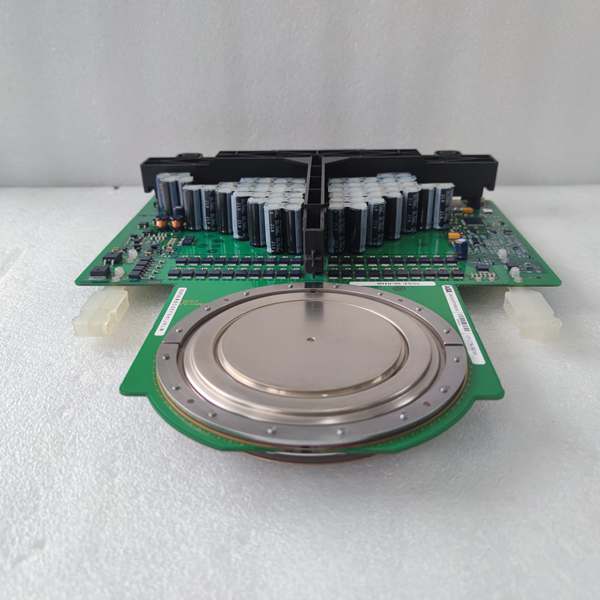
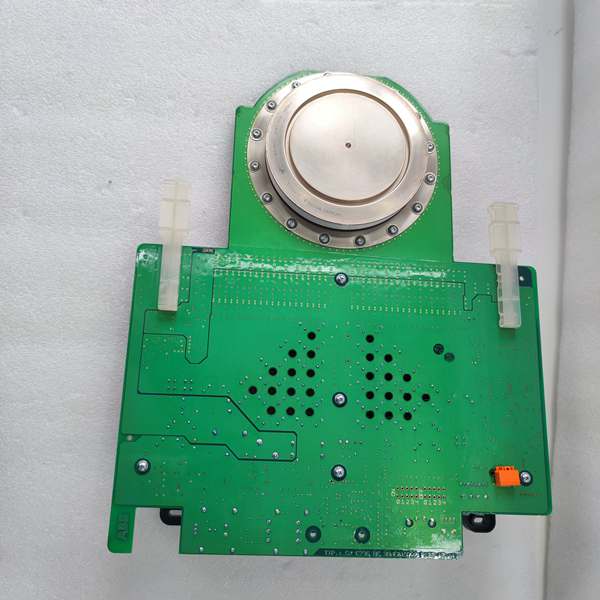
- Dimensions: 210mm×135mm×75mm (press-pack housing)
- Certifications: IEC 60747-10, UL 1557, ATEX Zone 2
- Gate Driver Compatibility: GVC736BE101 (v1.5+), GVC750BE101 (with adapter)
- Mounting Torque: 12 N·m (power terminals); 2.5 N·m (control terminals)

ABB 5SHX1960L0006
Field Application & Problem Solved
In power generation and heavy industry, the biggest challenge is balancing high power density with reliable switching in medium-voltage systems. Legacy GTO thyristors require bulky snubber circuits that increase system complexity and failure points, while early IGBT modules can’t handle the high di/dt demands of large synchronous generators and industrial motors. In power plants, excitation system failures due to unreliable semiconductors cause costly generator trips—one Midwest coal plant reported 5 unplanned outages in a single year, each costing $250k in lost generation.
This asymmetric IGCT module solves both pain points. You’ll find it in hydroelectric, combined-cycle, and pumped-storage power plants controlling synchronous generator excitation systems, in steel mills driving large rolling mill motors, and in refineries powering high-pressure pumps. It’s also a staple in ABB’s ACS6000 medium-voltage drives, which handle 3-27 MW motors up to 3.3 kV. In a Canadian hydro plant, replacing outdated GTO modules with this unit eliminated excitation system failures entirely over a three-year period, while reducing energy loss by 16%.
Its core value lies in its integrated gate technology and asymmetric design. Unlike GTOs, it doesn’t need external snubber circuits, reducing system components by 35% and failure points by 40%. Unlike symmetric IGCTs, it’s optimized for unidirectional power flow, delivering lower conduction losses and higher efficiency in rectifier and excitation applications. For field teams, this means faster installations, simpler troubleshooting, and longer maintenance intervals—often 4+ years in power plant environments, even with daily load variations.
Installation & Maintenance Pitfalls (Expert Tips)
- Liquid Cooling System Contamination Ruins Modules: Rookies often skip proper deionization and filtration, leading to corrosion and blockages in the cooling channels. I saw a steel mill’s module fail in 6 months because they used tap water instead of deionized water—scale buildup restricted flow, causing junction temps to spike to 130°C. Always use a 50/50 deionized water/glycol mix with a 10μm filter, and test conductivity monthly (keep below 10μS/cm).
- Gate Fiber Optic Cable Handling Is Critical: Bending fibers tighter than 50mm radius or routing them near high-power cables introduces signal noise and latency. In a power plant’s excitation system, unshielded gate fibers routed alongside 10kV power cables caused intermittent switching delays, leading to generator voltage fluctuations—rerouting the fibers 30cm away from power cables fixed the issue in 3 hours. Use strain relief clips and avoid sharp bends during installation.
- Pressure-Pack Mounting Torque Must Be Precise: Under-torquing creates thermal resistance gaps; over-torquing cracks the ceramic housing. Use a calibrated torque wrench set to 12 N·m for power terminals—never use pliers or impact tools. I’ve replaced two modules in a refinery where technicians used a pipe wrench to tighten terminals, costing $18k in downtime each.
- Pre-Commissioning Leakage Current Testing Is Overlooked: Off-state leakage current above 8mA indicates a damaged module. Test with a microammeter at 4500V DC—if readings exceed specs, replace immediately. A Florida power plant’s generator tripped during startup because a module with 15mA leakage current arced, taking out the entire excitation system.
- Surge Protection Can’t Be Ignored: While the module has built-in protection, external surge arresters are necessary for grid-connected applications. In a wind farm’s ACS6000 drive system, a lightning strike damaged three modules because they lacked proper surge protection—installing MOV arresters (4.8kV rating) prevented future failures.
ABB 5SHX1960L0006
Technical Deep Dive & Overview
This module is an asymmetric integrated gate-commutated thyristor (IGCT), a power semiconductor optimized for unidirectional power flow applications like rectifiers and excitation systems. At its core is a non-punch-through (NPT) silicon die that blocks 4500V in the forward direction while allowing fast reverse recovery—eliminating the need for external freewheeling diodes in many applications.
The module’s operation hinges on its gate drive interaction. During turn-on, a high-current positive gate pulse (up to 800A peak) injects carriers into the die, creating a low-resistance path for current flow. To turn off, a negative gate pulse extracts these carriers, rapidly cutting off anode current in ≤6.0μs without relying on external commutation circuits. This design delivers faster switching than GTOs while maintaining lower conduction losses than IGBTs in high-power applications.
In excitation systems, it controls the flow of current to the generator’s rotor windings, regulating output voltage and reactive power. In ACS6000 drives, multiple modules are connected in series to handle 3.3kV voltage levels, with each module switching at precise intervals to create a sinusoidal output waveform. The module’s pressure-pack housing ensures consistent thermal performance and voltage balancing, even with component tolerances or temperature variations.
What makes it stand out in harsh environments is its robustness: the corrosion-resistant stainless steel housing handles humidity and chemical exposure in power plants and refineries, while the simplified design reduces sensitivity to vibration compared to complex GTO-based systems. It communicates with the system controller via the gate driver, providing real-time data on current, temperature, and status—critical for predictive maintenance in remote power generation facilities.