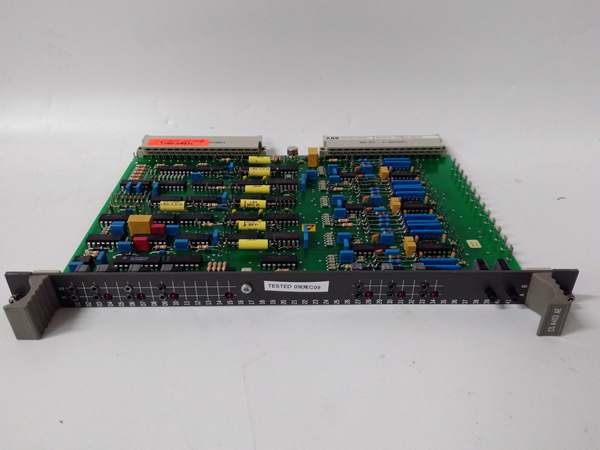
Description
Key Technical Specifications
- Model Number: 3HNM09400-1
- Manufacturer: ABB Robotics Division
- Safety Certifications: SIL 2 (IEC 61508), PL d (ISO 13849-1), Category 3 (EN 954-1)
- Safety Input Channels: 8 dual-channel (configurable PNP/NPN, 24VDC)
- Safety Output Channels: 4 (24VDC, 3A continuous per channel, NO/NC configurable)
- Power Supply: 24VDC ±10% (1.5A max current draw)
- E-Stop Response Time: ≤8ms (full signal-to-output shutdown)
- Isolation Rating: 2500VDC (input-output-control circuit isolation)
- Operating Temperature: 0°C to 45°C (ambient)
- Mounting Type: 35mm DIN rail (IRC5 controller cabinet-compatible)
- Diagnostic Features: Channel status LEDs, 30-event fault logging, short-circuit detection, power supply monitoring
- Compatible Controllers: ABB IRC5 Compact, IRC5 Single, IRC5 Dual
- Weight: 0.65kg
- Protection Class: IP20 (panel-mounted in controller cabinet)

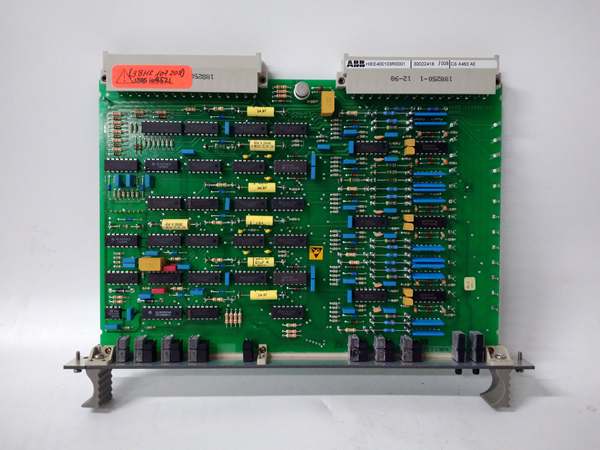
ABB CSA463AE
Field Application & Problem Solved
In robot-intensive manufacturing—automotive assembly, electronics production, material handling—the biggest safety challenge is reliable interlock monitoring and rapid E-Stop execution. Legacy safety relays lack dual-channel redundancy and diagnostic capabilities, leading to false shutdowns or, worse, failed safety triggers. In a Detroit automotive plant, outdated relays caused 3 unplanned line stops in 6 months due to intermittent interlock signals, costing $180k in downtime.
This module solves both compliance and reliability gaps. You’ll find it in welding robot cells monitoring safety gates, electronics assembly lines integrating light curtains, and palletizing systems validating two-hand controls. It’s the go-to for IRC5-based robots where human-robot proximity is unavoidable—its SIL 2/PL d certification meets global safety standards, eliminating audit headaches. In a Mexican electronics plant, retrofitting with this module reduced safety-related downtime by 90% and simplified OSHA compliance documentation.
Its core value is balancing ruggedness with smart safety. Unlike generic safety relays, it’s engineered for IRC5’s safety bus, ensuring seamless communication without integration glitches. The dual-channel inputs prevent single-point failures, while built-in diagnostics pinpoint issues (e.g., open E-Stop wiring) in minutes—no need for manual circuit tracing. For field teams, this means faster troubleshooting, fewer false alarms, and confidence that safety functions won’t fail when needed most.
Installation & Maintenance Pitfalls (Expert Tips)
- Dual-Channel Input Wiring Is Non-Negotiable: Rookies often wire E-Stop buttons to a single input channel, bypassing redundancy. This violates PL d requirements and creates a safety blind spot. Always wire critical devices (E-Stop, safety gates) to paired input channels (e.g., CH1/CH2) and verify continuity with a multimeter—one open channel should trigger a fault.
- Don’t Overload Output Channels: Each output is rated for 3A continuous—hooking up high-current devices (e.g., large safety brakes) without an external contactor burns out the module. I saw this ruin a module in 2 weeks at a warehouse palletizing cell. Use ABB MS132 safety contactors for loads exceeding 2.5A to protect the module’s internal relays.
- Grounding Separates Safety from Noise: Improper grounding introduces electromagnetic interference (EMI), causing erratic input signals. Mount the module on a grounded DIN rail, connect the safety ground terminal to the controller’s chassis ground, and keep safety wiring 30cm away from power cables. A Cincinnati plant fixed intermittent light curtain faults by re-routing safety wiring away from robot motor cables.
- Skip Functional Testing at Your Peril: Technicians often skip post-installation safety tests to save time. Always verify E-Stop response time with an oscilloscope (target ≤8ms) and test all interlocks—one missed fault could lead to a safety incident. In a Canadian automotive plant, a skipped test led to a non-functional safety gate interlock that wasn’t discovered until a near-miss.
- DIP Switch Configuration Must Match Wiring: The module’s DIP switches set input type (PNP/NPN) and output mode (NO/NC). Mismatched settings cause non-responsive inputs or failed outputs. Label switches after configuration and document in the maintenance log—this prevents confusion during future upgrades.
ABB CSA463AE
Technical Deep Dive & Overview
This module is a dedicated safety relay for IRC5 robots, acting as an independent safety layer between field devices and the robot’s motion controller. It operates on a dual-channel monitoring principle: critical safety signals (E-Stop, interlocks) are wired to paired inputs, which the module cross-validates to prevent false triggers or failed detections. If one channel fails or signals mismatch, the module immediately de-energizes the safety outputs, halting robot motion.
Internally, a dedicated safety microprocessor executes preconfigured logic (no user-programmable code—factory-set for standard safety functions) with a response time under 8ms. It communicates with the IRC5 controller via the safety bus, sending status updates and fault codes without compromising safety integrity—even if the main controller malfunctions, the module maintains independent safety oversight.
The 4 configurable outputs control robot motion enable, safety brakes, and alarm indicators. Short-circuit detection on outputs prevents module damage, while LED status lights (one per input/output) provide at-a-glance diagnostics. The 2500VDC isolation protects against EMI, critical in welding cells or motor-dense environments where electrical noise is rampant.
What makes it field-reliable is its simplicity: no complex programming, just hardwired safety logic and plug-and-play IRC5 integration. It’s built to withstand the vibration and temperature swings of manufacturing floors, with a design that prioritizes fail-safe operation over unnecessary features—exactly what’s needed for safety-critical robot applications.