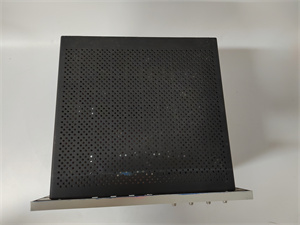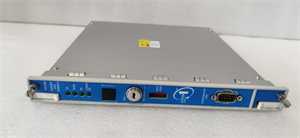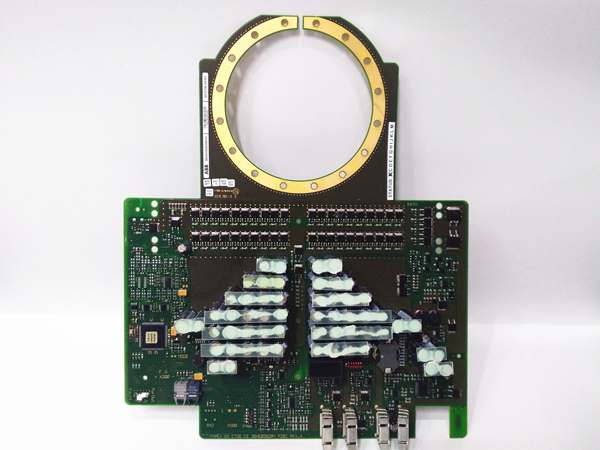
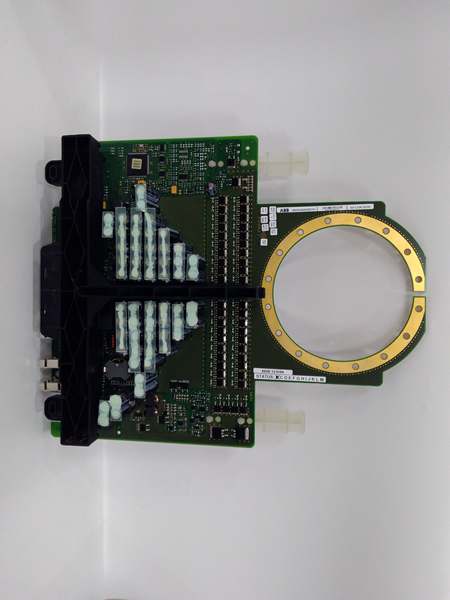
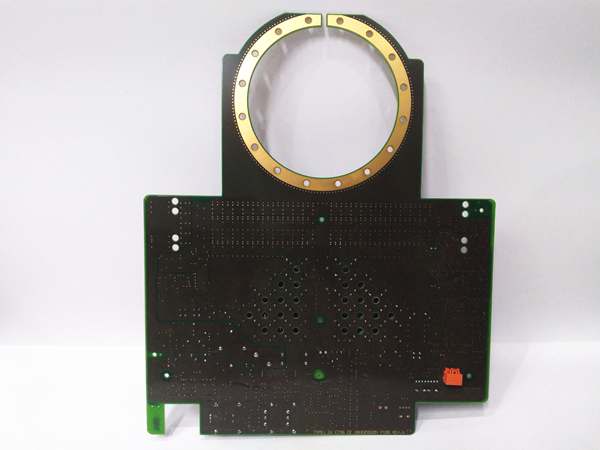
Description
Key Technical Specifications
-
Model Number: 3BHB030310R0001 GVC736CE101
-
Manufacturer: ABB Drives & Controls
-
Firing Channels: 6 independent channels (matches 3-phase full-bridge thyristor configuration)
-
Input Signal: 0-10V DC control signal (from drive CPU); 4-20mA current feedback input
-
Output Type: Isolated pulse (via 6 integrated pulse transformers)
-
Isolation Rating: 2kV AC (output to control circuit); 5kV AC (output to power circuit)
-
Operating Voltage: 24VDC ±10% (control power); derived from drive internal power supply
-
Operating Temperature: -10°C to +55°C (derate 5% above 45°C)
-
Response Time: ≤10μs (from control signal input to firing pulse output)
-
Physical Design: PCB-mounted (fits ACS800 drive power unit), 180mm×120mm×30mm (W×H×D)
-
Protection Functions: Over-temperature (thermal shutdown at 65°C), under-voltage lockout
-
Certifications: IEC 61800-5-1, CE, UL 61800-5-1

3BHB030310R0001 GVC736CE101
Field Application & Problem Solved
In high-power drive applications—steel mill rolling mill drives, mine hoist systems, and marine diesel-electric propulsion—the biggest risk isuncontrolled thyristor switching. Thyristors (SCRs) in 500kW+ drives rely on precise firing pulses to regulate power; a delayed or distorted pulse causes uneven current, leading to drive tripping, thyristor burnout, or even mechanical damage to motors. I once saw a 1.2MW mine hoist drive fail because a legacy firing module sent jittery pulses—this fried three $15k thyristors and shut down the mine for 48 hours.
You’ll find the GVC736CE101 mounted in the power cabinet of ACS800 high-voltage drives, directly interfacing with the thyristor bridge. It’s the “nerve center” of the drive’s power stage, translating low-voltage control signals from the CPU into high-isolation firing pulses for thyristors. Its core value ismillisecond-level pulse precision: the module’s internal timing circuit ensures firing pulses align with the AC voltage zero-crossing, eliminating current spikes. At a Pennsylvania steel mill, retrofitting old firing modules with this model cut thyristor-related failures by 92%—saving $120k in replacement parts in the first year.
Another unbeatable value is its robust isolation. High-power drives generate massive electromagnetic interference (EMI); the module’s 5kV AC isolation between the control and power circuits blocks EMI from corrupting firing signals. This is critical in marine applications, where salt air and vibration amplify signal noise—something I confirmed during a cruise ship propulsion drive overhaul, where the GVC736CE101 maintained stable pulses despite extreme EMI from the ship’s generators.
Installation & Maintenance Pitfalls (Expert Tips)
Pulse Transformer Wiring Polarity Is Non-Negotiable
Each firing channel connects to a thyristor’s gate via a pulse transformer. Rookies reverse the transformer’s primary wires, causing the thyristor to fire at the wrong phase angle—this leads to “current unbalance” faults and drive tripping. The module’s terminal block is clearly marked (e.g., “T1+”, “T1-” for Channel 1); use a multimeter in diode mode to verify transformer polarity before powering on. I fixed a steel mill drive in 20 minutes by correcting this mistake—they’d wasted 8 hours replacing thyristors unnecessarily.
Thermal Management Is Make-or-Break
The module’s internal power transistors generate heat, but technicians often block its cooling vents with cable ties or ignore fan failures. At 65°C, the module triggers a thermal shutdown, tripping the drive. Mount the module with at least 50mm of clearance above/below for airflow, and check the drive’s cooling fan status during PMs. A Chilean copper mine’s hoist drive tripped 11 times in a month until we cleaned the blocked vents—post-fix, it ran fault-free for 6 months.
Control Signal Shielding Stops EMI-Related Jitter
The 0-10V control signal from the drive CPU is vulnerable to EMI from nearby power cables. Unshielded cables cause pulse jitter, leading to “firing pulse error” alarms. Use twisted-pair shielded cable for the control input, and ground the shield only at the module end—grounding both ends creates ground loops. A Norwegian marine drive had persistent jitter until we re-routed the control cable away from 480V power lines and fixed the shield grounding.
Pre-Commissioning Pulse Test Saves Catastrophe
Never power on the drive with a new module without testing firing pulses first. Use an oscilloscope to verify pulse shape (10μs width, 5V amplitude) and timing (aligned with AC voltage zero-crossing). A Canadian pulp mill skipped this step and fried a $20k thyristor bridge—their new module had a factory defect that would’ve been caught with a 5-minute scope test.
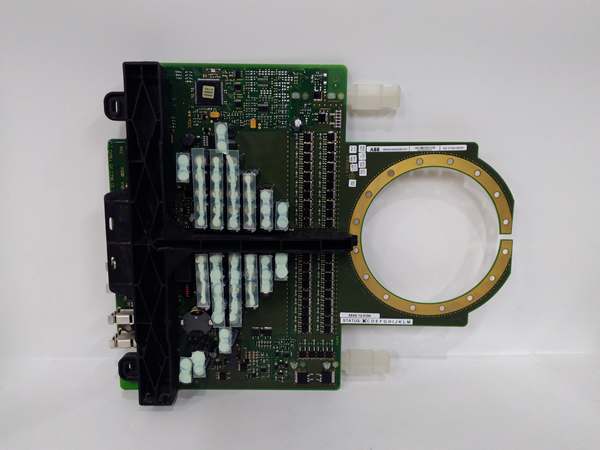
3BHB030310R0001 GVC736CE101
Technical Deep Dive & Overview
The GVC736CE101 is a dedicated thyristor firing module for ABB’s ACS800 high-power drives, designed to bridge the gap between low-voltage control logic and high-voltage power circuits. At its core, a precision timing ASIC (application-specific integrated circuit) synchronizes firing pulses with the drive’s AC input voltage—this synchronization ensures thyristors switch on at the exact phase angle needed to regulate output current smoothly.
The module receives a 0-10V control signal from the drive’s CPU (e.g., RDCU-02) that dictates the desired firing angle. The ASIC converts this analog signal into a digital timing command, then triggers the pulse transformers to generate isolated firing pulses for each thyristor. The pulse transformers are critical: they electrically isolate the low-voltage control circuit from the thyristor’s high-voltage (up to 10kV) power circuit, preventing voltage spikes from damaging the module or CPU.
Unlike generic firing modules, it’s calibrated for ABB’s specific thyristor models (e.g., 5STP series), optimizing pulse energy to ensure reliable triggering even at low temperatures. Its thermal shutdown circuit monitors internal temperature via a built-in thermistor, cutting power to the pulse transformers if overheating is detected. Built with conformal-coated PCBs to resist dust and moisture in industrial environments, it’s rated for 8-10 years of operation in harsh settings—making it the backbone of ACS800 drive power control.