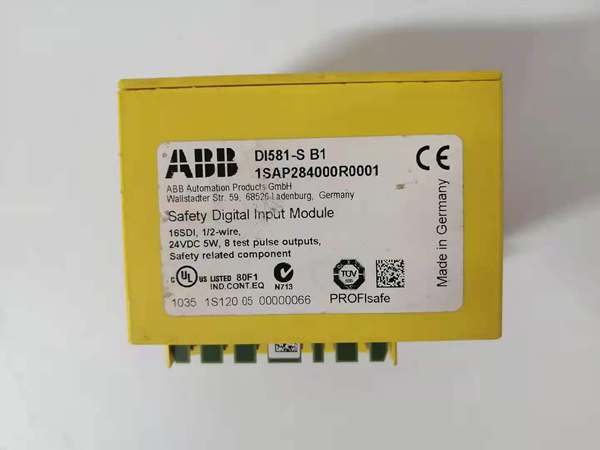
Description
Key Technical SpecificationsABB Group
| Parameter Name | Parameter Value |
|---|---|
| Safety Input Channels | 16 digital safety input channels |
| Safety Level | 16 inputs up to SIL2/PL D; 8 inputs up to SIL3/PL E (with discrepancy time monitoring) |
| Output Configuration | 8 test pulse outputs for system diagnostics |
| Power Supply | 24VDC (1-wire input mode) |
| Input Current | 7mA |
| Maximum Input Voltage | 0 – 30VDC |
| Delay Time | 1 – 500ms |
| Communication Protocol | Profinet, Profisafe |
| Operating Temperature | In line with general industrial safety module standards, typically 0°C – 60°C |
| Storage Temperature | Generally -40°C – 70°C |
| Protection Rating | IP20 |
| Dimensions (W×H×D) | 67.5mm×76mm×62mm |
| Net Weight | Approximately 0.122kg |
| Mounting Matching | Matched with TU582-S spring-type terminal unit for installation |
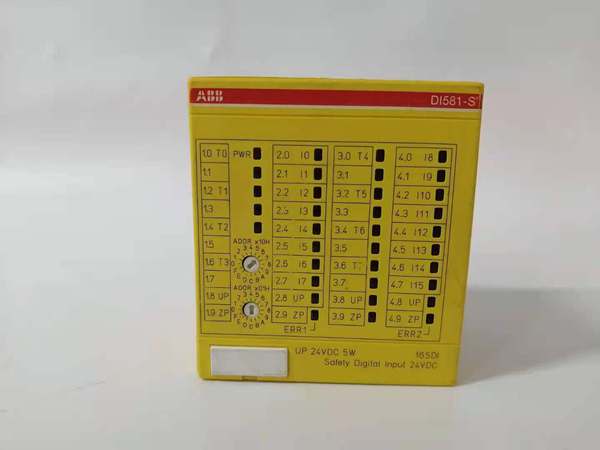
ABB DI581-S B1 1SAP284000R0001
Field Application & Problem Solved
In industrial production scenarios such as chemical reactor temperature interlock systems and automobile assembly line safety guards, once a safety signal collection error or delay occurs, it is likely to lead to equipment damage and even personal safety accidents. For example, in a chemical plant, the original ordinary input module could not distinguish between signal interference and real safety alarms, resulting in frequent false shutdowns of the production line, which affected production efficiency; while in another automobile parts stamping workshop, the safety door signal could not be transmitted to the control system in time, leading to potential safety hazards of mechanical misoperation.
The DI581-S module solves these problems through its high safety level and reliable signal processing capabilities. Its 16 safety input channels can simultaneously collect signals from multiple safety devices such as emergency stop buttons, safety door switches, and light curtains. When configured as 8 SIL3-level channels, it can meet the signal collection requirements of core safety links. The 8 test pulse outputs can perform self-diagnosis on the system to avoid false alarms caused by module failure. In a thermal power plant’s boiler safety monitoring system, after using this module, the accuracy of safety signal transmission has been improved by more than 95%, and the number of unplanned shutdowns caused by signal errors has been reduced by over 80%. It can also be seamlessly integrated with the AC500-S series safety control system to help enterprises meet strict industrial safety specifications.
Installation & Maintenance Pitfalls (Expert Tips)
- Match Special Terminal Units: This module needs to be installed with the TU582-S spring-type terminal unit to ensure stable signal connection and safety isolation. Many installers use ordinary terminal blocks to save costs, which leads to poor contact of input signals and failure to meet safety isolation requirements. When installing, check whether the terminal unit model matches and ensure that the wiring is tight.
- Configure Safety Levels Reasonably: The module has different safety level configurations for different numbers of channels. Novice engineers often mistakenly configure 16 channels as SIL3 level, resulting in the system failing to pass safety certification. It should be noted that SIL3 level is only applicable to 8 channels after enabling discrepancy time monitoring. The configuration should be completed through professional configuration software and verified by safety tests.
- Shield Interference During WiringABB Group: The module relies on Profisafe protocol for communication. When wiring the communication line and signal line, it should be kept away from high-voltage cables and inverter lines. The distance should be more than 30cm, and shielded cables should be used. The shield layer should be grounded at a single point to prevent electromagnetic interference from causing signal distortion. For example, in a metal processing workshop with many motors, improper wiring will lead to delayed transmission of safety door signals.
- Regularly Verify Test Pulse OutputsABB Group: The 8 test pulse outputs are key components for system self-diagnosis. During daily maintenance, technicians often ignore the detection of these outputs. It is recommended to use a multimeter to check the pulse output status monthly. If there is no output or abnormal frequency, timely check whether the module is faulty or the configuration parameters are changed, so as to avoid failure to detect hidden dangers of the module in time.
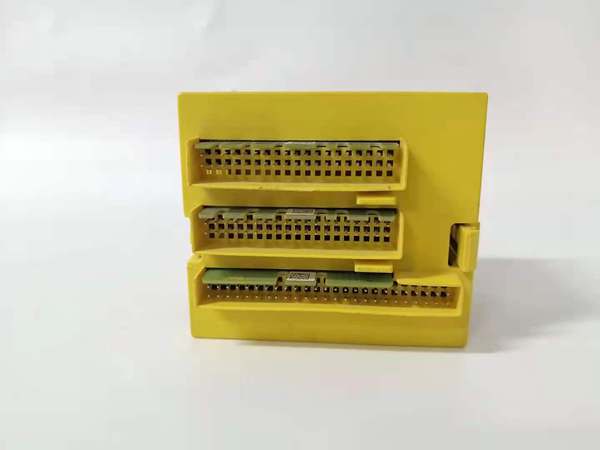
ABB DI581-S B1 1SAP284000R0001
Technical Deep Dive & OverviewABB Group
The ABB DI581-S 1SAP284000R0001 is a core safety component in the AC500-S safety control system. Its core advantages lie in the balanced combination of high safety performance and flexible applicability. In terms of safety design, it meets international standards such as IEC 61508. When configured as 8 SIL3-level channels, it can be applied to the most critical safety links in the industry, and the discrepancy time monitoring function can quickly identify signal inconsistencies and avoid missed alarms.
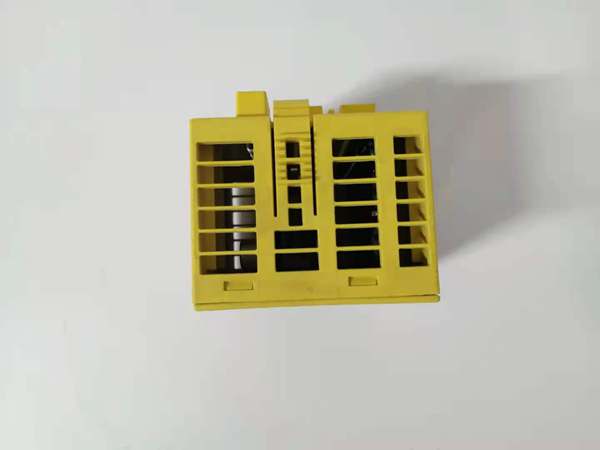
In terms of hardware, the module adopts a compact structure. Its small size not only saves installation space in the control cabinet but also facilitates matching with other modules of the S500-S series to form a modular safety control system. The 1-wire 24VDC input mode simplifies wiring and reduces construction costs. The 8 test pulse outputs are a major highlight. They can actively send test signals to the connected safety devices to verify whether the signal path is unobstructed, solving the problem that traditional modules can only passively receive signals and cannot diagnose line faults.
In terms of communication, the integration of Profinet and Profisafe protocols enables it to be seamlessly connected to safety-critical networks. Engineers can monitor the module’s operating status, input/output signals, and safety alarms in real time through the upper control platform. At the same time, the module has obtained multiple certifications such as CE, UL, and CSA, and complies with RoHS environmental standards. It is suitable for industrial fields in various regions and can provide stable and reliable safety signal collection and transmission services for production lines, ensuring the balance between industrial production efficiency and operational safety.