Product Core Brief
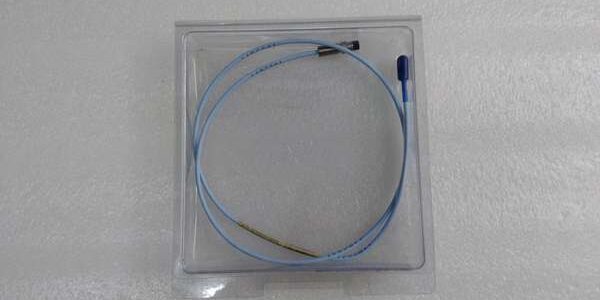
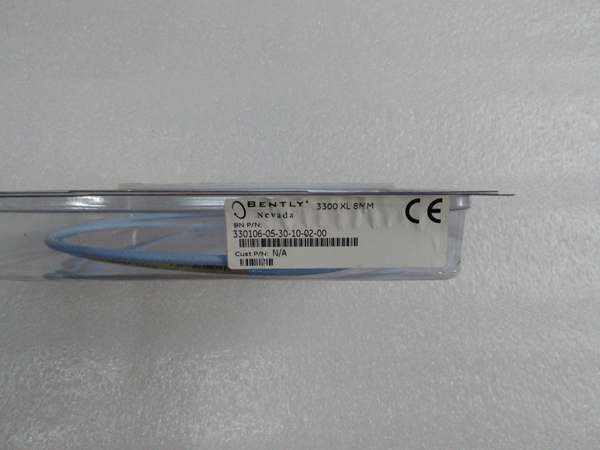
- Model: 330106-05-30-10-02-00
- Brand: Bently Nevada
- Series: 3300 XL 8mm
- Core Function: Non-contact eddy-current probe for measuring shaft relative vibration, axial displacement, and keyphasor in reverse-mount applications.
- Product Type: Reverse Mount Proximity Probe
- Key Specs: 8mm Tip | M10x1 Thread | 1m Cable | 2mm Linear Range
- Condition: New Surplus / Original OEM
Bently 330105-02-12-10-02-CN
Key Technical Specifications
- Manufacturer: Bently Nevada
- Part Number: 330106-05-30-10-02-00
- Product Category: 3300 XL 8mm Reverse Mount Eddy-Current Probe
- Tip Diameter: 8 mm
- Thread: M10 x 1 (Metric)
- Cable Length: 1 meter (integrated)
- Sensitivity: 7.87 mV/µm (200 mV/mil) ±5%
- Linear Range: 2.0 mm (approx. 80 mils)
- Recommended Gap: 1.27 mm (-10 VDC typical)
- Operating Temp: -52°C to +177°C (Standard)
- Compliance: API 670
Product Introduction (No Fluff)
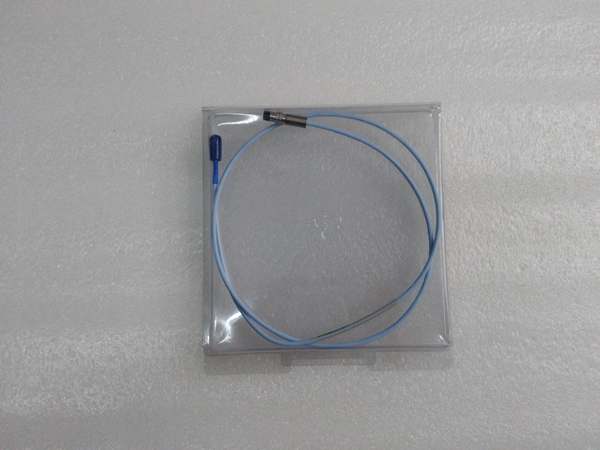
The 330106-05-30-10-02-00 is a reverse-mount proximity probe designed for installation from the outside of a bearing housing or bracket, where the threaded portion engages a tapped hole and the sensing tip faces inward toward the shaft. This configuration is essential when internal access is impossible or when the bracket geometry requires external mounting.
As part of the 3300 XL 8mm system, this probe provides high-fidelity dynamic vibration and static position data to the proximitors. The 1-meter integrated cable requires an extension cable to reach the proximitors, offering flexibility in routing. Sourcing this exact OEM part ensures calibration integrity, preventing false trips and data loss caused by degraded coils or non-linear response in aged probes.
QA & Testing SOP (Dynamic & Transparent)
Every 330106-05-30-10-02-00 undergoes a rigorous validation process:
- Anti-Counterfeit Inspection: Verify Bently Nevada laser etching, tip epoxy finish, and cable jacket markings against OEM baselines.
- Electrical Validation: DC resistance check and insulation impedance test (>2 MΩ) to rule out internal shorts or moisture ingress.
- Sensitivity Verification: Calibrated target simulator test to confirm 7.87 mV/µm output is within ±5% tolerance across the linear range.
- Visual Inspection: Tip face examined for scratches, oxidation, or pitting that would distort the gap voltage signal.
- Packaging: Shipped in anti-static shielding with a printed QA test report.
Bently 330105-02-12-10-02-CN
Installation Pitfalls & Guide (Engineer to Engineer)
❗ Reverse Mount Geometry: Unlike standard probes, the threads are on the sensing end. Ensure the mounting hole is tapped M10x1 and has sufficient clearance for the probe body. Do not overtighten. The housing is stainless steel, but the internal ceramic insulator is brittle. Torque to spec (typically ~2.3 N·m) using a thin-wall socket or open-end wrench.
❗ Gap Voltage Target: For an 8mm probe with 200 mV/mil sensitivity, set the static gap voltage to -10.0 VDC ± 0.2 VDC (or the specific midpoint on the calibration sheet). This centers the probe in its 2mm linear range, allowing symmetric positive/negative vibration swing. Never set gap voltage based on mechanical measurement alone; always use the proximitors’ voltage readback.
❗ Cable Management: The 1m integrated cable is short. Use the correct extension cable (e.g., 330130-040-00-00 for 4m total system length) to reach the proximitors. Never splice the probe cable. Splices introduce impedance mismatches and noise. Ensure the ClickLoc connector is fully seated and locked; a loose connection causes intermittent signal loss.
❗ Ground Loops: The probe shield must be grounded at the proximitors only. Grounding the shield at the reverse-mount bracket creates a ground loop that injects 50/60 Hz hum into the vibration signal. Verify the bracket is isolated from machine ground if necessary.
Replacement Protocol:
- Pre-Install: Lock out proximitors power. Verify 0 VDC at the extension cable. Clean the M10x1 mounting hole threads.
- Removal: Unscrew the old probe. Inspect the extension cable connector for bent pins or corrosion.
- Install: Hand-thread the 330106-05-30-10-02-00 into the bracket. Torque to spec. Connect the extension cable and verify the O-ring seal.
- Power-on Test: Restore power. Monitor gap voltage. Adjust probe depth (if adjustable) or verify fixed gap until -10.0 VDC is achieved. Lock the jam nut while holding the probe body to prevent rotation.
Technical FAQ
Is this an exact drop-in replacement for my older 330106 probe?
Yes, provided your system is 3300 XL 8mm with 200 mV/mil sensitivity. The “10” in the part number indicates a 1-meter cable length. Verify this matches your run distance when combined with the extension cable. If replacing a 3300 (non-XL) probe, check the sensitivity match, as older probes may differ.
Why is this listed as “New Surplus” instead of factory-new?
This is genuine Bently Nevada stock that was never deployed on a turbine or compressor. It has been stored in climate-controlled inventory rather than exposed to oil mist, steam, and vibration. You receive the exact same calibration stability and lifespan as a factory-fresh unit, typically at a significantly lower cost and without the 12-week lead time.
Can I hot-swap this probe while the proximitors are powered?
Technically yes, but don’t. Disconnecting the probe under power can cause a transient voltage spike that may damage the proximitors’ internal oscillator or input stage. It takes 30 seconds to power down the channel. Do it safely.
What is the warranty coverage on this part?
We provide a standard 12-month functional warranty. If the probe fails open, shorted, or drifts out of calibration under normal operating conditions within that window, we replace it. Our QA testing proves the probe met sensitivity specs before it left our bench.
My vibration readings are noisy. Is this probe bad?
Not necessarily. Before replacing the 330106-05-30-10-02-00, check the extension cable for continuity and shield integrity. Verify the proximitors’ gap voltage is stable. Noise is often caused by a loose ClickLoc connector, a grounded shield at the wrong end, or EMI from a nearby VFD. Only replace the probe if electrical tests confirm an internal coil fault.