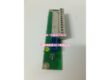
Product Core Brief
- Model: DSQC633
- Brand: ABB
- Series: ABB IRC5 Robot Controller Serial Measurement Board (SMB)
- Order Code: 3HAC022286-001 (standard variant)
- Core Function: Serial Measurement Board (SMB) for ABB IRC5 robot controllers, processing resolver/encoder feedback signals from robot joints to provide real-time position data for closed-loop motion control.
- Product Type: Serial Measurement Board / SMB Module
- Key Specs: Resolver/encoder signal processing | Up to 7 analog feedback channels | 24VDC backplane power | Galvanic isolation | Fault self-diagnosis
- Note: Condition: New Original (New Surplus). Compatible with IRC5 standard and compact controller variants.
Key Technical Specifications
| Parameter | Value |
|---|---|
| Device Model | |
| Device Type | Serial Measurement Board (SMB) |
| Series | ABB IRC5 Robot Controller SMB Module |
| Standard Order Code | 3HAC022286-001 |
| Core Function | Resolver/encoder signal acquisition and digitization |
| Input Channels | Up to 7 analog feedback channels (resolver/encoder) |
| Communication Interface | High-speed serial bus to IRC5 axis computer |
| Power Supply | 24VDC from IRC5 controller backplane (redundant design) |
| Operating Temperature | -25°C ~ +70°C |
| Storage Temperature | -40°C ~ +85°C |
| IP Rating | IP20 (inside control cabinet) |
| Isolation Voltage | 2.5 kV (bus-to-internal circuit) |
| Safety Certification | CE, UL, ISO 13849-1 (SIL2 compatible) |
| Mounting | DIN rail or backplane mount in IRC5 control cabinet |
| Weight | Approx. 0.36~0.5 kg |
| Compatible Controllers | ABB IRC5 series (standard and compact variants) |
| Compatible Robots | ABB IRB series (e.g., IRB 120, IRB 2600, IRB 6600, IRB 6700, etc.) |
| Self-Diagnosis | Built-in loop self-check and fault code logging |
| Typical Applications | Robot joint position feedback, external axis coordination, encoder signal processing |
| Condition | New Original (New Surplus) |
Product Introduction
The ABB DSQC633 is a Serial Measurement Board (SMB) designed for ABB IRC5 robot controllers. It serves as the critical interface between the robot’s physical joints and the controller’s motion processing system, converting analog resolver/encoder signals from each joint into digital position data that the IRC5 axis computer can process for real-time closed-loop control.
In an IRC5 robot system, precise motion control depends entirely on accurate feedback from each joint’s resolver or encoder. The DSQC633 receives these analog feedback signals, conditions and digitizes them, then transmits the position, velocity, and acceleration data to the axis computer via a high-speed internal serial bus. This data enables the controller to execute TrueMove and QuickMove motion algorithms with sub-millimeter path accuracy.
The module supports up to 7 analog feedback channels simultaneously, which is sufficient to cover a standard 6-axis robot plus one external axis (such as a positioner or track drive). This makes it suitable for most IRC5 applications, from simple pick-and-place cells to complex multi-robot coordination with external axes.
Built-in self-diagnosis continuously monitors the integrity of the feedback loop. When encoder signal anomalies are detected—such as open circuits, short circuits, or signal degradation—the module logs specific fault codes that can be read through the teach pendant or RobotStudio, enabling rapid troubleshooting without external test equipment.
The DSQC633 is powered by the IRC5 controller’s 24VDC backplane supply with redundant design, ensuring stable operation even during transient power fluctuations. Galvanic isolation of 2.5 kV between the bus and internal circuitry protects the controller from electrical noise generated by servo drives and other high-power equipment in the cabinet.
Common applications include:
- Automotive welding cells: Processing resolver feedback from 6-axis welding robots to maintain precise torch positioning during seam tracking.
- Material handling: Converting encoder signals from IRB 6600/6700 palletizing robots for accurate box placement and layer pattern execution.
- Machine tending: Providing joint position feedback for IRB 2600 robots loading/unloading CNC machines, ensuring repeatable approach and retract paths.
- External axis coordination: Processing feedback from rotary positioners or linear tracks to synchronize robot motion with workpiece positioning.
For maintenance teams supporting IRC5 installations, the DSQC633 is a direct drop-in replacement for failed or degraded SMB modules. When replacing, verify that the order code (3HAC022286-001) matches the original and that the hardware revision is compatible with your controller version. Note that different hardware variants exist (e.g., DSQC633A with order code 3HAC031851-001, DSQC633C with 3HAC043904-001), each corresponding to different controller versions or axis configurations—always cross-reference the full 3HAC number with your controller’s hardware documentation before ordering.
QA & Testing SOP
Every unit goes through a structured verification process before shipment:
- Visual Inspection: Check the PCB for cracks, burnt components, corrosion on connector pins, and physical damage to the board. Verify that all components (serial bus connector, resolver input terminals, surface-mount ICs, isolation barriers) are securely mounted with no cold joints or solder bridges. Inspect the module housing and mounting clips for damage.
- Connector Pin Verification: Inspect all resolver input connectors and the serial bus connector for straightness, corrosion, or bending. Verify that connector pins are intact, as bent pins cause signal loss or intermittent feedback failures.
- Power-On Self-Test: Install the module in an IRC5 controller rack and apply power. Verify that the module powers up correctly and that no SMB-related fault codes are reported by the controller. Check for any abnormal heating during the initial power-on.
- Channel Continuity Test: Verify that each of the 7 analog feedback channels has proper continuity from the input connector to the signal conditioning circuitry. Check for open circuits or short circuits between channels.
- Signal Conditioning Test: Apply a known resolver/encoder simulation signal to each channel and verify that the module correctly digitizes and transmits the position data to the axis computer. Confirm that the reported position values match the simulated input within specification.
- Isolation Test: Verify that the 2.5 kV galvanic isolation between the bus and internal circuitry is intact. This test ensures that electrical noise from servo drives does not propagate to the controller or corrupt position feedback data.
- Self-Diagnosis Verification: Simulate a feedback signal fault (open circuit) on a test channel and verify that the module correctly logs the fault code and reports it to the controller. Confirm that the fault is cleared when the signal is restored.
- Anti-Counterfeit & Packaging: Verify authenticity markings on the PCB and components. Each unit is shipped in anti-static protective packaging with desiccant to prevent moisture absorption and connector oxidation during transit.
Installation Pitfalls & Guide
Installing or replacing an SMB module requires careful attention to signal wiring, connector integrity, and proper handling.
❗ Power-Down Before Installation: Always disconnect power to the IRC5 controller before removing or inserting the DSQC633 module. Although the module connects via the backplane, it is strongly recommended to replace it with power off to prevent electrical damage to the module or the controller’s backplane connector.
❗ Anti-Static Protection: Always wear an anti-static wrist strap when handling the DSQC633 module. The PCB contains sensitive analog signal conditioning components that can be damaged by electrostatic discharge (ESD). Handle the module by its edges only, avoiding contact with components or connector pins.
❗ Verify Order Code Compatibility: Before ordering a replacement, document the full order code (3HAC number) from the original module. DSQC633 has multiple hardware variants (DSQC633, DSQC633A, DSQC633C) with different 3HAC codes corresponding to different controller versions and axis configurations. Installing an incompatible variant can cause communication failures or incorrect position readings.
❗ Document Resolver Wiring: Before removing the original module, carefully document all resolver/encoder wiring connections. Label each cable with its corresponding axis number (Axis 1 through Axis 6/7). Incorrect reconnection of resolver cables will cause the robot to report incorrect joint positions, potentially resulting in collisions or unsafe motion.
❗ Verify Serial Bus Connection: Ensure the high-speed serial bus connector between the DSQC633 and the axis computer is securely seated. A loose serial bus connection will cause intermittent communication failures and position data dropouts.
4-Step Replacement Guide:
- Pre-install: Document all resolver/encoder wiring connections and the module’s full order code (3HAC number). Label each resolver cable with its axis number. Back up the IRC5 controller’s system configuration, including calibration data. Verify the replacement module’s model and order code match the original. Prepare anti-static protection, tools, and a resolver simulator for verification.
- Removal: Disconnect power to the IRC5 controller. Wear an anti-static wrist strap. Disconnect all resolver/encoder cables from the module’s input connectors, keeping the axis labels intact. Disconnect the serial bus connector. Release the module’s mounting clips and gently pull the module straight out of the controller rack. Inspect the controller’s backplane connector and serial bus connector for damage or debris.
- Install: Align the new DSQC633’s backplane connector with the controller rack slot guides. Push firmly and evenly until fully seated. Secure the module with the mounting clips. Reconnect the serial bus connector, ensuring it is fully seated. Reconnect all resolver/encoder cables to the correct axis terminals according to the documented labels. Double-check each connection before proceeding.
- Power-on Test: Apply power to the IRC5 controller. Verify that the module powers up correctly and that no SMB-related fault codes are reported by the controller. Use the teach pendant to verify that all joint positions are being read correctly—manually move each axis and confirm the reported position changes smoothly and accurately. If the robot requires recalibration after SMB replacement, follow ABB’s calibration procedure using the teach pendant. Monitor the module for several minutes to confirm stable operation.
Technical FAQ
1. What is the DSQC633 used for in an IRC5 robot system? The DSQC633 is a Serial Measurement Board (SMB) that processes resolver/encoder feedback signals from the robot’s joints. It converts these analog signals into digital position data that the IRC5 axis computer uses for real-time closed-loop motion control. Without a functioning SMB, the controller cannot determine joint positions and the robot cannot operate.
2. How many axes can the DSQC633 support? The DSQC633 supports up to 7 analog feedback channels simultaneously, covering a standard 6-axis robot plus one external axis (such as a rotary positioner or linear track). For robots without external axes, only 6 channels are used.
3. What are the differences between DSQC633, DSQC633A, and DSQC633C? These are different hardware variants of the same SMB function, each with a different 3HAC order code and compatibility with different IRC5 controller versions:
- DSQC633 (3HAC022286-001): Standard variant for earlier IRC5 controllers.
- DSQC633A (3HAC031851-001): Updated variant for later IRC5 controller revisions.
- DSQC633C (3HAC043904-001): Variant with DeviceNet communication support for distributed I/O applications. Always verify your controller’s hardware revision and cross-reference the 3HAC code before ordering a replacement.
4. What are common symptoms of a failing DSQC633 SMB module? Common symptoms include: Joint position errors or drift reported by the controller; SMB communication fault codes (e.g., encoder data异常 codes in the 4xxx range); robot refusing to move due to missing feedback; intermittent position jumps on one or more axes; and self-diagnosis fault codes logged in the controller’s event log. If you’re experiencing any of these symptoms, check the resolver cable connections first, then use the teach pendant’s diagnostic function to read the specific SMB fault codes.
5. Can the DSQC633 be used with OmniCore controllers? The DSQC633 is designed for ABB IRC5 series controllers. OmniCore controllers use a different hardware architecture and may require different SMB modules. Always verify your controller model and consult ABB’s compatibility documentation before ordering replacement SMB modules. Note that ABB has been transitioning from IRC5 to OmniCore since 2024, with IRC5逐步退出市场 as of 2026.
6. Does the DSQC633 require recalibration after replacement? In most cases, yes. The SMB module stores calibration offsets for each joint. When replacing the SMB, the controller may lose these calibration values and require recalibration using the teach pendant’s calibration procedure. Always back up the controller’s calibration data before removing the original module, and be prepared to recalibrate if the new module does not retain the original calibration offsets.
7. What’s the difference between New Surplus and Refurbished for SMB modules? We supply this unit as New Original (New Surplus)—unused, original factory stock. This comes with a standard 12-month warranty. Refurbished SMB modules carry risks including degraded analog signal conditioning components, weakened isolation barriers, and latent failures in serial communication ICs that may only manifest under full operational load. For a module that is critical to robot position accuracy and safety, new surplus is the safer choice.