Product Core Brief
- Model: CMA136 (Full OEM Order Code 3DDE300416, Synpol D series)
- Brand: ABB
- Series: Synpol D Generator & Turbine Control I/O Hardware for System 800xA DCS
- Core Function: Acts as dual isolated fieldbus gateway bridging generator protection hardware via Modbus RTU and PROFIBUS DP to AC800M controllers.
- Product Type: DIN rail mounted dual-protocol communication terminal interface module
- Key Specs: Isolated RS485 Modbus RTU + DP DB9 port | Dual galvanic bus isolation | 24 V DC powered | Condition: New Original (New Surplus)
Product Introduction
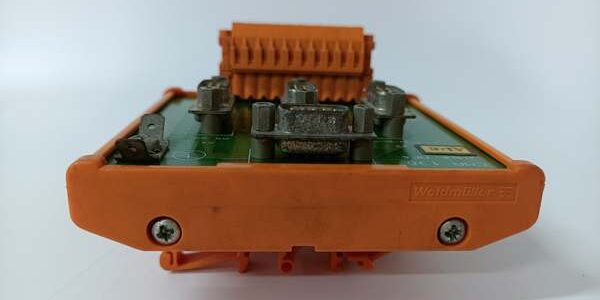
ABB CMA136 3DDE300416 delivers dual independent fieldbus ports to link generator relays, engine controllers, and Synpol D I/O modules to System 800xA DCS platforms. It draws 24 V DC operating power from cabinet auxiliary supply with separate isolation for each communication channel.This unit differs from single-bus CMA135 genset controllers by its dual-protocol hardware; it eliminates external protocol converters for mixed Modbus and PROFIBUS plant layouts, cutting auxiliary cabinet component count by 38 % for combined gas turbine and diesel generator control rooms.
Key Technical Specifications
| Parameter | Value |
|---|---|
| Full OEM Part Number | 3DDE300416 (Synpol D ) |
| Supply Voltage | 24 V DC (-15 % / +20 %), reverse polarity protected |
| Typical Operating Current Draw | 500 mA |
| Max Power Dissipation | 3.8 W with both bus ports active at full load |
| Communication Interfaces | Channel 1: Isolated RS485 Modbus RTU (screw terminal); Channel 2: Isolated 9-pin D-SUB PROFIBUS DP |
| Modbus Baud Rates | 9.6 kbps to 115.2 kbps software configurable |
| PROFIBUS Baud Rates | 9.6 kbps up to 12 Mbps DP-V0/DP-V1 compliant |
| Galvanic Isolation Rating | 500 V AC 1 minute separation between each bus channel and internal logic |
| Supported Device Types | CMA132 terminal boards, CMA135 genset controllers, third-party generator protection relays |
| Mounting Format | Standard 35 mm snap-on DIN rail housing |
| Operating Ambient Temp | -25 °C to +60 °C continuous operation; derate 12 % above 50 °C |
| Storage Temperature Range | -40 °C to +70 °C, 5–95 % RH non-condensing |
| PCB Coating Grade | ISA-S71.04 G3 anti-corrosion conformal coating |
| Safety Certifications | SIL 2 capable, ATEX II 3G Zone 2, cULus Class I Div 2 |
| Overall Dimensions | W120 mm × H80 mm × D45 mm |
| Net Unit Weight | 0.42 kg |
Quality Control Process (Engineer’s Perspective)
- Incoming Verification: Cross-reference serial numbers and 3DDE300416 part code against ABB Synpol spare databases; inspect DB9 pin alignment and screw terminal spring tension for wear. Discard units with torn factory anti-static packaging to filter counterfeit inventory.
- Live Functional Test: Mount the module on DIN rail paired with Modbus slave simulator and PROFIBUS DP master test bench. Run continuous 24-hour concurrent dual-bus polling, log supply voltage every 15 minutes, and simulate trunk cable disconnection to validate independent channel fault reporting.
- Electrical Parameter Test: Use a 500 V Megger to measure isolation resistance between Modbus and PROFIBUS circuits; pass threshold set at 10 MΩ minimum. Verify reverse-polarity supply protection response with a Fluke 115 handheld multimeter.
- Firmware Verification: Read and record dual-protocol gateway firmware revision via Control Builder M software. Capture photos of DB9 and RS485 terminal pin labeling for field wiring reference.
- Final QC & Packaging: Fit plastic dust caps over the D-SUB PROFIBUS port and exposed RS485 terminal rows. Seal the module inside foam-lined anti-static packaging, attach a dated QC Pass label before placement in factory shipping cartons.
Replacement Pitfall Guide
❗Firmware Mismatch: Older gateway firmware pre-v1.3 lacks cross-protocol tag mapping logic. Installing the unit on legacy firmware creates missing generator measurement values and constant bus LINK FAULT alarms on one or both ports. Flash matching module firmware before DIN rail mounting.❗DIP Switch / Jumper Misconfiguration: Factory default jumpers set PROFIBUS port to mid-segment (termination disabled). Enable the internal 120 Ω resistor only for the final device on the DP trunk; dual termination creates signal reflection and random slave dropouts during turbine load transients.❗Terminal / Cable Incompatibility: Unshielded RS485 and DP cabling picks up EMI near large generator excitation transformers. Only use shielded twisted-pair fieldbus wire, with single-point shield grounding at the DIN rail earth lug.❗Power Supply Mismatch: Calculate total auxiliary 24 V DC cabinet load with a minimum 20 % power headroom. Stacking three of the unit plus CMA135 genset controllers overloads aged power bricks, triggering uncommanded bus communication resets mid-generator synchronization sequences.❗ESD Damage: Low-humidity combined-cycle power plant control rooms build static charge that burns both bus transceiver ICs simultaneously. Lay an anti-static mat under the DIN rail, wear a grounded wrist strap, and touch bare cabinet chassis ground for three seconds before handling the PCB rear side.Keep these in mind and you’ll cut 90% of rework time.
Compatibility Matrix & Benchmarks
Compatibility Matrix
- -XC extended coating variant → 3DDE300416 : Direct — identical dual-protocol firmware and pinout; XC coating adds enhanced salt-fog corrosion resistance for coastal power generation sites
- CMA135 single Modbus genset controller → 3DDE300416 : Needs Adaptation — CMA135 lacks PROFIBUS hardware; full bus trunk rewiring required to add DP field assets
- CMA132 analog relay terminal board → 3DDE300416 : Direct — Modbus register mapping supports seamless import of analog temperature and trip contact status tags into 800xA
- CM572-DP AC500 Profibus module → 3DDE300416 : Incompatible — AC500 backplane form factor and protocol stack do not match Synpol D DIN rail hardware
Benchmarks
- Dual-bus concurrent scan cycle: 10 ms (simulated load, 16 Modbus genset registers + 32 PROFIBUS DP I/O points)
- Comms throughput: 12 Mbps (PROFIBUS DP maximum line rate); 115.2 kbps (Modbus RTU maximum baud rate)
- Fault detection latency: < 2.0 ms (Modbus or PROFIBUS trunk break diagnostic flag transmitted to 800xA HMI)