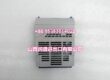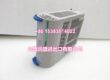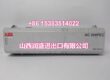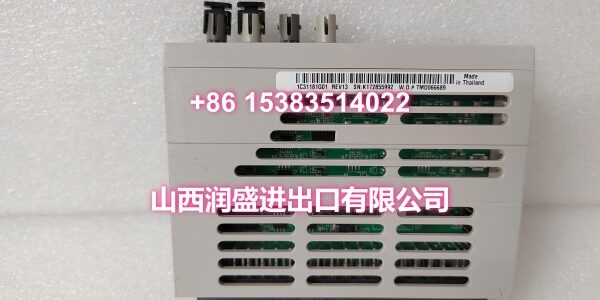
Product Core Brief
- Model: 1C31181G01
- Brand: Emerson (Ovation System)
- Series: Ovation DCS Remote I/O Subsystem
- Core Function: 2-port fiber optic converter module that extends the Ovation I/O bus to remote cabinets over long distances.
- Product Type: Master Attachment Unit PMOD (Fiber Optic Interface)
- Key Specs: 2-Node Support | 2km Fiber Optic Range | RS-485 to Fiber Conversion
- Condition: New Original / New Surplus
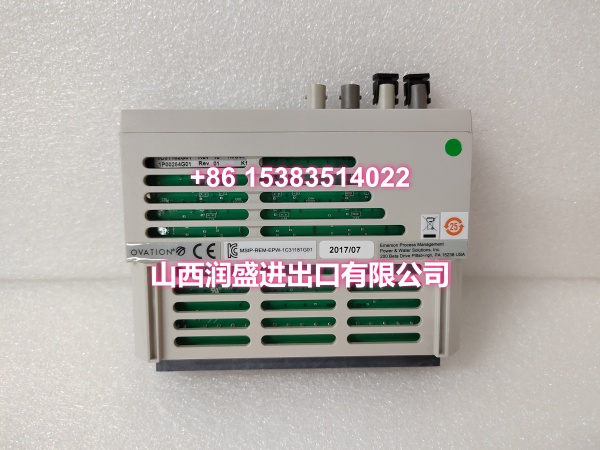
Key Technical Specifications
- Module Type: Master Attachment Unit PMOD – 2 Node (2km)
- Supported Nodes: 2 remote I/O nodes per module
- Fiber Optic Range: Up to 2 kilometers (approx. 1.24 miles)
- Communication Interface: RS-485 serial (local) to Fiber Optic (remote)
- Bus Cycle Time: Less than 100 microseconds
- Communication Rate: 10 MB (controller to node), 2 MB (between remote nodes)
- Operating Voltage: 24V DC (supplied via backplane)
- Operating Temperature: -40℃ to +85℃
- Mounting: DIN-rail base assembly (1C31206G01)
- Redundancy: Supports redundant serial communication between nodes
Product Introduction
This fiber optic converter module is a core component of the Emerson Ovation Remote I/O subsystem. It converts the local RS-485 I/O bus signal into fiber optic transmission, enabling the DCS controller to communicate with remote I/O cabinets up to 2 kilometers away. This is essential for distributed process control applications in power plants, oil and gas facilities, and large-scale manufacturing sites where field instruments are spread across vast areas.
The 2-node architecture allows each module to manage two separate remote I/O drops, cutting hardware costs compared to the 4-node variant (1C31181G02). Fiber optic transmission provides complete electrical isolation between the control room and the field, eliminating ground loop issues and electromagnetic interference (EMI) that plague copper-based communication in high-voltage environments. Bottom line: if your remote cabinet is more than a few hundred meters away, this module is the only reliable way to keep your I/O data intact.
QA & Testing SOP
Fiber optic modules fail in subtle ways — a cracked connector or degraded transceiver won’t show up on a basic power-on test. Here’s our validation protocol:
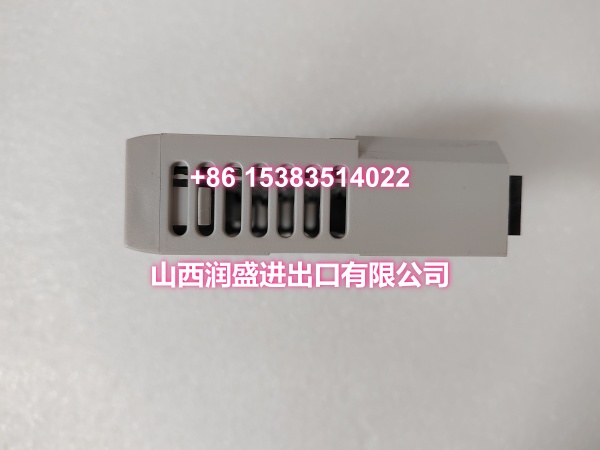
- Physical & Anti-Counterfeit Inspection: We verify the OEM chassis, check for authentic Emerson labeling, and inspect the fiber optic ports for scratches, dust contamination, or physical damage that could cause signal attenuation.
- Power-On & LED Diagnostics: The module is seated on an OEM test rack and powered up. We verify all panel LEDs (P for power, C for communication, E for ground, I for internal error) display correct status per the Ovation diagnostics spec.
- Fiber Optic Link Test: Using a calibrated optical power meter and light source, we verify the transmit (TX) and receive (RX) power levels are within spec for the 2km range. We also test loopback functionality to confirm the transceiver can send and receive data without errors.
- Communication Handshake Test: The module is connected to an Ovation controller on the test rack to validate RS-485 to fiber conversion, ensuring zero packet loss and correct bus cycle timing (<100μs).
- Anti-Static & Dust Protection: After validation, the fiber ports are capped with protective dust plugs, and the module is sealed in industrial-grade ESD shielding bags for transit.
Installation Pitfalls & Guide
Fiber optic I/O extensions are unforgiving. A single dirty connector or exceeded distance spec will drop your entire remote node.
- ❗ Fiber Connector Contamination: Dust or oil on the fiber optic end-face is the #1 cause of link failure. Always use lint-free wipes and isopropyl alcohol to clean connectors before mating. Never touch the fiber end-face with bare fingers.
- ❗ Exceeding the 2km Range: This specific module (1C31181G01) is rated for 2km maximum fiber distance. If your remote cabinet is farther, you need the 3.7km variant (1C31181G03). Exceeding the range causes intermittent communication drops that are extremely difficult to troubleshoot.
- ❗ TX/RX Polarity Reversal: Fiber optic links require cross-connected TX and RX pairs. Reversing the polarity at either end will result in a dead link. Verify the patch cable pinout before powering up.
- ❗ Bend Radius Violation: Fiber optic cable must maintain a minimum bend radius (typically 10x the cable diameter). Sharp bends cause signal attenuation and can permanently damage the fiber core.
Replacement Procedure:
- Pre-Install: Verify the replacement module matches your system configuration (2-node, 2km). Document the existing fiber patch cable connections (TX/RX labeling).
- Removal: Open the blue locking lever on the module, gently disengage it from the base assembly, and pull straight out. Do not yank on the fiber cables.
- Install: Remove the dust caps from the new module’s fiber ports. Align the module with the base assembly guides and seat it firmly. Close the blue locking lever to secure.
- Power-On Test: Reconnect the fiber patch cables (verify TX/RX polarity). Restore power and verify the P (power) and C (communication) LEDs are solid green. Check the Ovation controller for remote node communication status.
Technical FAQ
What’s the difference between 1C31181G01 and 1C31181G02? The G01 supports 2 remote I/O nodes over 2km of fiber. The G02 supports 4 nodes over the same 2km distance. If you only need to connect two remote cabinets, the G01 is the cost-effective choice. Don’t over-spec your hardware.
Can I use copper cable instead of fiber with this module? No. This module is specifically designed for fiber optic transmission. If you need copper-based remote I/O, you’d use a different module variant. Fiber is mandatory for distances beyond a few hundred meters or in high-EMI environments.
What happens if one of the two nodes fails? Each node operates independently on the RS-485 bus. A failure in one node’s I/O subsystem won’t affect the other node’s communication. However, if the fiber link itself is cut, both nodes will lose communication with the controller.
Is this module hot-swappable? The Ovation system supports online module replacement for most I/O components. However, swapping a fiber converter module will temporarily interrupt communication to both connected remote nodes. We strongly recommend scheduling a maintenance window to avoid process disruption.
Do you offer volume pricing for MRO stocking? Yes. We understand that remote I/O modules are critical spares for plant shutdowns. Contact our sales team with your required quantity — we offer flexible pricing tiers for bulk MRO procurement orders.
Need the compatible base assembly (1C31206G01) and fiber patch cable specs for this module? I can pull those up for you.